Sierra Leone
2000
Two journalists killed by gunmen; two others wounded
Click here to read more about press freedom conditions in SIERRA LEONE New York, May 24, 2000 — The Committee to Protect Journalists is outraged by the latest murderous attack on journalists in Sierra Leone, which claimed the lives of two western journalists and left two others injured on Wednesday, according to news agencies and…
Sierra Leone: In climate of increasing press freedom violations, editor detained illegally
Your Excellency: The Committee to Protect Journalists (CPJ) is deeply disturbed by recent serious press freedom violations in Sierra Leone. We are particularly concerned about the continued illegal detention of Abdoul Kouyateh, acting editor of the private Freetown weekly Wisdom Newspaper.
Commonwealth: CPJ protests conditions in Sierra Leone, Malaysia
Dear Mr. McKinnon, On the occasion of World Press Freedom Day, the Committee to Protect Journalists (CPJ) is writing to express its concerns about press freedom violations in Malaysia and Sierra Leone, which have been Commonwealth member states since 1957 and 1961, respectively. We would like to draw your attention to the fact that the leaders of these Commonwealth countries rank among CPJ’s “10 worst enemies of the press” for 2000.
Attacks on the Press 1999: Preface
By Philip GourevitchNearly a hundred years ago, in Boston, the Congo Reform Association published a pamphlet by Mark Twain, titled King Leopold’s Soliloquy, A Defense of His Congo Rule (1905). The text is an imagined monologue by the Belgian monarch, delivered as he reads through stacks of literature protesting the systematic murder and mutilation of…
Attacks on the Press 1999: Introduction
By Ann CooperAs a foreign correspondent covering the Soviet Union a decade ago, I was an eyewitness to a dramatic example of the press’ critical role in building democracy. Granted a bit of freedom by Mikhail Gorbachev’s mid-1980s glasnost policy, long-suppressed Soviet journalists set their own daring agenda: they probed forbidden history, investigated contemporary corruption,…
Attacks on the Press 1999: Africa Analysis
By Claudia McElroyAll over Africa, conflict continued to be the single biggest threat to journalists and to press freedom itself. Both civil and cross-border wars were effectively used as an excuse by governments (and rebel forces) to harass, intimidate, and censor the press–often in the name of “national security”–and in some cases to kill journalists…
Attacks on the Press 1999: 1999 Death Toll: Listed by Country
[Click here for full list of documented cases] At its most fundamental level, the job of a journalist is to bear witness. In 1999, journalists in Sierra Leone witnessed rebels’ atrocities against civilians in the streets of Freetown. In the Balkans, journalists watched ethnic Albanians fleeing the deadly menace of Serbian police and paramilitaries. In…
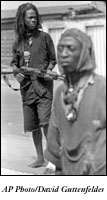
Attacks on the Press 1999: The Trauma of Sierra Leone
Introduction On January 6, 1999, rebel forces entered Freetown and launched a campaign of terror. Revolutionary United Front (RUF) fighters systematically murdered, mutilated, and raped thousands of civilians. During the three weeks that it took for Nigerian-led West African peacekeeping troops to expel the rebels from Freetown, Sierra Leone officially became the most dangerous country…