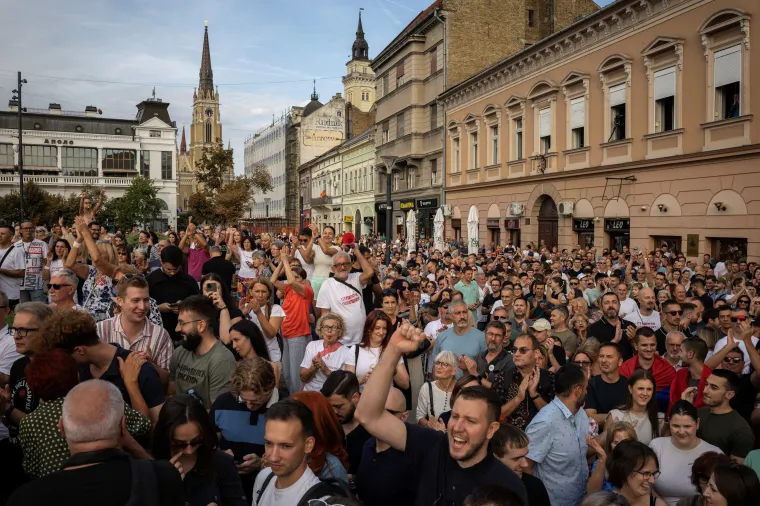
Berlin, September 22, 2026—As Serbians prepare to vote in October parliamentary elections, journalists covering the polls are at serious risk of threats, violence and hostility of the sort that has become increasingly common during President Aleksandar Vučić’s time in office.
Recent attacks on reporters covering political rallies ahead of the vote on October 25 provide an ominous early warning of the dangers that could lie ahead unless Serbia’s authorities act now to ensure journalists can do their work safely and without fear.
With press freedom facing challenges across the continent, CPJ calls on Serbia’s European partners to monitor the situation closely, encourage Belgrade to guarantee the rule of law is respected and speak out to challenge violations of press freedom.
CPJ and partner organizations visited the capital Belgrade in March this year and a report on that trip, published in July by partners of the Council of Europe’s Safety of Journalists Platform and the Media Freedom Rapid Response, documented escalating police violence, smear campaigns fueled by public officials, persistent impunity, legal and digital threats and the ruling party’s efforts to tighten its grip over the media.
Since that visit, reports of journalists being physically attacked while reporting on local elections and political gatherings have underscored these findings and raised fresh concerns about a rising climate of hostility ahead of the October vote.
“Our mission to Serbia exposed an alarming reality: journalists face violence in the streets, threats against their families, and relentless efforts to discredit their work, often led by senior government officials, while the institutions responsible for protecting them too often fail to act or hold perpetrators accountable,” said Attila Mong, CPJ’s Europe representative.
“Ahead of the October elections, conditions for journalists are getting worse. We have multiple reports of journalists being assaulted while out doing their jobs at rallies and other political gatherings, and online the atmosphere is increasingly febrile. Serbian authorities must act now to stem this hostility and Europe must insist on concrete actions to tackle this surge in violence,” he said.
Intense pressure and impunity
Since Vučić’s Serbian Progressive Party came to power in 2012, journalists have faced more and more physical attacks, police violence, threats and smear campaigns. After serving as deputy prime minister, prime minister or president since 2012, Vučić is now running for prime minister again.
During Vučić’s tenure, pressure on independent media has intensified. Vučić is often accused by critics of following in the footsteps of neighboring Hungary’s former prime minister Viktor Orbán in attempting to build an authoritarian state with total control of the media, where critical news outlets are marginalized, discredited, and attacked with smear campaigns by pro-government tabloids or anonymous online trolls.
CPJ’s reporting has highlighted how what one journalist described as a “witch-hunt” against critical journalists escalated into a surge in assaults, threats, and spyware attacks, rising to a new peak during the anti-corruption protests triggered by the collapse of a railway station awning in Novi Sad in November 2024 that killed 16 people.
By September 2025, journalists were reporting that police deliberately beat, detained, and obstructed them, especially when they documented alleged police violence against protesters. This alarming trend of violence, threats and intimidation continued into this year.
The unresolved murder of journalist Slavko Ćuruvija in 1999 is emblematic of the impunity surrounding crimes against the press. Four former state security officers were acquitted in 2024, and the verdict remains binding despite the Supreme Court finding in January this year that the acquittal violated the criminal code.
In May, Slavko’s daughter, Jelena Ćuruvija, told CPJ that the fact that no one had been held accountable for her father’s murder sent a clear message to independent journalists in Serbia that reporting could be dangerous.
“The risks for independent media are real and they are getting worse,” said CPJ’s Mong. “Serbian authorities must act now to ensure that anyone who uses any kind of violence or threat against the press is held fully accountable for their actions. This is the only way reporters will be able to work safely at this critical time when voters need independent scrutiny of those seeking power.”
During the election campaign, Serbian authorities must:
- publicly instruct police to protect journalists covering election-related events and not to arbitrarily detain or obstruct them.
- ensure rapid responses to threats, and investigate attacks impartially, ensuring that those responsible are held accountable.
- condemn violence unequivocally while government officials and politicians must refrain from making statements that stigmatize journalists or encourage hostility toward them.
- protect journalists by safeguarding their access to public events, their confidential communications, and their ability to reach audiences.
- ensure that journalists are able to question candidates, document demonstrations, investigate allegations of wrongdoing, and report results without fear of violence or retaliation.
Serbia’s European partners also have a role to play at this critical time. They should raise attacks on journalists directly with the authorities, press for effective investigations and accountability, and publicly condemn official rhetoric that puts journalists at risk. They should make journalists’ safety and their ability to report freely a priority in their engagement with Serbia throughout the election period.
Recent developments
Since May, there have been more attacks and threats against independent media, including intimidation of journalists’ families. Some reporters have been forced to leave Serbia because of security threats.
In August, press freedom advocate Veran Matić told independent channel N1 TV that he helped six Serbian journalists relocate outside Serbia because of security concerns. Matić, who is board chair of the Association of Independent Electronic Media (ANEM) and a CPJ International Press Freedom Award laureate, has himself faced death threats in the past and new harassment this year.
He said most of the six journalists who were now living in exile had endured years of death threats and organized intimidation while the perpetrators remained unpunished.
Here are some examples of attacks and threats against independent journalists verified by CPJ since May:
Physical attacks, police violence, obstruction
- On June 17, an unidentified man forcibly took Matić’s phone while he filmed a gathering outside parliament in Belgrade. For months before this, Matić was publicly targeted by senior officials and pro-government media and social media; he was portrayed as a traitor and foreign agent and accused of embezzlement.
- On June 27, police detained freelance photojournalists Gavrilo Andrić, Nađa Gavrilović, and Marija Stojnić while they covered a Serbian Progressive Party gathering in Belgrade. Officers took them to a station without clearly communicating a legal basis for their detention and released them several hours later.
- On August 24, unidentified men wearing black T-shirts pushed Jovana Ristić, a journalist with the Glas Šumadije news portal, and Nenad Simović, a journalist with the LiKVidno portal, out of a public gathering in Kraljevo, in central Serbia, during a visit by Vučić. Despite the journalists’ visible press credentials and event accreditation, the men grabbed Simović’s camera lens and demanded that they stop filming.
- On August 29, a police officer attacked Marko Miletić, a journalist with the online news outlet Mašina, while he covered a Serbian Progressive Party gathering in Užice, in western Serbia. Despite Miletić’s visible press identification, the officer squeezed his hand, seized the phone he was using to livestream, and pushed him away. During the same event, a man allegedly struck a TV Pink camera crane operator with a hammer, causing minor injuries, while an unidentified person threw a stone that hit a cameraman with the public broadcaster RTS in the chest and injured him.
Threats against journalists and their families
- Overnight on June 20, unidentified individuals vandalized the car of David Gruhonjić, the son of journalist, press freedom advocate, and university professor Dinko Gruhonjić, in a parking lot in Novi Sad, northern Serbia. Local and regional media freedom groups described the attack as an example of how intimidation now extends to journalists’ families and noted that this attack followed renewed smear campaigns against Dinko Gruhonjić.
- In July, N1 TV’s news director Branislav Šovljanski and his family received threats in comments on news items, including calls for him to be impaled and roasted alive. Podcast host and daily newspaper Danas columnist Marko Vidojković, who lives abroad after leaving Serbia because of threats, received threatening emails saying he would be burned if he returned. He and co-host Nenad Kulačin received further death threats after news outlets reported an earlier complaint to prosecutors.
- In August, comments on social media called for Matić to be hanged and his corpse left for animals, while other comments demanded that Vidojković and Kulačin be killed. Aleksandar Blanuša, the editor of online news outlet Volim Zrenjanin, based in Zrenjanin in northern Serbia, was threatened during a phone call and told his head would be smashed; police arrested a suspect in this case. On August 29, another Instagram message called for everyone at the outlet to be killed.
- In September, journalists faced a wave of threats after they covered or commented on the funeral of convicted war criminal Ratko Mladić. N1 TV journalist Predrag Popović was warned on X that attackers knew where he lived and that he should watch his back, while a comment under a news piece about the glorification of war criminals and genocide denial called for N1 TV’s newsroom to be burned down. Danas newspaper journalist Safeta Biševac was threatened in a comment under a news piece with being sexually assaulted at her home and TV Nova presenter and editor Marko Novičić received a message on Instagram threatening to tear him to pieces.
CPJ will closely monitor the campaign, election day, and its aftermath, including attacks on reporters covering rallies, protests, and other election-related events.
This election could prove a watershed for press freedom in Serbia by either consolidating the abuses and impunity of recent years or marking a step change to a more accountable and secure environment for the press. Whoever wins the vote must ensure that journalists in Serbia are free to scrutinize those in power without fear of violence or retaliation.