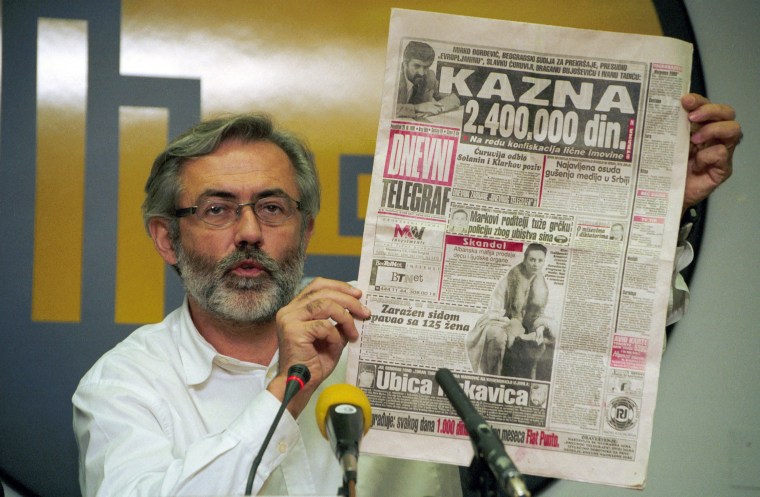
On April 11, 1999, Slavko Ćuruvija, the owner of Serbia’s first private daily newspaper, Dnevni Telegraf, was assassinated outside his home in the capital, Belgrade. After a decades-long pursuit of accountability, the case reached a turning point in February 2024 when the Belgrade Court of Appeal issued a final, non-appealable acquittal for four former Slobodan Milošević-era state security officers who were previously found guilty of the murder. Although the Serbian Supreme Court ruled in January 2026 that this acquittal was based on “serious legal violations” and misrepresented evidence, the verdict remains legally binding due to procedural protections. Today, the case is stalled in a state of complete impunity.
In this interview with CPJ, Ćuruvija’s daughter, Jelena Ćuruvija, discusses the current state of her fight for justice, what message her father’s murder sends to Serbian journalists today, and her ongoing “legal acrobatics” to find justice in Serbia and on the European level.
The interview has been edited for length and clarity.
If you were to tell a young person about your father today, what would you want them to know about him as a journalist?
Jelena Ćuruvija: My daughter is now 11 years old, and I want to introduce her to her grandfather somehow. When I talk to her, I say that her grandfather was a very brave man who did his job with such passion, honesty, and dedication that he did not want to make any compromises. I think he was a rare person — there weren’t many of them even then, and now there are fewer. He was passionate about insisting on justice.
How much do you think his murder case changed Serbia?
He was the last beacon of free journalism in Serbia, or even a pioneer, because his newspapers were the first private newspapers in the country and, within a very short time, they had the largest circulation at that time in Serbia. His murder sent a message that there cannot be free journalism in Serbia, that there cannot be free opinion and free speech, and that people who insist on this will be punished, It was the beginning of the destruction of free journalism, and I can say that what is happening in Serbia now is actually the result of my father’s murder.
Does this mean that if your father were an editor-in-chief now, it would be a very different country?
If my father were alive, Serbia’s landscape would be really different. He would be as loud as he was back then, and I’m sure the situation in the media wouldn’t be this catastrophic. If he hadn’t been killed, I don’t think Zoran Đinđić (pro-European prime minister of Serbia from 2001 until his assassination in 2003) would have been killed, and other important political murders might not have happened. Serbia would look completely different than it does now.
Looking back over these 27 years, did you have hope that the case would be solved? Did you believe Serbia would reach a verdict?
In the beginning I didn’t, I have to admit. For the first 13 years, absolutely nothing happened with solving my dad’s murder. Then, surprisingly, at the beginning of President Aleksandar Vučić’s rule, the government established a special commission, and people who were later suspected of my dad’s murder were arrested. It indicated that there was a political decision that the murder would be solved, so I had faith. The first verdict was a guilty verdict, and I thought that the matter would end properly.
How did you feel when the final acquittal happened? Did you expect it?
We were receiving information about six months before we officially got the verdict that the decision would be an acquittal, so I had time to emotionally prepare. But it was certainly a shock.
In an earlier interview, you referred to your current efforts as a “marathon.” What can you do now to keep his memory alive?
I have a foundation dedicated to his memory and we try to ensure all young people in Serbia can learn about who my father was. We make further efforts with the international press freedom community, too. And with some legal acrobatics, we are in the phase of exhausting all legal possibilities to reach justice here in Serbia before we bring the case to the European Court of Human Rights.
What do you think of the current threats Serbian journalists are facing today?
The impunity in my father’s case sent a clear message to journalists and citizens in Serbia that they could face serious consequences if they insist on expressing their views, and to journalists if they insist on objective reporting. This kind of targeting is more or less a reality for all journalists today who try to do their job properly. However, I believe there is now greater visibility, as well as more unity and solidarity among journalists than there was in the 1990s.
On a personal level, how have you managed this 27-year journey?
That path has been very emotionally intensive for me. But the good thing that happened, if there is anything good in this case, is that I have built a whole community of people to whom this case is important for the same reasons it is important to me. Today I am the same age as my father was when he was killed, and I say what he used to say: “We will win because we are beautiful and smart.”