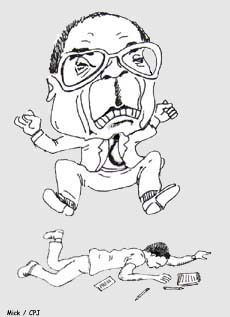
Zimbabwe Special Report: On a Rampage
New York, July 11, 2002–Tomorrow, Andrew Meldrum, a U.S. citizen and the Zimbabwe correspondent for the London-based Guardian newspaper, will go to trial on charges of “abusing journalistic privileges” and “publishing false information.” On July 22, his colleagues at Zimbabwe’s independent Daily News, reporter Lloyd Mudiwa, editor-in-chief Geoff Nyarota, and staff writer Collin Chiwanza, will…
LIBERIA: CPJ asks government to respond to reports of custodial death
July 3, 2002 President Charles G. Taylor President of the Republic of Liberia Monrovia, Liberia Via facsimile: 231-225-217 Your Excellency: The Committee to Protect Journalists is writing to request urgent information about the status of Hassan Bility, editor-in-chief of The Analyst newspaper based in Monrovia, who is missing and is feared dead. Bility, together with…
Two journalists arrested
New York, June 27, 2002—The Committee to Protect Journalists (CPJ) is disturbed by the recent arrests of João de Barros, publisher and editor of the independent daily Correio de Bissau, and Nilson Mendonca, editor at the state-run Rádio Difusão Nacional (RDN). Both journalists have been released. De Barros was arrested in Bissau, the capital of…
Prominent editor arrested again
New York, June 20, 2002—Police in Niger have again arrested Abdoulaye Tiemogo, publisher and editor-in-chief of the satirical weekly Canard Dechaine, on charges of defaming Niger Prime Minister Hama Amadou. This is the third time in eight months that Tiemogo has been arrested for his work. According to local journalists contacted by the Committee to…
Government imposes harsh licensing fees on journalists
New York, June 19, 2002—The Zimbabwean government has announced restrictive new licensing fees for journalists and media organizations. The announcement comes after the March passage of the contentious Access to Information and Protection of Privacy Act, under which Andrew Meldrum, a U.S. citizen and the Zimbabwe correspondent for the London-based Guardian, is currently being tried…
Journalist detained for two weeks
New York, June 18, 2002—The Committee to Protect Journalists condemns the continued imprisonment of Basile Agboh, publication director of the independent Lomébased weekly Le Scorpion. Agboh has been in prison for two weeks. Agboh was arrested on June 5 along with Maurice Atchinou, editor-in-chief of Le Scorpion, who was released the following day. Their arrests…
Foreign correspondent on trial, risks two years in jail
New York, June 11, 2002—The Committee to Protect Journalists (CPJ) condemns the upcoming trial of Andrew Meldrum, a U.S. journalist based in the Zimbabwean capital, Harare, on charges of “abusing journalistic privilege” and publishing “false information.” Meldrum, who writes for the London Guardian, The Economist, and contributes to Radio France Internationale, is due to appear…
Court bans newspaper from writing about businessman
New York, June 7, 2002—The Kenyan High Court has ordered copies of the Weekly Citizen off the streets following a complaint from a businessman. High Court judge Andrew Hayanga issued a temporary injunction forbidding the managing editor of Weekly Citizen, a tabloid known for salacious reporting, and its vendors from continuing to distribute the June…