
PRESS STATEMENT
string of unsolved arson attacks, a series of unchecked threats, and the passage of restrictive new laws have created deep mistrust between the Gambia’s government and its small independent press. Suspicions have been compounded by the December 2004 murder of veteran journalist Deyda Hydara and the government’s failure to bring the perpetrators to justice. Over…
Murder, arson, repression thwart Gambian press
Banjul, Gambia, April 12, 2005—A string of unsolved arson attacks, a series of unchecked threats, and the passage of restrictive new laws have created deep mistrust between the Gambia’s government and its small independent press. Suspicions have been compounded by the December 2004 murder of veteran journalist Deyda Hydara and the government’s failure to bring…
GHANA
JULY 4, 2005 Posted: July 22, 2005 Frank Boahene, Free Press IMPRISONED, LEGAL ACTION Claude Decker, Free Press Thomas Kpakpo Thompson, Free Press LEGAL ACTION An Accra high court sentenced Boahene, editor of the private weekly, and directors Decker and Thompson to 15 days in prison for contempt of court, according to local sources. Boahene…
Press freedom group threatened
New York, April 11, 2005—The Committee to Protect Journalists is concerned for the safety of members of Journaliste en Danger (JED), a press freedom organization based in Kinshasa, the capital of the Democratic Republic of Congo (DRC). On April 4, JED Secretary-General Tshivis Tshivuadi received an email containing death threats against him and Donat M’baya…
Judge acquits editor of criminal charges and creates new interpretation for media law
New York, April 5, 2005—The managing editor of the Nairobi-based East African Standard’s Sunday edition was acquitted of criminal charges yesterday. The charges against David Makali, pending since 2003, stemmed from an investigative article about the alleged murder of Dr. Crispin Odhiambo Mbai, a key player in Kenya’s constitutional reform process. Nairobi Chief Magistrate Aggrey…
DEMOCRATIC REPUBLIC OF THE CONGO
APRIL 4, 2005 Posted: April 13, 2005 Journaliste en Danger (JED) THREATENED Tshivis Tshivuadi, secretary-general of the Kinshasa-based press freedom organization Journaliste en Danger, received an email containing death threats against him and Donat M’baya Tshimanga, JED’s president, and their families. The threats sparked concern amongst JED staff as well as local media organizations.
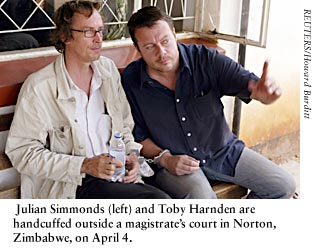
British journalists face trial on accreditation charges
New York, April 4, 2005—Zimbabwean government prosecutors are pushing ahead with a criminal trial of two journalists from the London-based Sunday Telegraph on accreditation charges that could bring two years in prison, the journalists’ lawyer, Beatrice Mtetwa, said today. Toby Harnden, the newspaper’s chief foreign correspondent, and photographer Julian Simmonds have been jailed since their…
ZIMBABWE
APRIL 1, 2005 April 7, 2005 Fredrik Sperling, Sveriges Television (STV) HARASSED, EXPELLED Sperling, a reporter for Sweden’s public broadcaster, Sveriges Television (SVT), was arrested in central Harare and deported to South Africa, despite having been accredited to cover Zimbabwe’s March 31 parliamentary elections.
ZIMBABWE
MARCH 31, 2005 Posted: May 10, 2005 Toby Harnden, The Sunday TelegraphJulian Simmonds, The Sunday Telegraph IMPRISONED, LEGAL ACTION Harnden, chief foreign correspondent for the London-based Sunday Telegraph, and photographer Simmonds were arrested at a polling station in Norton, a town near the capital, Harare, according to a statement from the newspaper. The journalists were…
NIGER
MARCH 30, 2005 Updated: April 15, 2005 Radio Alternative CENSORED Police in the capital, Niamey, shuttered the offices of the privately run Radio Alternative. No reason was given for the closure, according to a source at the station reached by CPJ, but employees believed it was linked to the March 26 arrest of Moussa Tchangari,…