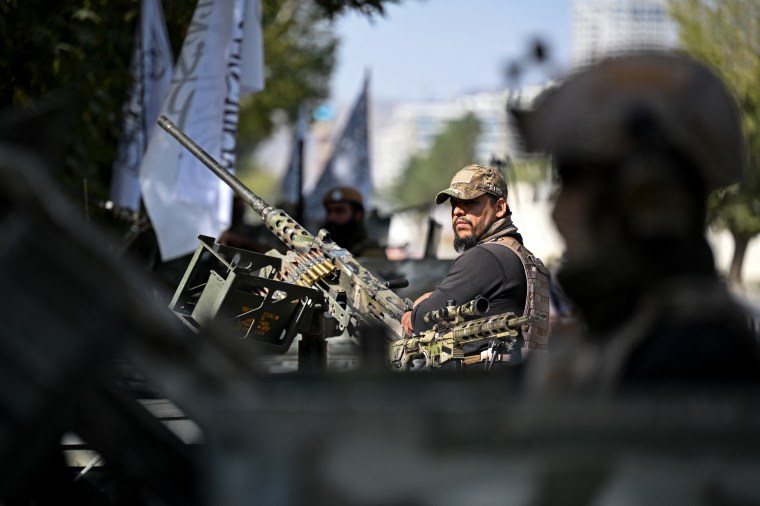
New York, August 14, 2026—Five years on from the Taliban’s seizure of Afghanistan, the Committee to Protect Journalists calls on the group to halt its brutal repression of the press — particularly women journalists — and lift sweeping restrictions that have cut access to independent information and allowed a propaganda ecosystem to flourish.
After capturing Kabul on August 15, 2021, Taliban authorities immediately began their attack on the media, barring female journalists from working at the public broadcaster, beating reporters while they covered protests, and, by 2022, using arbitrary detention and imprisonment as a tool to censor news outlets. Khalid Qaderi, a Radio Nawruz reporter and producer in Herat, was the first case CPJ documented of a journalist convicted and sentenced for his work after the Taliban takeover.
“Since taking over Afghanistan five years ago, the Taliban have made Afghanistan one of the world’s hardest places for journalists to report,” said Waliullah Rahmani, CPJ’s Afghanistan-Pakistan Representative. “Journalists are surveilled, detained, beaten, censored, or driven into exile. Women journalists face additional discrimination, and people are increasingly terrified to speak. Internet and mobile restrictions have deepened the press freedom crisis and cemented the Taliban’s control over Afghanistan’s information space.”
Women in the media face particularly severe and escalating discrimination. Taliban authorities have banned women’s voices from radio and TV in Helmand, prevented them from attending press conferences, and mandated that they cover their faces when appearing on TV. In February 2025, Taliban intelligence agents raided and suspended the women-led Radio Begum.
Censorship has expanded from pressure on individual journalists to systematic control over what reporters can cover. In 2024, Taliban authorities banned live political broadcasts, prohibited criticism of the group, and restricted interviews to a list of 68 approved analysts. They jammed the broadcasts of London-based Afghanistan International, banned television operations and public filming in Takhar province, and suspended broadcast licenses belonging to 14 media outlets in Nangarhar. In February 2025, authorities also prohibited domestic outlets from broadcasting political and economic programs.
The suppression of independent journalism has been accompanied by the construction of a sprawling Taliban-controlled information system. By 2025, the Taliban operated about 15 major television and radio stations, newspapers, and digital platforms. Journalists in several provinces told CPJ that meaningful reporting had become so restricted that, outside subjects such as health and education, traffic accidents were among the few stories they were permitted to cover.
Internet and mobile network blackouts have further disrupted access to information, hindering the ability of Afghan journalists to report and communicate safely. In September 2025, the Taliban blocked fiber-optic internet in multiple provinces, and later that month imposed a nationwide internet blackout lasting about 48 hours.
The crackdown has continued this year. In May, Taliban intelligence agents detained two TOLOnews reporters, then raided the TV station’s offices, confiscating employees’ phones, interrogating staff, and placing workers under surveillance. Many other cases remain undocumented due to access.
In June, armed members of the Taliban’s Ministry of Justice forced independent broadcaster Tamadon TV off the air and sealed its Kabul offices. It was one of the last remaining TV stations with Shia programming. Managing Editor Mohammad Rahmati and media worker Mohammad Reza Ehsani were subsequently detained after being summoned to the justice ministry. Several months earlier, Taliban intelligence agents took control of Rah-e-Farda TV, which later resumed broadcasting under a new owner licensed by the Taliban.
The destruction of Afghanistan’s independent media has also pushed hundreds of journalists into exile, particularly in neighboring countries, where many remain vulnerable to detention, deportation, and forced return to Afghanistan. Returning these journalists who fled Taliban persecution exposes them to foreseeable risks, including retaliation and arbitrary detention.