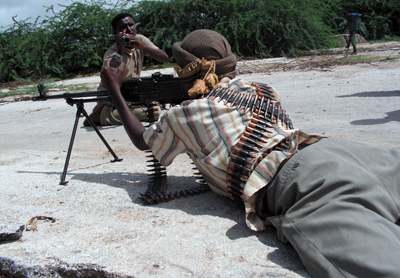
In August, Shabelle Media Network, one of Somalia’s leading independent broadcasters, did something incredibly brave–they rebroadcast news and music that the BBC’s Somali-language service beams to the war-torn Horn of African nation in defiance of a ban imposed by hard-line militant Islamist rebel groups Al-Shabaab and Hizbul Islam. For Somali journalists, who risk death by crossfire and assassination, and censorship from both insurgents and the weak U.S.-backed transitional government, it was a courageous pushback against forces hostile to independent media.
“We just made the decision not to be intimidated by these groups,” explained Nairobi-based Shabelle correspondent Abdulkarim Jimale. “I’m sure they will kill us eventually, but then a Somali journalist’s life is short anyways.” Jimale was speaking from experience–since the conflict between Islamist insurgents and the Transitional Federal Government of Somalia began in late 2006, five Shabelle journalists have been murdered in the line of duty.
More than four months ago, Al-Shabaab insurgents closed down the BBC’s facilities in its strongholds in southern Somalia, confiscating its properties and forcing local media to cancel contracts with the outlet. Around the same time, Al-Shabaab’s rival Islamist faction, Hizbul Islam, told radio stations that they had 10 days to ban music. “It is against Islam to play music and other lyrics,” Hizbul Islam leader Sheikh Ma’alin Hashi told reporters at a press conference in Mogadishu,” Kenya’s Nation reported. All broadcasters in Mogadishu complied, fearing the dire consequences if they did not. Then Hizbul Islam told the stations that jingles during advertisements and programs should also be cut.
“I decided to record gunshot sounds for our news bulletins,” one journalist who requested anonymity told CPJ. “There’s plenty of them to record around here and that’s usually what is covered in the news anyways.”
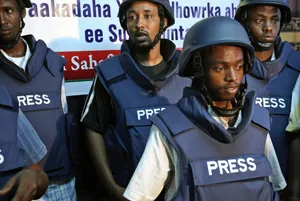
As if the insurgents’ censorship wasn’t enough, the government threatened to suspend stations in their strongholds that complied with the music ban. “We will not tolerate the four radio stations that halted airing music and songs in the government-controlled area,” Abdikafi Hilowle, the general-secretary of Banadir Regional Administration, which includes the capital, told reporters at an April press conference. On one hand, former Somali Information Minister Dahir Gelle signed a contract to air BBC and Voice of America programs on the state-run Radio Mogadishu, but, on the other, security agents shut down two stations that complied with the music ban for six hours the minister reversed the order, local journalists told CPJ. One of the stations affected, Tusmo Radio, said the conflicting directives of the militia and the government confused them, Shabelle reported.
Notwithstanding, the tiny enclave controlled by the government in Mogadishu and protected by African Union peacekeepers has become a relative haven for Somalia’s independent press. In June, for instance, increasingly draconian Al-Shabaab restrictions forced Shabelle to stealthily transfer its equipment, bit-by-bit, from the insurgent-controlled Bakara Market area to the besieged government zone. The station then resisted the insurgents’ order to ban coverage of Somalia’s July 1 Independence Day celebrations. Before the move, Al-Shabaab commanders had delivered new directives to Shabelle that included orders to never mention shells fired by Al-Shabaab “because our shells are religious” and to refer to civilians killed by them as “martyrs,” Shabelle Chairman Abdimaalik Yusuf told CPJ in an e-mail.
The move may have been timely: Al-Shabaab seized control of Radio IQK, another Mogadishu broadcaster which focused on Islamic issues, during the holy month of Ramadan. Radio IQK director Muhammad Adbiwahab read a notice sent by Al-Shabaab to local reporters declaring that all the radio staff were allowed to continue working under Al Shabaab “or they can leave.”
For the media outlets working inside the safer, government zone–the state-run Radio Mogadishu, Shabelle, Tusmo, Voice of Democracy, Codka Nabadda, the U.N.-backed Bar-Kulan, HCTV and Universal TV–fear of the insurgents induces self-censorship, Information Minister Abdirahman Osman told CPJ. “Tusmo and Codka Nabadda, even though they are based in our controlled area, they do not air music due to fear of Al-Shabaab,” Minister Osman said, “HCTV also received threats from Al-Shabaab and they take the easy option of not showing criticism of Al-Shabaab.”
Osman claimed that the media works without restrictions in the government-controlled areas, but journalists tell me that they all practice self-censorship, wherever their station is located. “You are not allowed to take pictures. If government soldiers are defeated in battle, they complain–whether it is fact or not,” said CPJ award-winner Mustafa Haji Abdinur. Police detained Abdinur and freelance cameraman Yusuf Jama in July for taking pictures of a colleague who was hit in crossfire. The journalists were interrogated for several hours and forced to delete their photographs, Abdinur told CPJ.
“Journalists feel more freedom in reporting in the government-controlled area since they are unlikely to be killed by government soldiers–but in the rebel-controlled area, that is a different story,” said another award-winning journalist and BBC correspondent, Mohamed Olad. Recipient of this year’s Speaker Abbot Award for bravery by the British Parliamentary Press Gallery at Westminster, Olad has experience reporting and residing on both sides of the conflict. “When it comes to sensitive topics, journalists always have to practice self-censorship regardless of which part of the capital they reside in.”
The challenges to report freely with such constant violence are immense. When gunmen killed Radio Mogadishu journalist Sheikh Nur Mohamed Abkey near his home in southern Mogadishu in May, none of the local media covered the tragic news, local journalists told me. It was simply too dangerous to cover such a topic—despite the fact the 60-year-old journalist was a friend to many in the media profession. Al-Shabaab took responsibility for the murder and local journalists said they suspect Abkey was targeted for his affiliation to the government-run Radio Mogadishu.
Nonetheless, Somali journalists are still venturing into the field and reporting one of the world’s worst humanitarian disasters on a daily basis. And some of those who were forced to flee the capital to survive continue to report from outside Somalia’s borders. Since August, the Nairobi-based Star FM, a Kenyan Somali-language station, can be heard in Mogadishu and soon in neighboring Puntland and Somaliland, Star reporter Kassim Mohamed told me. While some Kenyan radio stations can be heard along the border, the BBC reports, this is the first time one can be heard in the capital.