Shadows of emerging skyscrapers in a neighborhood in Nairobi come alive as the sun glides down the western horizon. I am walking down one of the deserted streets in the city’s Eastleigh shantytown. Lately, Eastleigh has become a contradiction of sorts. While the roads remain as torn as ever and clean drinking water and other social amenities remain out of reach, there is a new aura of affluence among the numerous huge buildings that seem to be coming up overnight.
Under one of the complexes with nine floors or more, I pause to wonder at the developments in this neighborhood, which just a few months ago seemed too familiar to me. Now I can only just recognize the place I call home. As I consider these changes, a loose piece of timber bolts from somewhere atop the building and, with a thud, lands a few meters away from me, barely missing a young man walking under the building.
At first the man stands tongue-tied—then he launches into a profuse diatribe about Somali pirates and the hasty and reckless structures they are putting up. This building, he says aloud, has been made possible by piracy money. As I watch him turn a corner and disappear behind another high-rise building, my curiosity about this small and fast-changing Somali neighborhood in Kenya and its possible connection to piracy money from the coast of Somalia jolts my nose for news into action. I know I have to do something to investigate—so begins my long trip to war-torn Somalia.
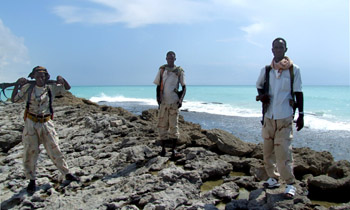
I travel to Eyl, a small village in the semi-autonomous region of Puntland that is the epicenter of the now infamous ship-hijacking trade. This small town used to be a fishing resort for the locals but all that has changed: abandoned wooden boats, and dirty, sandy beaches are everywhere. A woman helpfully directs me to a big house unlike the surrounding ramshackle structures. She says it is a meeting point for pirates. As the watchman opens the main gate, I feel like I am in a big capital city with cars parked inside the compound and comfy sofa sets all over the place. The house is incredibly beautiful.
“Hello. Welcome. You seem new here, what can we do for you?” says one of the more than 10 men chewing khat. I introduce myself and as seconds turned to minutes, the men become comfortable with me. These men, it turns out, are pirates. And they begin to tell me their side of the story.
“We started this trade because some countries are destroying our livelihood by dumping toxic materials into our sea,” says a man named Mohamed who is sipping coffee. “We are also up against the illegal fishing that takes place here.”
To the far right is a man about 70 years old with a bushy beard that is slowly taking over his round face. I am told he is the ringleader. “We are only waiting for the monsoon period to end and this time we will strike hard,” says Guled Mohamed.
On this Friday, the team is busy organizing the food to take to hostages held in different locations. Men clad in local Somali regalia crisscross the verandah. The team offers to take me to a group of Asian hostages secured at an island miles away. I agree to go.
Along the route, a confrontation ensues between the pirates onboard while deep in the Gulf of Aden. A section is opposed to the idea of a journalist recording and visiting the highly guarded territory. Two of them turn, pointing their AK-47 rifles at me. At this point I am speechless that the men who only a few minutes ago were friends are baying for my blood.
After more than four hours roaming the Gulf of Aden, we finally come ashore. They lead me to a dark room and hold me hostage for eight hours, often threatening me: “You’re going to die in the next four hours if we don’t get a kill today,” one of them says.
My Sony H4 Zoom recorder is my only companion as I keep the record button on, making sure that I leave evidence even if they end my life. At this point, I reflect on my initial questions that led me to this mission: Who is behind this trade and does it have links to the development that is on going back in Eastleigh? My nose for news is slowly being replaced by a desire to survive the ordeal. I keep praying for a quick intervention. I see July 31 as my last day on Earth.
Eventually, they release me, but not before a parting shot: Western forces must respect Somalia. “You must tell the international community that we are here to stay despite what the U.S., Russia, and France do,” the ringleader, Guled, said. “They should respect our waters and avoid dumping waste here.”
But I was adamant and wanted to get a story. Pausing and gauging my tone, I slowly whispered, “Do you have cohorts in Kenya?”
In a deep, husky voice, Guled answered, “Yes we do. Not just in Kenya but also Dubai, Germany, and even Canada. I will be honest: This business is bigger than you think. Though we carry out the operations, half the money goes to businessmen abroad who finance us and provide us with equipment.”
The International Maritime Bureau lists the Somali coast as one of the most dangerous waterways. For those who perceive the current calm in piracy off the Gulf of Aden as an end of sea piracy, Somali pirates are asking you to think again. The men, who earned themselves the nickname “The Robin Hoods of the Sea,” say they are still in action and are strategizing.
Kassim Mohamed is a freelance journalist based in East Africa who has contributed stories from Kenya, Somalia, Ethiopia, and Uganda to Current TV.