1839 results
Last week’s release of CPJ’s report on Turkey’s press freedom crisis generated widespread domestic media coverage and sparked a robust public debate. The response from Turkish journalists and commentators was largely positive, but there were some negative reactions as well. Turkey’s Justice Ministry has promised a detailed response this week. Here is a summary of…
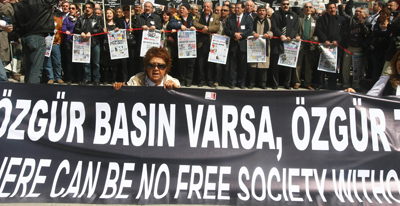
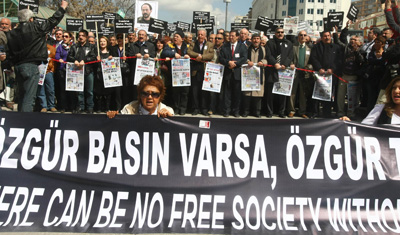
This week I joined CPJ board Chairman Sandra Mims Rowe, Executive Director Joel Simon, and Turkish researcher Özgür Ögret in Istanbul to present CPJ’s latest report, “Turkey’s Press Freedom Crisis,” and convey our main press freedom concerns, including the mass imprisonment of journalists.
1. Summary The Committee to Protect Journalists prepared this report to highlight the widespread criminal prosecution and jailing of journalists in Turkey, along with the government’s use of various forms of pressure to engender self-censorship in the press. CPJ’s analysis found highly repressive laws, particularly in the penal code and anti-terror law; a criminal procedure…
2. Assault on the Press Nuray Mert, one of Turkey’s most prominent political columnists and commentators, had a long history as a government critic, but in the view of Prime Minister Recep Tayyip Erdoğan, her comments last year opposing administration policies toward ethnic Kurds went too far. Erdoğan lashed out with a personal attack that…
5. Test of Political Will On March 25, 2012, the day before the Nuclear Security Summit got under way in Seoul, South Korea, U.S. President Barack Obama met with Turkish Prime Minister Recep Tayyip Erdoğan to discuss a world of troubles. On the agenda were efforts to compel Syrian President Bashar al-Assad to step aside,…
Appendix I: Journalists in Prison CPJ research identified 76 journalists imprisoned in Turkey as of August 1, 2012. After examining the government’s evidence, reviewing other public records, and speaking with defense lawyers involved in the cases, CPJ concluded that at least 61 detainees were being held in direct relation to their journalism.
Journalists, like many others in Pakistan, have spoken out strongly since the Taliban attempted to kill the teenage Malala Yousafzai on October 9. The Taliban, in return, are threatening the media over their coverage, according to journalists and news reports.
New York, September 26, 2012–Iran’s Press TV has reported that one of its correspondents, Maya Naser, was killed today while reporting on twin explosions and ensuing clashes in Damascus. The state-run station also said that its Damascus bureau chief, Hussein Mortada, was wounded in the same sniper fire and attributed both shootings to insurgents.
Alhamdulillah! Finally, a technologist designed a security tool that everyone could use. A Lebanese-born, Montreal-based computer scientist, college student, and activist named Nadim Kobeissi had developed a cryptography tool, Cryptocat, for the Internet that seemed as easy to use as Facebook Chat but was presumably far more secure.
The Chávez administration has used an array of legislation, threats, and regulatory measures to gradually break down Venezuela’s independent press while building up a state media empire—a complete reversal of the previous landscape. One result: Vital issues are going uncovered in an election year. A CPJ special report by Monica Campbell