Middle East & North Africa


News from the Committee to Protect Journalists, April 2015

CPJ launches annual publication Attacks on the Press At a U.N. press conference on April 27 to launch CPJ’s annual publication Attacks on the Press, CPJ Executive Director Joel Simon called on the U.N. Security Council to include in its May 27 debate on Journalist Safety a warning to states that they should not use…

Read More ›

Journalist kidnapped in Yemen as conflict intensifies

New York, May 7, 2015–The Committee to Protect Journalists calls for the immediate release of Yemeni journalist Waheed al-Sufi, who has been held for more than a month by unidentified kidnappers. Al-Sufi is the editor-in-chief of the Yemeni weekly newspaper Al-Arabiya and its website, Al-Arabiya Online, according to news reports and his family.

Read More ›

CPJ

On World Press Freedom Day and journalists’ safety

Last week, I met a Cameroonian journalist who worked in the Congo until he fled following a series of threats and an attack on his home by armed men who assaulted his sister. Elie Smith, a TV host who documented alleged abuses by police and was outspoken in his criticism of the government, said he…

Read More ›

Jordan jails journalist for criticizing Saudi campaign in Yemen

A Jordanian journalist was arrested on April 23, 2015, after publishing an article the week before that criticized Operation Decisive Storm, the bombing campaign by a Saudi-led coalition including Jordan against Houthi forces in Yemen.

Read More ›

Foreword

In Pakistan, an unknown gunman shoots a news anchor multiple times. No one is arrested for the crime, though arrest warrants are issued against the journalist–for his reporting.

Read More ›

A female reporter runs with a rebel fighter while evading snipers near Aleppo, Syria, October 10, 2014. (Reuters/Jalal Al-Mamo)

Going it alone: More freelancers means less support, greater danger

Matthieu Aikins probably wouldn’t saunter into Afghanistan again in the way he did six years ago.

Read More ›

Journalists are trained in battlefield medicine by Reporters Instructed in Saving Colleagues, or RISC, in New York City. Mike Shum, left, and Holly Pickett prepare to move a training dummy simulating an injured person during a care-under-fire exercise. (AP/RISC, James Lawler Duggan)

Covering war for the first time–in Syria

The small room in the back of the Monsours’ house was set up for two people: two desks, two nightstands, and two beds. The beds had matching sheets and pillowcases adorned with Superman cartoon characters.

Read More ›

Free Syrian Army fighters are filmed as they run towards the fence of the Menagh military airport, trying to avoid snipers loyal to Syria's President Bashar al-Assad in Aleppo's countryside on January 6, 2013. (Reuters/Mahmoud Hassano)

The rules of conflict reporting are changing

On the icy-cold morning of February 22, 2012, Marie Colvin, a 58-year-old Irish-American reporter, was killed by the blast of a rocket in the Baba Amr neighborhood of Homs, Syria.

Read More ›

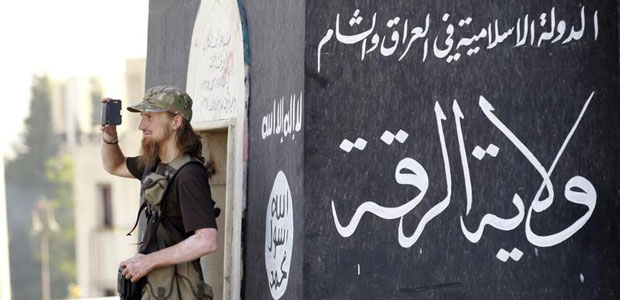
A militant uses a mobile phone to film fellow Islamic State fighters taking part in a military parade along the streets of Syria's Raqqa province on June 30, 2014. (Reuters/Stringer)

Broadcasting murder: Militants use media for deadly purpose

News of the August 19, 2014, murder of journalist James Foley broke not in the media but instead on Twitter. News organizations faced the agonizing questions of how to report on the killing and what portions of the video to show. If a group or individual commits an act of violence, and then films it,…

Read More ›

The mother, right, of photographer Nadhir Ktari, who disappeared with fellow journalist Sofiane Chourabi in Libya in September 2014, attends a demonstration held in solidarity with the missing pair, in Tunis on January 9, 2015. (Reuters/Anis Mili)

Lack of media coverage compounds violence in Libya

Near the end of August 2014, Egypt and the United Arab Emirates launched airstrikes against what were characterized as Islamist-allied militias fighting near Tripoli, Libya. Or maybe they didn’t. The New York Times broke the story on August 25, 2014; Egypt denied it, the UAE didn’t comment, and U.S. officials made seemingly conflicting statements.

Read More ›