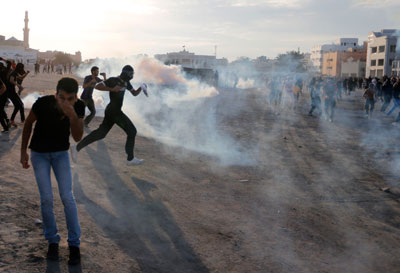
Bahrain racing in circles
Thursday, the official Bahrain News Agency announced the “final 30-day countdown [to] the Formula One extravaganza” to take place the first week of April. Every year the race acts as a lightning rod for criticism of the Bahraini government, which seeks to use high-profile international events like the F1 to gloss over human rights violations…
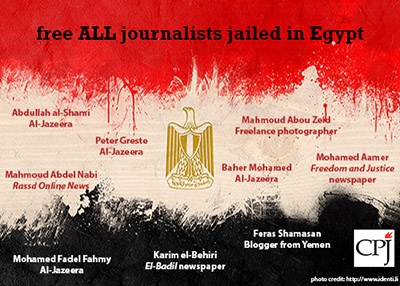
Egypt should #FreeAJStaff and other jailed journalists
Today, on Al-Jazeera’s Global Day of Action, the Qatari-based broadcaster is urging Egyptian authorities to release its journalists who have been held behind bars for months. CPJ calls on the Egyptian government to release all of the journalists jailed in the country. At least nine journalists are currently imprisoned in Egypt, four of whom work…
Press freedom in Bahrain three years after #Feb14
Three years ago, hundreds of thousands of Bahrainis descended to the streets to demand change. A harsh government crackdown and the turn to violence by some protesters have since dampened the hope lit on February 14, 2011. In this context, we asked Bahrainis and Bahrain observers on Twitter how they think the status of press…
Media surveillance and ‘the day we fight back’
Today, a broad coalition of technology companies, human rights organizations, political groups, and others will take to the Web and to the streets to protest mass surveillance. The mobilization, known as “The Day We Fight Back,” honors activist and technologist Aaron Swartz, who passed away just over a year ago. Throughout the day, the campaign…
Terror charges for Al-Jazeera in Egypt prompt outcry
Today, the Committee to Protect Journalists joined other leading international media freedom and human rights organizations, including Article 19, Index on Censorship, and Reporters Without Borders, in calling on the European Union and United States to demand Egyptian authorities drop charges against Al-Jazeera journalists and release those under arrest.
Put Syrian press freedom on Geneva agenda
Today the Committee to Protect Journalists joins 15 other press freedom and media development organizations calling on the participants of the Syrian peace conference in Geneva to include freedom of the press and expression as “fundamental cornerstones in any viable political settlement.”
Tunisia constitution needs stronger free press guarantees
Human rights groups and legislators are praising the third and final draft of Tunisia’s new constitution as one of the most liberal charters in the Arab world–and for being arrived at by a remarkably consensual process among political parties, especially if compared with neighboring Egypt and Libya.
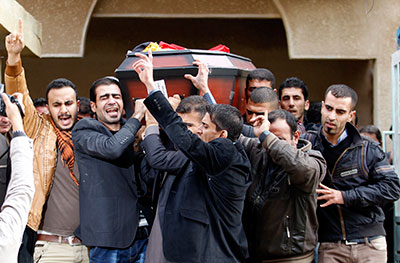
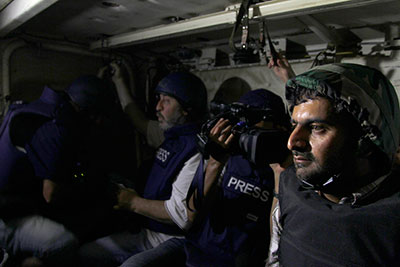
Arab journalists need training for civil unrest and wars
In recent years, Arab journalists have been taking great risks to report important stories in a region where war and civil unrest remain an ever-present threat. Many are operating without proper equipment or safety training in how to recognize and mitigate the various risks they face.