Journalists attacked by angry Milosevic supporters in Belgrade
New York, June 29, 2001 — Enraged supporters of former Yugoslav president Slobodan Milosevic attacked several journalists at a rally in central Belgrade on Thursday evening, June 28, local and international press reported. The demonstrators attacked the journalists because they were angry at local media coverage of Milosevic’s extradition to the international war crimes tribunal…
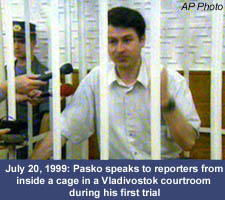
CPJ’S PETER ARNETT MEETS RUSSIAN AMBASSADOR TO DISCUSS PASKO TRIAL
New York, June 27, 2001 — A CPJ delegation led by board member Peter Arnett met today with Russian ambassador Yuri Ushakov in Washington, DC, to express its deep concern about the forthcoming trial of military journalist Grigory Pasko in Vladivostok. Russian military authorities have been pursuing Pasko for nearly four years on charges of…
Body of Corsican journalist found in river
New York, June 21, 2001 — The body of 52-year old journalist Nicolas Giudici was found in a river in northern Corsica on June 17, according to local and international press reports. Giudici had been shot twice, once in the head. His torched car was found 50 kilometers away in the town of Cervione. Guidici…
CPJ denounces third postponement in Pasko trial
New York, June 19, 2001 — The espionage trial of Russian military journalist Grigory Pasko has been postponed yet again, according to the Itar-Tass news agency and CPJ sources in Vladivostok. CPJ denounces these delays, which are clearly intended to exhaust Pasko’s legal defense. Military authorities have been pursuing the investigative reporter for nearly four…
Editor ordered to abstain from journalism in defamation case
Your Excellency: The Committee to Protect Journalists (CPJ), an independent organization dedicated to the defense of press freedom around the world, strongly protests the recent conviction of Oleg Liachko, editor of the independent Kyiv weekly Svoboda, on defamation charges.

ONE YEAR LATER, NO PROGRESS ON MISSING CAMERAMAN INVESTIGATION IN BELARUS
New York, July 6, 2001 On the one-year anniversary of cameraman Dmitry Zavadsky’s disappearance in Minsk, CPJ deplores the fact that Belarusian authorities have made little or no progress investigating the case, despite credible leads that have emerged over the past year. “The absence of concrete progress leads us to suspect that Belarusian authorities…
Journalist killed in brutal assault
New York, June 11, 2001 — Milan Pantic, a reporter for the Belgrade daily Vecernje Novosti, was killed this morning before 8 a.m. local time as he was entering his apartment building in the central Serbian town of Jagodina, according to CPJ sources and local news reports. Pantic had gone to fetch a loaf of…