Sierra Leone
2005
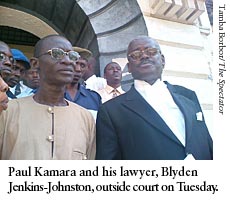
After a year in jail, editor freed in Sierra Leone
New York, November 30, 2005—The Committee to Protect Journalists welcomes Tuesday’s release of jailed journalist Paul Kamara after an appeals court overturned his conviction and two-year sentence for seditious libel. He had served more than a year in prison for articles criticizing President Ahmad Tejan Kabbah. “I am happy that I have been acquitted at…
One year later, an editor still jailed in Sierra Leone
New York, October 4, 2005—The Committee to Protect Journalists is outraged that journalist Paul Kamara remains in jail in Sierra Leone a year after being convicted of “seditious libel” for articles criticizing President Ahmad Tejan Kabbah. Kamara was convicted on October 5, 2004, and sent to Pademba Road Prison in the capital, Freetown, to serve…
SIERRA LEONE
JULY 28, 2005 Posted August 31, 2005 Harry Yansaneh, For Di PeopleKILLED – UNCONFIRMED An attack on newspaper editor Harry Yansaneh contributed to his death from kidney failure two months later, a judicial inquest found on August 26. A magistrate ordered the arrest of Member of Parliament Fatmata Hassan, three of her children, and two…
Inquest says editor’s death was manslaughter
New York, August 29, 2005—An attack on newspaper editor Harry Yansaneh contributed to his death from kidney failure two months later, a judicial inquest found on Friday. A magistrate ordered the arrest of Member of Parliament Fatmata Hassan, three of her children, and two other men for suspected manslaughter after the weeklong inquest, local journalists…
CPJ calls for independent inquiry into editor’s death
Your Excellency, The Committee to Protect Journalists is deeply troubled by the July 28 death of independent newspaper editor Harry Yansaneh. An autopsy attributed Yansaneh’s death to kidney failure. Yansaneh, acting editor of the daily For Di People, was assaulted on May 10 by a group of attackers. Prior to his death, Yansaneh alleged that Member of Parliament Fatmata Hassan had ordered the attack, according to local sources and press freedom organizations. Hassan, a member of your Sierra Leone People’s Party (SLPP), was seeking at the time to evict For Di People and five other independent newspapers from the office space they had rented from her family for many years. The other newspapers were The Independent Observer, The Pool, The African Champion, The Pioneer and The Progress.
CPJ disturbed that jailed editor denied due process
Your Excellency: The Committee to Protect Journalists is deeply concerned that imprisoned journalist Paul Kamara has been denied due process of law. Administrative obstacles have prevented his appeal from being heard, according to his lawyer, and Kamara has now served more than eight months of a two-year prison sentence. His family and friends say he was transferred to solitary confinement four months ago.
Journalists detained, charged with seditious libel
New York, May 25, 2005—The Committee to Protect Journalists condemns the criminal charges brought today against two journalists from the private weekly newspaper Trumpet. Managing editor Sydney Pratt and reporter Dennis Jones were arrested yesterday and were being held at the Criminal Investigation Department (CID) in the capital, Freetown, where the paper is based. Both…
SIERRA LEONE
MAY 24, 2005 Updated on June 13, 2005 Sydney Pratt, The Trumpet Dennis Jones, The Trumpet LEGAL ACTION, IMPRISONED Criminal charges were brought against managing editor Pratt and reporter Jones, of the private weekly The Trumpet. The journalists were arrested and held at the Criminal Investigation Department (CID) in the capital, Freetown, where the paper…
Attacks on the Press 2004: Africa Analysis
Overviewby Julia Crawford With the rule of law weak in many African countries, journalists regularly battle threats and harassment, not only from governments but also from rogue elements, such as militias. Repressive legislation is used in many countries to silence journalists who write about sensitive topics such as corruption, mismanagement, and human rights abuses. If…