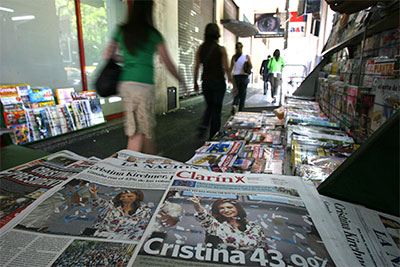
In the pitched battle between Cristina Kirchner’s administration and critical media outlets such as those owned by Grupo Clarín, the very credibility of journalism is at stake. Argentine citizens are deprived of objective sources of information on vital political and economic issues. A CPJ special report by Sara Rafsky
Published September 27, 2012
BUENOS AIRES
Guillermo Moreno, Argentina’s secretary of domestic commerce and one of the government’s most colorful figures, has been spotted in recent months with a range of striking accessories. In Congress, he was seen handing out traditional Argentine mini-cakes. In a picture taken on a government airplane, a balloon floats above his head. And during his state trip to Angola in May, an aide was photographed distributing socks to poor children. All of this paraphernalia bears the same white background emblazoned with the simple words “Clarín Lies.”
Grupo Clarín, which owns the country’s most widely read daily newspaper, Clarín, as well as radio stations, broadcast and cable television outlets, and an Internet service provider, is Argentina’s principal media conglomerate and one of Latin America’s largest. It is also the principal adversary of President Cristina Fernández de Kirchner in a battle pitting her and media outlets aligned with her government against those opposed to it. The government’s primary weapon is financial: It props up, through advertising, outlets with favorable editorial lines, while withholding that support from others, like Clarín. Critical media, in return, relentlessly hurl reproach at the administration.
In print
• Download the pdf
In other languages
• Español
The consequence of this bitter fight is an intensely polarized press. On one side, Kirchner’s critics accuse her of stifling press freedom by rewarding allied media and hammering—with regulation as well as advertising—unsympathetic outlets into silence. On the other side, many believe that Clarín has too much power and leverages its huge media holdings to further its private business interests.
Horacio Verbitsky, a renowned Argentine journalist and former CPJ International Press Freedom Awardee who has been closely aligned with the Kirchner administration, told CPJ: “In my opinion, Clarín and [owner of another critical newspaper] La Nación started this fight, and they did it in defense of their own political-economic interests.”
“Are we not going to investigate corruption?” countered a visibly angry Martin Etchevers, spokesman for Grupo Clarín. “Are we not going to say that the inflation numbers the government publishes are false? That’s not polarization or political opposition,” he told CPJ, slamming his hand on the table. “That’s journalism.”
Actually, the credibility of journalism is at stake as outlets on either side devote increasing coverage to discrediting each other. Argentina’s citizens are unable to trust publications and broadcasters for objective information on vital issues, such as corruption, inflation, crime, the safety of infrastructure, sputtering economic growth, and whether Kirchner will try for a third term in office. Since Argentina has no federal right-to-information laws, the lack of sources for objective news is especially damaging to the public.
Mónica Baumgratz, coordinator of the local press group Foro de Periodismo Argentino (FOPEA)’s freedom of expression monitoring program, told CPJ that the situation is troubling. When all news gathering has been discredited, even the truth becomes suspect, she said.
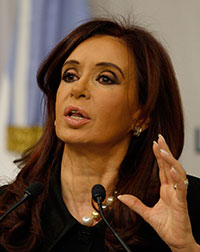
It wasn’t always this way. During the presidency of Cristina Kirchner’s late husband, Néstor Kirchner, who governed from 2003 to 2007, and early in Cristina Kirchner’s first administration (she was re-elected in October 2011), Clarín enjoyed a privileged relationship with the executive branch. Graciela Mochkofsky writes in her book, Original Sin: Clarín, the Kirchners and the Fight for Power, that Nestor Kirchner was “genuinely fascinated with [Héctor] Magnetto” (the powerful longtime chief executive and president of Clarín), a liking that was reflected in regular, shared leisurely lunches and the scoops Clarín was granted on government decisions. And it was Néstor Kirchner who approved the 2007 merger that gave Clarín control of one of the biggest cable companies in Latin America. The relationship changed in 2008, when the government increased farming export taxes and Clarín’s coverage sided with the farmers striking in protest. The government accused the group of being biased because of its own economic interests in the agricultural sector. Clarín and La Nación (which owns several print and digital publications as well as its flagship newspaper) are the principal organizers of Expoagro, the country’s largest annual agricultural fair.
Before their falling out, Clarín received substantial advertising from the federal government, according to “Quid Pro Quo: Official Advertising in Argentina and its Multiple Facets,” a report published by the nonprofit Poder Ciudadano (Citizen Power) in December. The author, Martin Becerra, an Argentine researcher and professor of communications at the universities of Quilmes and Buenos Aires, found through a study of television advertisements that there was close to zero federal government advertising on Clarín-owned channels between May and October 2011.
Government advertising—or “official publicity,” as it is called in Spanish—is common in Latin America; its intended function is to keep citizens informed of public services and policies. Under Article 13 of the Inter-American Commission on Human Rights’ Declaration of Principles on Freedom of Expression, discriminatory placement is prohibited, meaning it is not supposed to be used as reward or punishment for coverage of the government.
A 2008 report by the Open Society Institute, however, found that the practice is widely unregulated and abused in the region, to the point of being a form of “soft censorship.” In June, President Rafael Correa of Ecuador said he would suspend all government advertising in the Ecuadoran private media outlets with whom he has been engaged in his own fierce conflict.
A murky market for state funds
In Argentina, the distribution of and criteria for official advertising are unregulated and opaque at the federal, state, and local levels and across party lines. (The exception is the state of Tierra del Fuego, which adopted regulations in 2008.) Only two of 23 provinces fully answered information requests from Poder Ciudadano for reports on official publicity spending, Becerra told CPJ.

According to Andrés D’Alessandro, executive director of FOPEA, the use of government advertising has been a systemic problem for Argentine journalism throughout the country’s history. Media outlets have long been susceptible to retaliation for critical reporting in the form of fluctuating official advertising, regardless of political affiliation. It has come into sharp focus recently, he said, because state spending on advertising under Cristina and Néstor Kirchner dramatically increased.
Becerra found that in 2010, the federal government became the country’s principal advertiser, surpassing the corporations Unilever and Procter & Gamble to account for 9 percent of the total advertising market. That year, the national government spent roughly US$278.6 million, compared with US$10.5 million in 2003. The 2010 numbers rose sharply from the previous year due partly to the number of ads shown during the “Soccer for Everyone” program, which in August 2009, wrested away from Clarín the rights to broadcast top-tier soccer matches in Argentina. The group had shown the games on its cable sports channel for nearly two decades, and held the rights through 2014. The decision to make the matches available on public television was extremely popular, but critics said the move was intended to hurt Clarín while providing the government with primetime advertising opportunities in the year preceding the 2011 election. The matches are still flooded with government advertising that lauds the Kirchners and attacks the opposition.
Discrimination in placing ads is not limited to Clarín. Editorial Perfil, the country’s largest magazine publisher, sued the government over its advertising policies and in March 2011, the Supreme Court of Justice ruled in Perfil’s favor, saying the government must apply reasonable balance in its distribution of advertising. Seven months later, Perfil alleged that the government had placed only eight advertisements in its weekly publication since the ruling (including one that stated: “The publisher of this newspaper has honored businesses that are being investigated … for human trafficking and slave labor”). In March, the Justice Department fined the executive branch for noncompliance, and on August 14 a federal appeals court also upheld the decision and imposed a fine of 1,000 pesos (US$215) a day on the government.
Nor is discrimination confined to the federal government. According to Becerra’s report, the city of Buenos Aires—led by Mayor Mauricio Macri, a Kirchner foe—favors media groups like Clarín and La Nación at the expense of public media and pro-Kirchner outlets. However, Macri’s government represents only 1 percent of the advertising market in Argentina.
According to FOPEA, the situation is worse for smaller, provincial media outlets, many of whom are almost completely financially dependent on official advertising and therefore vulnerable to government pressure over their coverage. Marisa Rauta, director of the daily Diario de Madryn, told CPJ that when the state government of Chubut pulled all of its advertising in December 2010 after critical reporting by the daily, she had to cut the news staff in half and eliminate several sections. In March 2011, a local court ruled that the government had to reinstate advertising, but Rauta said the newspaper is still operating at reduced capacity.

The flip side of official advertising is that being friendly to the government pays. According to a study cited in several publications, the four newspapers belonging to Grupo Uno, a former foe-turned-ally of Kirchner, received US$8.2 million in federal advertising in 2011, up from about US$830,000 in 2010. The consultant separately found that the pro-Kirchner media group Veintitrés received US$6 million—the most of any group—in the first four months of 2012. In comparison, Clarín received US$109,000, down 61 percent from the same period in 2011. Clarín spokesman Etchevers has called the amount of resources given to these and other groups a “colonization of the media space,” and an attempt to use public resources to build up a vast network of outlets which, depending on their level of commitment, are “para-official,” “co-opted,” or “pro-government” and depend entirely on official advertising to survive. (None of the articles named the private consultant who carried out the study. Some media analysts have alleged the consultant was hired by Clarín, a claim the group denies.)
Roberto Caballero, director of Tiempo Argentino, a pro-Kirchner daily owned by Veintitrés, said that while he is troubled by official advertising’s potential to “create zombie journalists” without editorial independence, he doesn’t see a problem with the government giving his newspaper advertising at the expense of groups like Clarín and La Nación. “I think official advertising distribution should be regulated and egalitarian, but always in such a way that it benefits small media outlets” who receive less private advertising, he told CPJ. He noted that Clarín didn’t object to the way advertising was distributed during earlier administrations, when it benefited and other newspapers suffered. “They are the ones who gorged gluttonously on the advertising pie for 40 years and now they want us to share the bit we have?” he said. Grupo Uno did not respond to phone or email requests for comment.
A broad spectrum of journalists, academics, and civil society members interviewed by CPJ in Argentina in April mostly said that censorship is not a source of concern in Argentina. But in a survey conducted by FOPEA of 1,000 Argentine journalists in 2011, dependence on government advertising was ranked the third most serious challenge facing Argentine journalism after low salaries and lack of professionalism. Fifty-eight percent of the subjects said they thought journalism in the country was “conditioned” and 72 percent said they thought the business departments at their outlets had influence in the newsroom.
The Secretary of Public Communication, which is responsible for the government’s media policies, directs state media, and acts as the president’s spokesperson, did not reply to repeated requests by phone or email seeking an interview. Publicly, the Kirchner government has dismissed concerns by stating that, at 9 percent, federal advertising is an inconsequential part of the overall advertising market.
Haunted by the nation’s past
In any case, the government has other tools at its disposal. In addition to handing out props that paint Clarín a liar, Kirchner’s administration has accused the group of being a monopoly and even of committing crimes against humanity during the country’s brutal military dictatorship of 1976 to 1983. Both Clarín and La Nación have been criticized for being silent about the crimes of the dictatorship, and many Argentines believe that alignment with the junta allowed them to build undue influence.
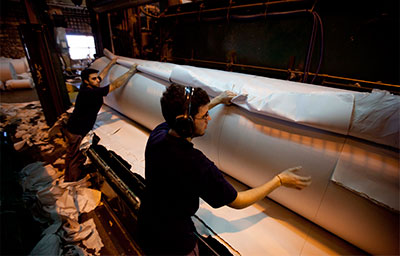
The Kirchners—widely credited with continuing the process initiated by President Raúl Alfonsín to bring some leaders of that dark era to justice—have accused Clarín and La Nación’s ownership of colluding with the dictatorship to force the sale of Papel Prensa, the country’s only newsprint manufacturer, from its original proprietor (whose family was later arrested and tortured by the junta). The newspaper groups have denied the charges; Clarín told CPJ in an emailed statement that the case was a “bastardization of the cause of human rights.” An investigation by a federal court is ongoing. Clarín’s owner was also accused of illegally adopting the children of people killed by the regime; those charges were disproved by DNA tests.
“The Argentine press never made a mea culpa for its journalistic coverage during the dictatorship. Clarín and La Nación, to varying degrees, never did either,” D’Alessandro told CPJ. “So they have this open wound for [their detractors] to keep hitting and criticizing them and linking everything they do in the present with their role in the dictatorship.” Clarín, in its statement to CPJ, said, “Within the context of that period, Clarín did have spaces for questioning [the junta] that were not exactly common in the press at the time,” citing denouncements of persecution in the cultural sector and coverage of visiting delegates from the Inter-American Commission on Human Rights. La Nación did not respond to requests for comment.
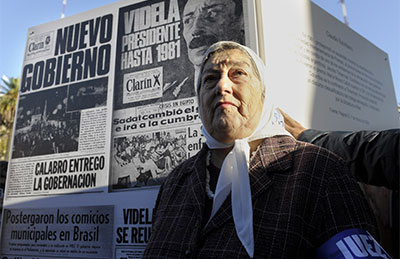
In December, Hebe de Bonafini, head of the legendary Argentine human rights group Madres de Plaza de Mayo—who has been criticized in some circles for being too closely aligned with the Kirchner governments—enacted a public trial against Clarín in Buenos Aires’s main plaza for its alleged complicity with the junta.
Public shaming of anyone associated with Clarín particularly incenses Miguel Wiñazki, Clarín’s editor-in-chief. “The business side of the company can defend themselves,” Wiñazki told CPJ. “But the smearing of individual journalists is discrediting the entire field.”
Much of that criticism has played out on publicly funded media. The most prominent forum for attacks is the television show “6,7,8,” where hosts and their guests delight in insulting high-profile journalists such as Joaquín Morales Solá—a columnist at La Nación who spent over a decade at Clarín—who was targeted with sardonic medleys insinuating unseemly actions during the dictatorship and featuring superimposed pictures of his head on the body of a gorilla. Jorge Lanata, one of Argentina’s most critical journalists, is another frequent target. When Lanata declared on his then-cable television show that the world was “laughing” at Argentina because of its government, “6,7,8” leapt to Kirchner’s defense, running a montage of favorable international headlines.
Critics complain that this highly politicized content is broadcast with taxpayer dollars on a public station. D’Alessandro noted that lack of regulations for public media is a long-standing problem in Argentina. Verbitsky told CPJ: “It should behave neutrally and pluralistically, which it does not. If it was the only source of information, the situation would be intolerable.” However, Verbitsky added, one must take into the account the vast media landscape in the hands of Clarín.
Kirchner has not been afraid to join the fray. She and her camp have classified opposing journalists and media executives as “Nazis” and “mafiosos.” But many Argentines say that the critical media are also guilty of excessive, even absurd, rhetoric. Lanata has accused “6,7,8” of being “pure Goebbels” and the government of “being bothered by freedom” for saying they would go after him for smoking, illegally, on his network television show. Even Caballero, the director of the pro-Kirchner Tiempo Argentino, protested that he was “constantly being attacked in Clarín and La Nación.”
Laura Zommer, a journalist with La Nación, said the climate is so charged that journalists are censoring themselves out of fear of how their reporting will be interpreted. When “everyone is classified as a friend or enemy, many prefer to stay quiet,” she told CPJ. FOPEA agreed that this atmosphere is detrimental to the exercise of journalism. “You lose your sources, [the government] doesn’t invite you to cover public events, they don’t answer your questions at press conferences, and they launch smear campaigns against you,” D’Alessandro said. Prominent reporters have complained about the scarcity of presidential press conferences (five in Kirchner’s tenure as of mid-September) and allege that officials purposely deceive them. Kirchner told the Casa Rosada (Pink House, as the executive mansion is called) press corps in an informal chat that “for official information, there are my speeches. I’m not going to speak against myself,” according to news reports. At the provincial and local level, CPJ research shows, journalists have also been at risk of physical violence for criticizing local governments.
Showdown looms over broadcast law
A couple of government moves have brought the battle into the legislative and judicial arena. In December, new legislation established newsprint as a commodity of public interest whose manufacture would be regulated by the government, and created productivity requirements for Papel Prensa, of which Clarín and La Nación are majority owners (the state is a third partner). The two media groups decried another attack on the government’s principal critics. Many analysts, however, described the move as necessary to counteract the companies’ monopoly control over the newsprint market.
Similarly, a broadcast law passed in 2009 to replace a law dating back to the dictatorship era, is aimed at curbing monopolies and democratizing ownership and access to radio and television outlets, the government said. Opposition politicians said it was a means for the government to exert greater control over news content and force Clarín to give up some holdings. Under parts of the law, the company could lose a significant chunk of its assets, which include at least six dailies, eight magazines, four network television channels, six cable channels, five radio stations, a cable company, and an Internet service provider, as well as other businesses.
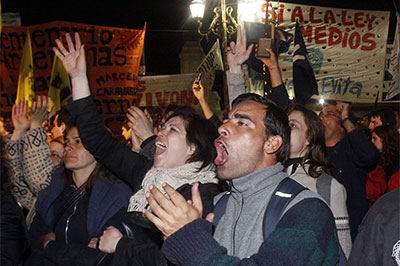
Implementation of the provision requiring divestment was held up in courts until May, when the Supreme Court ruled that media groups had until December 7 to comply. Clarín is still pursuing one more legal avenue, which challenges the constitutionality of the law. It claims the government has not pursued other media groups with sympathetic editorial lines, who Clarín alleges are also in violation of the some of the new law’s provisions. “They are not looking to create new voices, they are looking to silence voices,” Etchevers said. Kirchner has said the government will not make any groups divest until the legal fight with Clarín, which stands to lose the most holdings, is resolved. Clarín has also claimed that Kirchner’s increasingly frequent use of cadenas—nationwide radio and television addresses that pre-empt programming on all stations—is in violation of the law, which dictates that they may only be employed in exceptional circumstances. The president has countered that her use of cadenas is legal.
The pace of implementation has frustrated media analysts, including those who argued that breaking up Clarín was essential to make room for new media voices. Becerra, the author of the study on government advertising who is a staunch advocate for the legislation, told CPJ that all parties have played a part in the delay. “It’s the government’s responsibility for being so obsessed with the fight with Clarín that it is distracting them from implementing the law. They are only focusing on the aspects that go against Clarín,” he said. At the same time, Clarín, who he said is “used to the government legislating in their favor,” has impeded progress with their “army of lawyers.” And the political opposition, which is aligned with Clarín, refused until this year to join the new media regulatory body created by the law.
Claudio Schifer, a director of the regulatory body, told CPJ that while “it takes some time to construct a new house,” the government was advancing with its goal of opening up access to media outlets, citing the creation of university television stations and 14 radio stations run by indigenous communities. Journalists and analysts from across the political spectrum have praised programming on new state television stations devoted to education and culture.
To be sure, the Kirchners have made at least one big move for press freedom; even the most staunchly anti-Kirchner journalists praise the decriminalization of libel in 2009. “Personally, I was probably more persecuted under Menem,” said Clarín Editor-in-Chief Wiñazki, referring to former Argentine President Carlos Saúl Menem, who in the 1990s launched a series of criminal defamation complaints against critical journalists.
And an important factor in the outlook for Argentine journalists—one that sets the country apart from some other Latin American nations where the press is besieged by thin-skinned governments—is its independent judiciary. As shown by the Perfil decision, judges are not afraid to rule against the Casa Rosada. Still, the government has shown no intent to comply with that decision and, other than fines, there are no apparent repercussions for noncompliance, media analysts said.
For many journalists, the most serious consequence of the dispute is not the blaring of headlines or the ownership of assets, but the long-term standing of the profession itself. In July, after critical journalist Lanata and pro-government journalist Víctor Hugo Morales—two of the most prominent figures in the Argentine press—traded a series of nasty allegations about each other on the airwaves, one journalist titled his piece about the episode, “Journalism loses.”
Sara Rafsky is research associate in CPJ’s Americas program. A freelance journalist in South America and Southeast Asia, she was awarded a 2008 Fulbright Grant to research photojournalism and the Colombian armed conflict.