Radio journalist Ahmed Omar Hashi is a survivor, but he has paid dearly. He’s been threatened and targeted for death. He’s seen his colleagues and friends killed. Now, like other Somali journalists, Hashi struggles in exile and hopes one day he can resume his work. By Karen Phillips
Posted April 13, 2010
KAMPALA, Uganda
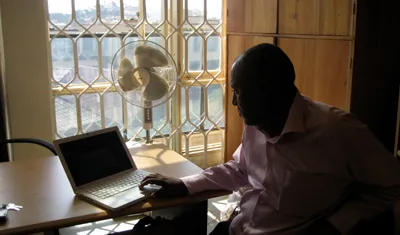
As Ahmed Omar Hashi strode toward me, his figure silhouetted in the bright morning light, it was hard to believe this was the same man who left Mogadishu on a stretcher just six months earlier after suffering a near-fatal gunshot wound. As I reached to shake his hand, he pulled me into a bear hug.
• Video Report
• CPJ’s Journalist
Assistance Program
Hashi, 43, news editor of Radio Shabelle in Somalia, has survived three attempts on his life. The most recent occurred in June 2009 when hard-line Al-Shabaab insurgents tried to kill him in the Mogadishu hospital where he was recovering from gunshot injuries suffered just days earlier in an attack that left his colleague, Radio Shabelle Director Mukhtar Mohamed Hirabe, dead. “I recognized that they wanted to kill me, absolutely,” Hashi told me. “And that’s when CPJ helped.”
Somalia is a focus of CPJ’s Journalist Assistance Program, which has aided dozens of local journalists who have been attacked or threatened during the country’s brutal, ongoing fighting. The conflict in Somalia has claimed the lives of 21 journalists since 2005 and has sent numerous others into exile. Journalists find themselves both literally and figuratively in the crossfire between the U.N.-backed transitional government and militant Islamic groups—most notably Al-Shabaab, which uses threats, attacks, and murder to silence critical voices.
With the help of regional human rights organizations, CPJ got Hashi on a flight out of Mogadishu. His wife and two youngest children joined him soon after, and together they have tried to piece together a new, if precarious, life in exile. I was fortunate to be in Kampala in January 2010 to meet Hashi and his family and learn how they are doing.
Surviving in a foreign country
Hashi insisted on meeting me in downtown Kampala so I wouldn’t get lost on the way to his house—with good reason as it turned out. After exiting the industrial center of the city, we jumped a curb and drove onto a dirt lot that eventually turned into a rugged road lined on either side by pineapple vendors.
The Somali refugee population has been growing in Uganda in recent years. In Kampala, the highest concentration of Somalis is in the poor urban areas of Kisenyi, but Hashi prefers to avoid these neighborhoods for security reasons. Al-Shabaab operatives can enter Uganda through porous borders or simply purchase a visa at the airport on arrival. A well-known refugee like Hashi would not be hard to track down. In order to keep a low profile, Hashi and the 15 other journalists I met live scattered throughout Kampala’s suburbs, avoiding the major diaspora communities.
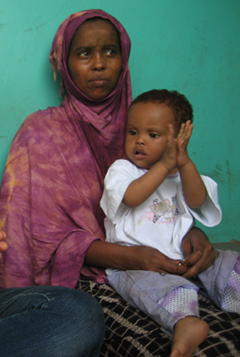
We entered Hashi’s walled compound through a rusty metal gate. The domestic scene that greeted us in the courtyard—children’s toys scattered beneath the colorful, billowing laundry hung up to dry—was far different from the dangerous circumstances he and his family left behind in Somalia. Hashi’s wife, Fartun, came out to greet me holding their youngest daughter, 1-year-old Caliya. Her older sister, mischievous 2-year-old Nahyan, ran at her father and was swung up in the air. “This one I sometimes call ‘Sherly’ after Sheryl Mendez at CPJ,” he told me smiling. Of his days in the hospital, Hashi recalls, “Sheryl used to call me every night and speak with me for at least two hours. So I never feel alone.”
Hashi’s three other children, the oldest of whom is 10, are living in Somalia with family, and his eyes sadden when I ask about them. “Really, they are too young. They can’t live without me and now I don’t know what to do for them. I hope they will survive and I can bring them here. Life is not easy there for children.”
Hashi and his family share a three-bedroom home with four other Somali refugees, three of them journalists and one a journalist’s wife. There is a strong sense of solidarity among the exile Somali journalist community, even though most live far from one another and the cost and risk of getting together can be prohibitive. (While I was visiting with Hashi, though, 10 other exiled Somali journalists stopped in to tell me their stories and say thank you to CPJ.) Hashi benefited from this support network when he arrived in Kampala still nursing his wounds. Three of his former Radio Shabelle colleagues helped him navigate life in Kampala and get to the hospital to receive medical care.
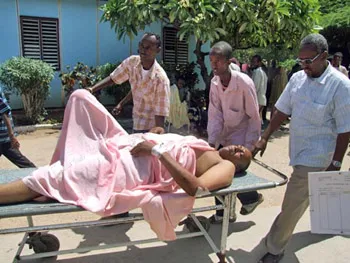
Today, aside from the scars from two bullet wounds and some continuing chest pain, Hashi appears to have recovered from his attack. His emotional wounds, however, run much deeper and put a strain on his daily life. “Sometimes, when I’m walking, I dream,” he tells me. Referring to his slain colleague Hirabe, he adds, “I see my friend being shot in the head.” In these moments he has to sit down to avoid stumbling or being hit by a car, he says. Hashi can’t know for sure what prompted the Al-Shabaab attack as he and Hirabe were walking through Mogadishu’s Bakara Market last June: Was it the station’s decision to air interviews with two moderate Islamic groups? Or was it simply an attempt to complete a job begun four months earlier when Hashi and Hirabe escaped an Al-Shabaab ambush that killed Said Tahlil, director of HornAfrik radio?
Whatever the reason, it was enough for someone to fire a gunshot into Hashi’s hospital room (it missed him because he was lying down) and for two Al-Shabaab operatives armed with explosives and pistols to return to the hospital the next day to ask about his whereabouts (the two were arrested by government forces).
The memories of the trauma Hashi endured in Mogadishu are intensified by the ongoing threat he perceives in Uganda, where low-security borders and a growing Somali refugee population make it possible for Al-Shabaab operatives to enter unnoticed. In December, he and many of his exiled colleagues received the same text message threat on their cell phones: They would never be safe in Uganda. The journalists alerted local authorities, who said they tried unsuccessfully to trace the sender. His biggest fear is that insurgents might try to hurt his children back in Somalia. “Al-Shabaab can kill even a small child,” he says quietly.
For exiled journalists, many hurdles
Hashi faces many practical concerns as well. Since his arrival, he has relied on financial support from CPJ, the Kampala-based East and Horn of Africa Human Rights Defenders Project (which also paid for English lessons when he first arrived), and other human rights organizations, but this support will eventually come to an end.
When I ask about the possibility of finding work in Kampala, he shakes his head and looks down. His limited English skills and the country’s high unemployment rate make job prospects tight. Other Somali refugees benefit from employment opportunities within the close-knit exile community, but Hashi and his colleagues are not willing to take the risk of being recognized by the wrong Somali.
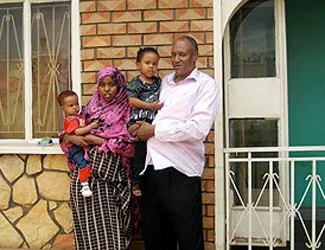
His biggest hope today is to reunite his family and move to a third country, preferably the United States. He is registered as a refugee with the United Nations High Commissioner on Refugees (UNHCR), which can refer him for resettlement to a third country if his safety in Uganda is judged to be at risk. The process can take up to two years, and even then Hashi faces hurdles in rejoining the journalism profession. CPJ research has found that only about one exiled journalist in three is able to resume his or her profession. Language, cultural, and legal barriers can make integration a challenge.
But Hashi has never been easily deterred.
As if to illustrate this point, Hashi’s wife brings out a copy of an Eritrean newspaper to show me. On the cover is Eritrean President Isaias Afewerki sitting across from an intent Hashi. He had been invited along with a handful of other international reporters to interview Afewerki on the occasion of Eritrea’s Independence Day. Departing from the pre-approved script, Hashi questioned Afewerki about arms that the Eritrean leader was reputed to have provided to Islamist militant groups in Somalia. An angry Afewerki rebuked Hashi after the interview, a reaction that clearly makes the editor proud.
On his return to Somalia, Hashi aired the full interview on Radio Shabelle. Telephone threats followed: He would get what he deserved for asking such stupid questions.
Repeated attacks on his life, in fact, did bring his work to a stop. But Hashi said he is determined to make that a temporary situation, a professional hiatus instead of a termination. “I want to proceed [with] my work of journalism,” he told me. “I don’t want to stop. I want to work. I want to write about my country.”
As we said our good-byes, the first afternoon raindrops landing on the dusty road outside his house, I marveled at how far Hashi had come in six months and at the long, uncertain road that lay ahead as he tried to regroup his family and reestablish a sense of stability in their lives.
Karen Phillips is a freelance writer and consultant for CPJ’s Journalist Assistance Program.
Editor’s Note: The situation for Hashi and his family is not unique. CPJ’s Journalist Assistance program helps journalists at risk by advocating with the United Nations and foreign embassies for resettlement and offering limited financial assistance for these journalists’ material needs. We can’t do it alone. Visit our Journalist Assistance program and see how you can help.