Mexico
2013

Remembering Mike O’Connor
It is a sad end to 2013 for the global press freedom community. With the sudden death of CPJ Mexico Representative Mike O’Connor, 67, on Sunday, Mexican journalists have lost one of their most formidable advocates. Mike will be remembered as someone who was on the forefront of the struggle for press freedom. His superb…
CPJ testifies on challenges to democracy in the Americas
Carlos Lauría’s testimony starts at 1:10 in the video. Carlos Lauría, CPJ’s Americas senior program coordinator, provided testimony before the Subcommittee on the Western Hemisphere of US House of Representatives on Tuesday. Lauría emphasized that violence and government harassment are the main emerging trends that illustrate the major challenges facing the press in the Western…
Mexico’s special prosecutor hesitates over early cases
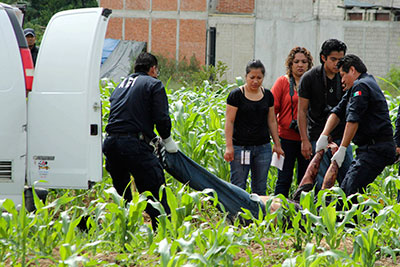
Organized crime capos and corrupt politicians have been getting away with murdering journalists in Mexico for so long that there isn’t a reliable count on the number of the dead or a useful way to measure the crushing effects on a democracy when a country’s press is afraid to tell the truth. CPJ research shows…
Family murdered, Veracruz journalist seeks asylum in US
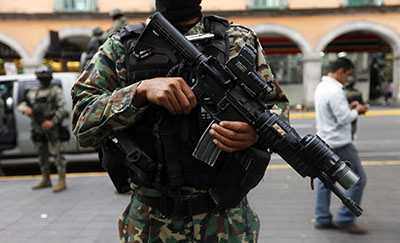
A fellow newspaper photographer phoned him and said he had to get right over to his parents’ home because something very bad had happened. When Miguel Angel López remembers seeing when he got there was “just blood. You can’t understand that much hatred.” He was talking about the murders of his mother, his father–a senior…
What’s risky? In Mexico’s twin cities, journalists don’t know
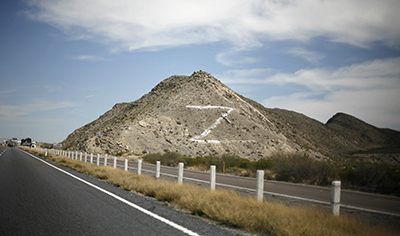
The Durango state governor was on his way to meet with reporters. Before he arrived, the reporters huddled to decide the question of the moment. It seemed obvious: Why had a former mayor been arrested the day before in what clearly seemed to be a political move? “That was the only question,” a reporter said…
Mexican press fails to question Martínez murder case
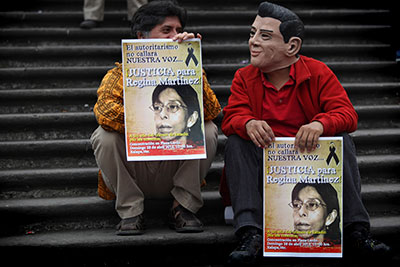
He certainly looked guilty of something, and as if he’d finally been caught. With either his head down or with a kind of scared, dead-eyed stare, in a white jumpsuit, in front of the four Veracruz state police officers crowded behind him. They were all in black uniforms, with a strip of face and eyes…
In Mexico, a movement and a bill against impunity
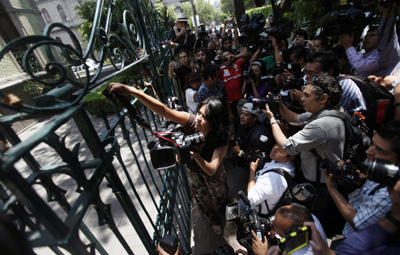
Who can say exactly when the work of press freedom groups, human rights defenders, and budding networks of Mexican journalists became a movement? It would have been many murders, many funerals, many orphans ago. It would have been countless news events–about crime, corruption, violence–that went uncovered because reporters and news organizations concluded that the only…

At OAS, a victory for human rights and free expression
By reaffirming the autonomy and independence of the regional human rights system and rejecting attempts to neutralize the work of the Inter-American Commission on Human Rights (IACHR) and its special rapporteur for freedom of expression, the Organization of American States (OAS) chose last week to discard proposals that would have made citizens throughout the hemisphere…
Arrests in Torreón press crimes; will it make difference?
Twenty-one people have been arrested for a wave of crimes that included 11 murders (six of which were committed against police officers), the abduction for hours of five employees of El Siglo de Torreón newspaper, the murder of a mayoral candidate, and attempted murder of a current mayor in a large metropolitan area in central…
Do news blackouts help journalists held captive?
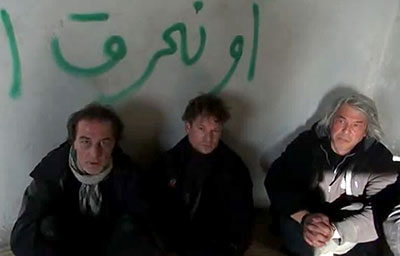
At any given time over the past two years, as wars raged in Libya and then Syria, and as other conflicts ground on in South Asia and sub-Saharan Africa, a number of journalists have been held captive by a diverse array of forces, from militants and rebels to criminals and paramilitaries. And at any given…