By Shawn W. Crispin
Before Henry Araneta and his colleagues set off on the morning of November 23, 2009, on what would be their last assignment, the DZRH reporter sent his wife a text message: There could be trouble.
ATTACKS ON
THE PRESS: 2009
• Main Index
ASIA
Regional Analysis:
• As fighting surges,
so does danger to press
Maguindanao:
• Makings of a Massacre
Country Summaries
• Afghanistan
• Burma
• China
• Nepal
• North Korea
• Pakistan
• Philippines
• Sri Lanka
• Thailand
• Vietnam
• Other developments
The assignment would seem routine to anyone unfamiliar with the violent political climate on the southern island of Mindanao. The journalists would accompany a convoy of people who intended to file candidacy papers for political clan leader Esmael Mangudadatu’s bid for governor of Maguindanao province. Having been warned of a possible ambush, Mangudadatu would not travel with the group but would instead send female family members and supporters, and invite the press to go along, in the belief that women and independent reporters would not be attacked. One reporter was troubled enough by rumors of an assault that he called a military commander to request security but was told that no protective escort would be deployed. Unnerved, he and two other journalists decided not to go.
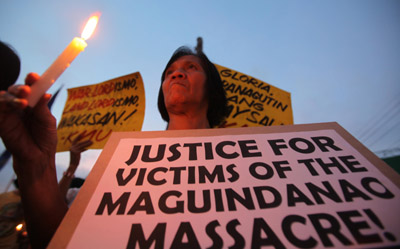
En route to Shariff Aguak, the provincial capital, the journalists and Mangudadatu clan members were ambushed by more than 100 heavily armed militiamen and led at gunpoint to a remote clearing where large pits had been prepared. Thirty journalists and two media support workers were shot and dumped into two mass graves in an attack that took 57 lives altogether and gained notoriety around the world as the Maguindanao massacre. Authorities charged a number of suspects linked to a rival political clan, the ruling Ampatuans, including Andal Ampatuan Jr., mayor of Dato Unsay. Witnesses quoted in local news reports accused the mayor himself of shooting many of the victims. Ampatuan professed innocence and blamed the massacre on a Muslim rebel group known to be active in the area.
Details of the killings, the deadliest event for the press ever recorded by CPJ, emerged in an authoritative fact-finding report compiled by four local press organizations and a follow-up mission conducted by international groups, including CPJ. Solutions to end the entrenched culture of violence and impunity are more elusive.
While the scale of the attack was unprecedented, it was not entirely unpredictable in the often lawless context of Philippine politics. Before the massacre, CPJ had undertaken two missions to the country in 2009 to express its deep concerns and conduct research into the culture of impunity in media killings. In March, CPJ ranked the Philippines sixth on its annual Impunity Index, which measures unsolved journalist killings as a percentage of total population. Even before the massacre, the Philippines’ impunity ranking was the highest in the world for a peacetime democracy, behind only war-ridden Iraq, Sierra Leone, Somalia, Sri Lanka, and Colombia. It is sure to rise when CPJ compiles its new index in 2010. Sixty-five journalists have been murdered in the Philippines in the past two decades, a death toll trailing only Iraq. Philippine authorities have obtained convictions in just five murder cases during this time.
Yet the nation’s leadership has consistently played down the gravity of the impunity problem. In March, presidential spokesman Cerge Remonde discounted CPJ’s findings as an “exaggeration.” His deflection was indicative of an official stance that has allowed wayward local government officials, so frequently involved in media killings in the Philippines, to perpetrate crimes without fear of punishment—even, apparently, the premeditated mass murder of 32 media workers.
Like the 42-year-old Araneta, the press victims in Maguindanao were all local journalists, according to the fact-finding report compiled by the National Union of Journalists of the Philippines, the Philippine Center for Investigative Journalism, the Freedom Fund for Filipino Journalists, and MindaNews. Most of the victims were reporters and photographers for Mindanao-based newspapers, although some were employed by radio and television outlets.
“Nearly an entire generation” of local journalists was wiped out, said the report, which noted that most of the victims were married and had children. For those journalists who remain, fear is a constant. Local reporters who spoke with CPJ lamented that the security protocols they had implemented—traveling in large numbers to mitigate risks, requesting that authorities provide security for dangerous assignments—failed to save the lives of their friends and colleagues. Some of the slain journalists had undergone security training, but Mike Dobbie, a trainer for the International Federation of Journalists, said security protocols for local reporting would need to be “entirely revised” given the massacre and the strong possibility of more political violence in the run-up to May 2010 elections.
Many local journalists said they feared for their safety while reporting on the massacre’s aftermath. Those fears were underscored by reports that unidentified men were photographing journalists as they reported on the arrests of Ampatuan clan members and the discovery of a massive underground armory said to belong to the group. Illustrating the depth of the journalists’ concerns, several reports on the killings ran without bylines or datelines in both national and local newspapers.
Relatives of the slain journalists told CPJ that they, too, were fearful that the politically powerful suspects would evade justice, as has happened in so many previous media killings in Mindanao. In their fact-finding report, the local press groups found several troubling aspects to the official investigation, including the apparent mishandling of evidence. The report noted that recovery teams used a backhoe rather than shovels to extract victims’ remains from the pits, a technique that likely compromised forensic evidence. “There was little or no consideration given to preserving evidence,” the fact-finding team found, and “no consideration given to avoid contamination of the crime scene.” Many days after the massacre, retrieval teams had failed to gather used mobile phone SIM cards and other evidence strewn about the crime scene.
There were also signs that police themselves could have been involved in the killings. Witnesses said vehicles with police markings were seen during the ambush, and at least one Maguindanao police vehicle was unaccounted for in the aftermath. Just three days before the massacre, six new police checkpoints were established along the route the Mangudadatu convoy would take. The reason for the new checkpoints was unclear.
When CPJ traveled to Mindanao in December, a local prosecutor assigned to build the case against the accused described a lack of coordination between his panel and the police officials who had gathered evidence. He also expressed concern that his team members had insufficient resources to construct a case and inadequate security to ensure their own safety.
The mishandling of evidence, the intimidation of witnesses, the questions of official involvement, and the lack of sufficient investigative resources all fit a disturbingly familiar pattern in the Philippines, one that over the years has allowed the killers of journalists to wiggle free of justice. Given the Ampatuan clan’s political power, including its ties to President Gloria Macapagal-Arroyo, could even these horrific killings go unpunished?
In a meeting with international and local press groups, including CPJ, press secretary Remonde rejected any suggestion that the government be held directly accountable for the Maguindanao massacre. He emphasized that Arroyo had attended the wakes of victims and that the government would provide scholarships and compensation to slain journalists’ family members. But without a clear commitment to protecting journalists and breaking the cycle of impunity, there was no guarantee that the Maguindanao massacre would be the Philippines’ last.
Shawn W. Crispin is CPJ’s senior Southeast Asia representative. He conducted three missions to the Philippines during 2009, advocating and conducting research on the issue of impunity. CPJ’s Global Campaign Against Impunity is underwritten by the John S. and James L. Knight Foundation.