Iraqi editor reported missing in Baghdad
New York, February 26, 2007—The Committee to Protect Journalists is deeply concerned about the safety of an Iraqi newspaper editor who disappeared in central Baghdad on Saturday. Jamal al-Zubaidi, 56, an economics editor for the Baghdad-based dailies As-Saffir and Al-Dustour, was last seen leaving As-Saffir’s offices in the central Karada neighborhood around 1 p.m. on…
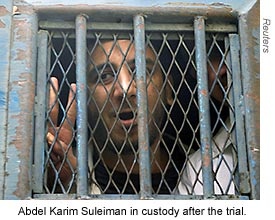
Egyptian blogger jailed for insulting Islam, Mubarak
New York, February 22, 2007—The Committee to Protect Journalists condemns an Egyptian court’s verdict sentencing an Egyptian Internet writer to four years in prison for his online criticisms. The case represents the first time that an Egyptian blogger has stood trial and been sentenced for his work. Abdel Karim Suleiman, who goes by the online…
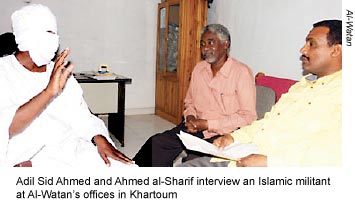
In Sudan, two editors accused of sedition
New York, February 14, 2007—The Committee to Protect Journalists is deeply concerned by the recent detention of two Sudanese editors and the temporary closure of their newspaper after they interviewed religious militants last week. At around midnight on February 7, a Sudanese security officer visited the home of Adil Sid Ahmed, deputy editor-in-chief of the…
In Tunisia, police arrest TV journalist
New York, February 8, 2007—The Committee to Protect Journalists is troubled by the overnight arrest of an opposition television station director by Tunisian police in the capital Tunis. Tahar Ben Hassine, director of Italy-based satellite channel Al-Hiwar Tunisi, was detained by Tunisian police in the Al-Manar neighborhood after leaving Tunisian dissident journalist Taoufik Ben Brik’s…
2006 prison census: 134 journalists jailed
ALGERIA: 2 Djamel Eddine Fahassi, Alger Chaîne III IMPRISONED: May 6, 1995 Fahassi, a reporter for the state-run radio station Alger Chaîne III and a contributor to several Algerian newspapers, including the now-banned weekly of the Islamic Salvation Front, Al-Forqane, was abducted near his home in the al-Harrache suburb of the capital, Algiers, by four…
Attacks on the Press in 2006: Preface
By Anderson CooperSilence. When a journalist is killed, more often than not, there is silence. In Russia, someone followed Anna Politkovskaya home and quietly shot her to death in her apartment building. The killer muffled the sound of the gun with a silencer. Her murder made headlines around the world in October, but from the…
Attacks on the Press in 2006: Introduction
By Joel SimonAs Venezuelan elections approached in November, President Hugo Chávez accused news broadcasters of engaging in a “psychological war to divide, weaken, and destroy the nation.” Their broadcast licenses, he said, could be pulled–no idle threat in a country where a vague 2004 media law allows the government to shut down stations for work…
Attacks on the Press 2006: Countries That Have Jailed Journalists
ALGERIA: 2 Djamel Eddine Fahassi, Alger Chaîne III IMPRISONED: May 6, 1995 Fahassi, a reporter for the state-run radio station Alger Chaîne III and a contributor to several Algerian newspapers, including the now-banned weekly of the Islamic Salvation Front, Al-Forqane, was abducted near his home in the al-Harrache suburb of the capital, Algiers, by four…
Attacks on the Press 2006: Asia Analysis
Afghan-Pakistani border off-limits to most journalists By Bob Dietz The Afghanistan-Pakistan border is a critical front in the most challenging news story in the world: the confrontation between U.S.-led Western countries and militant Islamists. Yet access to the border region has become increasingly restricted, and the Pakistani government continues to do everything in its power…
Attacks on the Press 2006: Middle East Analysis
As democracy falters, Arab press still pushes for freedom By Joel Campagna Across the Middle East, political reform gained momentum in the aftermath of the September 11, 2001, attacks on the United States and the U.S.-led invasion of Iraq in March 2003. Egyptians and Lebanese clamored for democracy; elections in Iraq, Palestine, Yemen, and Saudi…