CPJ testimony focuses on Russian impunity
Nina Ognianova, CPJ’s Europe and Central Asia program coordinator, provided testimony to the U.S. Commission on Security and Cooperation in Europe on the pressing issue of impunity in journalist murders in Russia. The commission held a hearing this week on Russia’s human rights record. A transcript of the testimony follows:
Good discussions in Bonn; murder in Mogadishu
Journalism conferences discussing global trends often inflate the real but intermittent risks faced by foreign correspondents from wealthier nations who travel to and report from less stable regions of the world. They do so at the expense of downplaying if not plain ignoring the much greater risks faced by local journalists who live in such…
The ‘cruel censorship’ of Turkmenistan
Even though Turkmen President Gurbanguly Berdymuhammedov announced two years ago the necessity of universal Internet access, the Web is more than restricted in the country. This is connected to cruel official censorship, the serious limitation of the availability and speed of Internet connections in cities, and its total absence in villages. I haven’t even mentioned…
Corrupt Russian police are a ‘dark force’ against press
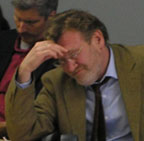
Leonid Nikitinsky has a dry sense of humor. “Unless you are killed in a very interesting way, don’t come and see me,” he told an audience at CPJ’s offices on Thursday. There are, after all, too many murders for him to cover, said Nikitinsky, right, a court reporter for Russia’s Novaya Gazeta.
In Russia, criminal ties to government fuel impunity
In Russia, even official statistics present a depressing picture: Contract-style murders of journalists, more often than not, remain unsolved. Even the rare investigations that result in trials do not answer the main question: Who ordered the killing?
For investigative reporters, many risks and some answers
Reporters who dig up carefully buried facts about those in power can easily find themselves in danger. In countries where a tradition of watchdog journalism has not yet taken hold, the risks of practicing investigative reporting can be real and physical for those reporters that take it on.
Murder pushes Novaya Gazeta to request guns
In a November 2007 interview, just before receiving CPJ’s International Press Freedom Award, Dmitry Muratov, the editor of the embattled Russian newspaper Novaya Gazeta, recalled the loss of three colleagues to work-related murders in six years. “We have suffered war-like casualties,” Muratov said.
Medvedev, endangered sheep, and online controls
Russian President Dmitry Medvedev has tried to create an image apart from his mentor Vladimir Putin. Medvedev claims to support civil liberties, vows to combat corruption, and likes to speak about press freedom. In his first State of the Nation address last fall, Medvedev said the Internet was a guarantor of press freedom in Russia.
Press freedom in the news 12/19/08
Making news today is yesterday’s release of our year-end analysis of the deadliest countries for journalists. The report found that 41 journalists were killed for their work in 2008, with Iraq named the most deadly for the sixth straight year. The Associated Press, Reuters, and Agence France-Presse all ran stories outlining the report’s findings yesterday. Today the story is receiving widespread coverage in both the…