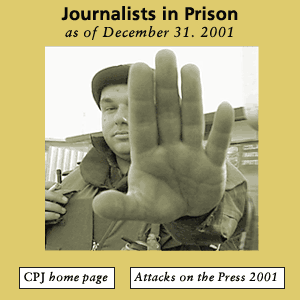
Attacks on the Press 2001: Journalists in Prison
There were 118 journalists in prison around the world at the end of 2001 who were jailed for practicing their profession. The number is up significantly from the previous year, when 81 journalists were in jail, and represents a return to the level of 1998, when 118 were also imprisoned.
Journalist freed
New York, January 17, 2002—Shodi Mardiev, the Uzbek radio reporter who was sentenced in 1998 to an 11-year prison term for defamation and extortion, was released under an amnesty earlier this month, according to local and international sources. The journalist’s lawyer, Khakim Bobonorov, who met with Mardiev shortly after his release, told CPJ in a…
Covering the New War
Read first-hand accounts by journalists covering the war in Afghanistan. • December 21, 2001—The New York Times reported that on December 20, Afghan tribal fighters detained three photojournalists working for U.S. news organizations. The journalists were detained for more than one hour, apparently at the behest of U.S. Special Operations forces in the Tora Bora area….
Independent television station head flees country
Your Excellency: The Committee to Protect Journalists (CPJ), an independent organization of journalists dedicated to the defense of our colleagues around the world, is deeply concerned by the criminal charges of forgery against TV ALC director Shukhrat Babadjanov.
CPJ testifies before U.S. Congress on press freedom conditions in Central Asia
New York, July 19, 2001–A CPJ representative testified before a joint congressional subcommittee yesterday about the terrible state of press freedom in Central Asia. [Read the transcript] “Repression and violence, or the threat thereof, are ever present for many reporters, encouraging self-censorship as a survival mechanism,” CPJ Washington representative Frank Smyth told the joint hearing…
Government harasses relatives of VOA reporter
Your Excellency: The Committee to Protect Journalists (CPJ), a nonpartisan organization of journalists dedicated to the defense of our colleagues around the world, is writing to protest your government’s efforts to silence the U.S.-based Voice of America journalist Jahongir Mamatov by harassing his relatives in the Uzbek city of Samarkand.
Attacks on the Press 2000: Europe & Central Asia Analysis
POLITICAL REFORMS AND ECONOMIC GROWTH, along with the advent of democratic governments in Croatia and Serbia, brightened the security prospects for journalists in Central Europe and the Balkans. In contrast, Russian’s new government imposed press restrictions, and authoritarian regimes entrenched themselves in other countries of the former Soviet Union, particularly in Central Asia, further threatening…