John Emerson
Attacks on the Press 2001: Uruguay
Although Uruguay boasts one of Latin America’s most vibrant and diverse media scenes, journalists say its quality has suffered during a three-year economic recession. Many journalists have lost their jobs, while increased competition with foreign publications, a decline in Uruguayans’ buying power, and a decrease in advertising have exacerbated the crisis.
Attacks on the Press 2001: Uzbekistan
Torture of political and religious dissidents remains commonplace under the brutal regime of President Islam Karimov. In February, writer Emin Usman died in detention, and the July death of imprisoned human rights activist Shovriq Rusimorodov confirmed the deteriorating political situation. Karimov has also cracked down on civil liberties by jailing thousands of Muslims under the…
Attacks on the Press 2001: Venezuela
During 2001, supporters of President Hugo Chávez Frías clashed with the opposition over the government’s political and economic policies, while in December the business sector called for street demonstrations to protest anti-business legislation. Venezuela’s political situation–along with Chávez’s popularity–appeared tenuous at the end of the year.
Attacks on the Press 2001: Vietnam
During 2001, Vietnam forged closer ties with the international community. In July, the country hosted the Association of Southeast Asian Nations conference, and in November, the national assembly signed a long-awaited trade agreement with the United States. Spurred by China’s admission, the Vietnamese government moved ahead with efforts to enter the World Trade Organization. Yet…
Attacks on the Press 2001: Yemen
While Yemen is known for its vocal independent and opposition press, the practice of journalism carries considerable risk. In 2001, the government continued to use criminal prosecutions, censorship, arrests, and intimidation against the press. For years, officials have prosecuted journalists under Yemen’s vaguely worded Press and Publications Law and Penal Code, which prohibits criticizing the…
Attacks on the Press 2001: Yugoslavia
The revolutionary political changes of late 2000 and early 2001 that ousted former Yugoslav President Slobodan Milosevic ended a decade of repression for Yugoslavia’s independent journalists. But after a year in power, the Democratic Opposition of Serbia (DOS), which replaced Milosevic, failed to enact needed reforms in media-related laws. And while the DOS proved far…
Attacks on the Press 2001: Zambia
Incumbent president Frederick Chiluba failed to convince Zambians that he should be allowed to run for an unconstitutional third term in the December 2001 general elections. Political controversies surrounding the elections dominated media headlines in Zambia all year long. Mounting tensions between the ruling Movement for Multiparty Democracy (MMD) and the opposition were mirrored in…
Attacks on the Press 2001: Zimbabwe
President Robert Mugabe was named to CPJ’s list of the ten worst enemies of the press in 2001. See CPJ’s 2001 Enemies list. Backed by his volatile minister of information and publicity, Jonathan Moyo, Mugabe harangued, insulted, threatened, and intimidated journalists throughout the year. Mugabe, his unpopularity growing at home, found himself increasingly isolated on…
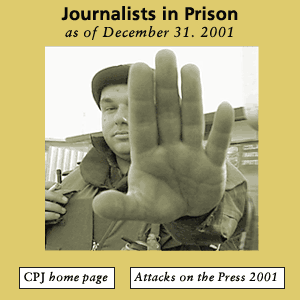
Attacks on the Press 2001: Journalists in Prison
There were 118 journalists in prison around the world at the end of 2001 who were jailed for practicing their profession. The number is up significantly from the previous year, when 81 journalists were in jail, and represents a return to the level of 1998, when 118 were also imprisoned.
Attacks on the Press 2000: Preface
By Peter ArnettSHE STOOD DEFIANTLY IN THE CRAMPED QUARTERS OF ISTANBUL’S BEYOGLU CRIMINAL COURT at high noon of a hot midsummer day. The slight, dark-haired Nadire Mater had a message for the court and for the two dozen Turkish reporters and photographers who had gathered to hear her. “The truth is plain to see. Banning…