Criminals attack press with impunity, CPJ finds
Your Excellency: The Committee to Protect Journalists (CPJ) is greatly alarmed by the frequency and severity of violent attacks against journalists in Bangladesh, and urges your government to take immediate action to ensure that these crimes are prosecuted vigorously.
CPJ Calls for Prosecution of Journalist’s Killers
Your Excellency: The Committee to Protect Journalists (CPJ) is deeply disturbed by the recent murder of Withayut Sangsopit, a radio journalist and commentator who was gunned down on April 10 in the southern city of Surat Thani. While we are pleased that arrests have been made in the case, we trust Your Excellency will urge local prosecutors to pursue charges vigorously against the arrested men.
CPJ alarmed by move to restrict foreign broadcasters
New York, April 19, 2001 — The Committee to Protect Journalists (CPJ) is alarmed by the Singapore Parliament’s passage today of a bill designed to curb foreign broadcasters’ coverage of local issues. The new law, which gives the government broad power to restrict or suspend broadcasters for “engaging in domestic politics,” is expected to take…
Government Threatens to Impose Additional Restrictions on Foreign Correspondents
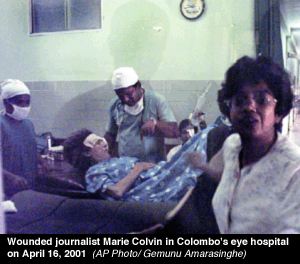
New York, April 17, 2001 —The Committee to Protect Journalists (CPJ) is deeply concerned about the injuries suffered by Marie Colvin, an award-winning American journalist who works for the British newspaper The Sunday Times. Colvin, who was caught yesterday in a skirmish between rebel forces and government troops, received four shrapnel wounds in her head,…
Sri Lanka: Reporter threatened after covering alleged rape of jailed Tamil women
Your Excellency: The Committee to Protect Journalists (CPJ) is deeply concerned about the security of A.S.M. Fasmi, a reporter for the Tamil-language newspaper Thinakkural. Fasmi, who is based on the northern island of Mannar, says he has been detained, interrogated, and threatened repeatedly with death since he reported on the alleged rape of two Tamil women detained by local security forces last month.
Reporter’s murder still unsolved
Your Excellency: The Committee to Protect Journalists (CPJ) requests information about the status of the investigation into the murder of Mylvaganam Nimalarajan, a Jaffna-based journalist who was killed in October 2000. Nimalarajan covered the civil war for various news organizations, including the BBC’s Tamil and Sinhala-language services, the Tamil-language daily Virakesari, and the Sinhala-language weekly Ravaya.
Broadcaster’s murder still unsolved
New York, March 27, 2001 — CPJ is investigating the January murder of Roland Ureta, program director of the radio station dyKR, an affiliate of the Radio Mindanao Network. Ureta was gunned down on the night of January 3, when two motorcycle-riding men waylaid him en route from Kalibo, the capital of Aklan Province, to…