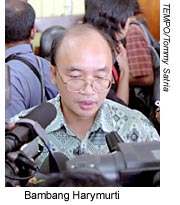
CPJ condemns guilty verdict in libel case
New York, Sept. 16, 2004—The Committee to Protect Journalists deplores today’s guilty verdict and sentencing of Indonesia’s Tempo magazine Chief Editor Bambang Harymurti. The journalist received a one-year prison sentence for publishing an allegedly libelous article in the weekly last year. “Today’s ruling is a disturbing setback for Indonesia’s hard-won press freedoms,” said CPJ Executive…
Jakarta court delays Tempo verdict as international observers crowd courtroom
Jakarta, Sept. 7, 2004—Under intense scrutiny from the international media and press advocates from around the world, a court yesterday delayed its verdict in a criminal defamation case widely seen as a grave threat to press freedom in Indonesia. No official reason was given for delaying a verdict in the trial of Tempo editor Bambang…
CPJ protests criminal defamation charges
Your Excellency: The Committee to Protect Journalists (CPJ) is deeply troubled by the continuing use of Indonesia’s outdated criminal defamation laws to punish journalists who criticize public figures. This disturbing trend is having a chilling effect on local journalists and poses a direct threat to press freedom in Indonesia. We call on you to do everything in your power to uphold Article 28 of Indonesia’s Constitution, which guarantees press freedom, and to fight for the removal of defamation laws from your country’s Criminal Code.
Journalist released from rebel captivity
New York, May 17, 2004—The Committee to Protect Journalists (CPJ) welcomes the release of Fery Santoro, a cameraman for Indonesia’s privately owned Rajawali Citra Televisi (RCTI) television station, on Sunday, May 16. Santoro was taken hostage by the Free Aceh Movement (known by its Indonesian acronym, GAM) in June 2003 along with RCTI senior reporter…
Magazine found guilty of libel
New York, March 18, 2004 —The Central Jakarta District Court today ordered Tempo magazine to publicly apologize and to pay a fine of 500 million rupiah (US$59,000) in a case filed by prominent businessman Tomy Winata. “This verdict, coming on the heels of a criminal defamation suit filed by Tomy Winata, sends a chilling message…
Attacks on the Press 2003: Introduction
By Ann CooperIn real-time images, the war in Iraq splashed across television screens worldwide in March, with thousands of journalists covering the U.S.-led war against Saddam Hussein and his regime. The conflict and its aftermath had a far-reaching impact on the press and its ability to report the news, with the reverberations felt in some…
Attacks on the Press 2003: Asia Analysis
Across Asia, press freedom conditions varied radically in 2003, from authoritarian regimes with strictly regulated state-controlled media in North Korea and Laos, to democratic nations with outspoken and diverse journalism in India and Taiwan. Members of the media throughout the region struggled against excessive government interference, outdated press laws, violent attacks, and imprisonment for their…