China: CPJ calls for release of journalist Li Yuanlong
New York, February 27, 2006—The Committee to Protect Journalists called on China today to release Li Yuanlong, a reporter with the daily Bijie Ribao, who was charged with “inciting subversion of state authority” for articles he posted online. Li was charged on February 9 but news of the indictment has only recently emerged. “Chinese authorities…
CPJ alarmed by attacks on Chinese journalists in U.S.
New York, February 23, 2006—The Committee to Protect Journalists is alarmed by attacks and threats against ethnic Chinese journalists based in or near the U.S. cities of Atlanta, San Francisco, and New York. Journalists for the Falun Gong-affiliated newspaper and Web site Epoch Times told CPJ that they believe they have been targeted in retaliation…
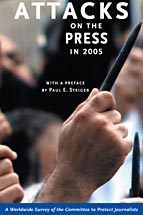
Attacks on the Press 2005: CPJ Releases Attacks on the Press in Four Cities
New York, February 14, 2006–Highlighting the global nature of its press freedom advocacy work, the Committee to Protect Journalists today released its annual press freedom survey Attacks on the Press in four cities: Bangkok, Cairo, London and Washington, D.C.
China: Weekly supplement to reopen without key editors
New York, February 16, 2006— The Committee to Protect Journalists is troubled by an official decision to remove two prominent editors as a condition to allow the reopening of the China Youth Daily weekly supplement Bing Dian (Freezing Point). Editors Li Datong and Lu Yuegang told international reporters that Bing Dian, which was shuttered in…
Attacks on the Press in 2005: Headlines
January 11: A killing in Colombia reinforces self-censorship — Gunmen kill radio news host Julio Hernando Palacios Sánchez as he drives to work in Cúcuta. Attacked from all sides, the Colombian press censors itself to an extraordinary degree, CPJ later reports. Probing journalists are killed, detained, or forced to flee. Verified news is suppressed, and…
Attacks on the Press 2005: Countries That Have Jailed Journalists (Follow Links for More Details)
AFGHANISTAN: 1 Ali Mohaqqiq Nasab, Haqooq-i-Zan (Women’s Rights) Imprisoned: October 1, 2005 The attorney general ordered editor Nasab’s arrest on blasphemy charges after the religious adviser to President Hamid Karzai, Mohaiuddin Baluch, filed a complaint about his magazine. “I took the two magazines and spoke to the Supreme Court chief, who wrote to the attorney…
Attacks on the Press 2005: China
CHINA President Hu Jintao consolidated his leadership in March during a legislative session that formalized the transition of power from Jiang Zemin. Hu’s administration distinguished itself by its hard-line stance against dissidents, intellectuals, and activists, intensifying a far-reaching and severe crackdown on the media. Central authorities arrested and prosecuted journalists under broad national security legislation,…