Latin American press faces violence, legal harassment
Violence and legal harassment: the two greatest obstacles to press freedom in Latin America today. That’s the message that CPJ Executive Director Joel Simon is delivering this morning in Washington, D.C., at a briefing hosted by Congressman Sam Farr. Farr, a California Democrat, hosts a monthly series looking at emerging trends in the Western Hemisphere.…
In Venezuela, a media landscape transformed
In more than a decade in power, President Hugo Chávez Frías has overseen the transformation of nearly every aspect of Venezuelan society, including the media. When Chávez came to office in 1999, he enjoyed the support of the country’s established private media. But the relationship soon soured, and in April 2002 he was briefly deposed…
Venezuela’s private media wither under Chávez assault
The Chávez administration has used an array of legislation, threats, and regulatory measures to gradually break down Venezuela’s independent press while building up a state media empire—a complete reversal of the previous landscape. One result: Vital issues are going uncovered in an election year. A CPJ special report by Monica Campbell
State media focus on opposition, critics; stifle debate
Many state media in Latin American are used for political propaganda, but the Venezuelan government has built an unprecedented media empire that it uses to attack critics and independent journalists and obscure issues like crime and inflation. By Carlos Lauría
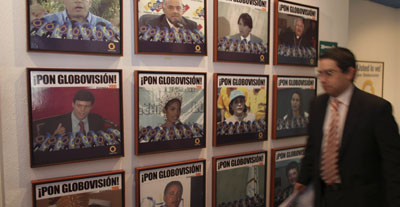
Globovisión besieged by investigations, fines, violence
The recent regulatory probe into coverage at Globovisión, the only TV broadcaster critical of the Chávez administration, is the latest in a long string of investigations and other harassment. The network is struggling to stay afloat. By Monica Campbell
Audio: Venezuela’s private media wither
Since President Hugo Chávez Frías took office more than a decade ago, legislation, threats, and regulatory measures have withered Venezuela’s independent press even as the state has built a huge media empire. Carlos Lauría, CPJ’s Americas Senior Program Coordinator, talks about the developments in this podcast. Listen on the player above, or right click here…
Venezuelan court ruling limits coverage of water quality
New York, March 26, 2012–The decision by a Venezuelan court to forbid the press from reporting on issues of water contamination without using a government-approved report is a clear attempt by authorities to censor critical information, the Committee to Protect Journalists said today.
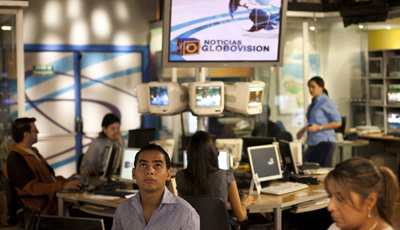
Globovisión journalists attacked in Venezuela
New York, March 6, 2012–The Committee to Protect Journalists condemns Sunday’s attack in Venezuela on Globovisión journalists covering an opposition political rally that came under gunfire. The station reported that assailants, who wore the red shirts associated with supporters of President Hugo Chávez, threatened the journalists and stole their equipment.
Attacks on the Press in 2011: State Media As Anti-Media Tool
In some Latin American countries, state-owned media are used not only for propaganda but as platforms to smear critics, including journalists. Some elected leaders have even invested in large multimedia holdings to further their agendas. By Carlos Lauría