Nine more journalists detained, bringing total to 19
New York, March 20, 2003— In the second day of a sweeping crackdown on the political opposition and the independent press in Cuba, police arrested nine more independent journalists last night, bringing the total detained to 19. The nine journalists—Manuel Vázquez Portal, Héctor Maseda, Oscar Espinosa Chepe, Adolfo Fernández Saínz, Mario Enrique Mayo, Fabio Prieto…
Ten journalists detained
New York, March 19, 2003— In a harsh crackdown on the political opposition and independent media, Cuban authorities have arrested at least 10 independent journalists and 20 political activists throughout the country. The government has vowed to prosecute the detainees but has not yet specified under what charges. The arrests, which began on Tuesday, March…
Argentine professor detained for interviewing independent journalists
New York, February 14, 2003—Cuban authorities detained Argentine journalism professor Fernando Ruiz Parra, who was researching a book about Cuba’s independent journalism movement, on February 11 and held him incommunicado. He was released on February 12 and was deported the following day. Ruiz Parra, who arrived in Cuba on February 3 on a tourist visa,…
Independent press under siege
New York, August 7, 2002—In a fresh series of actions against Cuba’s independent press corps, Cuban state security agents have harassed, detained, and threatened several independent journalists during the last 10 days. Journalist detainedÁngel Pablo Polanco, 60, director of the independent news agency Noticuba, was detained on July 30. According to Polanco’s wife, at around…
CPJ awardee granted asylum in the United States
New York, March 29, 2002—Cuban independent journalist and CPJ International Press Freedom awardee Jesús Joel Díaz Hernández has left Cuba for the United States, where he has been granted political asylum. Díaz Hernández arrived in the United States on March 21 and has settled in Fort Worth, Texas. Díaz Hernández, formerly the executive director of…
Periodista galardonado por el CPJ recibe asilo en los Estados Unidos
Nueva York, 29 de marzo de 2002 — Jesús Joel Díaz Hernández, periodista independiente cubano que recibió el Premio Internacional a la Libertad de Prensa, galardón que otorga el Comité para la Protección de los Periodistas (CPJ, por sus siglas en inglés), abandonó Cuba con destino a los Estados Unidos, donde ha recibido asilo político.…
Attacks on the Press 2001: Introduction
IN THE WAKE of September 11, 2001, journalists around the world faced a press freedom crisis that was truly global in scope. In the first days and weeks after the terrorist attacks on New York City and Washington, D.C., governments across the globe–in China, Benin, the Palestinian Authority Territories, and the United States–took actions to…
Attacks on the Press 2001: Americas Analysis
AGAINST A BACKDROP OF TROUBLED ECONOMIES AND DEMOCRACIES, the Americas saw an increase in violent and verbal attacks against journalists during 2001. The number of journalists murdered in the region has grown, with 11 killed for their work in 2001, compared to seven in 2000 and six in 1999. The violence is also occurring in…
Attacks on the Press 2001: Cuba
During 2001, Cuban authorities continued to wield an assortment of repressive tools to silence independent journalism: harassment and intimidation; prison terms and threats of prosecution; detention; disruption of phone communications; and restrictions on the freedom of movement, among others. In May 2001, for the seventh straight year, CPJ named President Fidel Castro Ruz to its…
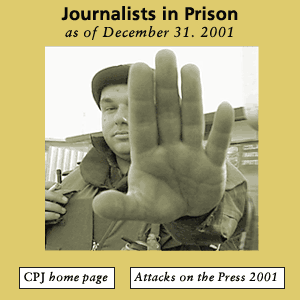
Attacks on the Press 2001: Journalists in Prison
There were 118 journalists in prison around the world at the end of 2001 who were jailed for practicing their profession. The number is up significantly from the previous year, when 81 journalists were in jail, and represents a return to the level of 1998, when 118 were also imprisoned.