Attacks on the Press 1999: Enemies of the Press
Each year on World Press Freedom Day (May 3), CPJ announces its list of the ten worst enemies of the press. Those who made the list this year, as in the past, earned the dubious distinction by exhibiting particular zeal in the ruthless suppression of press freedom. They were singled out for their unrelenting and…
Attacks on the Press 1999: 1999 Death Toll: Listed by Country
[Click here for full list of documented cases] At its most fundamental level, the job of a journalist is to bear witness. In 1999, journalists in Sierra Leone witnessed rebels’ atrocities against civilians in the streets of Freetown. In the Balkans, journalists watched ethnic Albanians fleeing the deadly menace of Serbian police and paramilitaries. In…
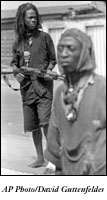
Attacks on the Press 1999: The Trauma of Sierra Leone
Introduction On January 6, 1999, rebel forces entered Freetown and launched a campaign of terror. Revolutionary United Front (RUF) fighters systematically murdered, mutilated, and raped thousands of civilians. During the three weeks that it took for Nigerian-led West African peacekeeping troops to expel the rebels from Freetown, Sierra Leone officially became the most dangerous country…
Attacks on the Press 1999: Burkina Faso
President Blaise Compaoré seized power in 1987 before seeking legitimacy through the ballot box in 1991 and again in 1998. But his regime still draws much of its authority from the army, especially from the infamous Presidential Guard Regiment (RSP), which local independent journalists blamed for several extrajudicial killings last year. It remains dangerous to…
Attacks on the Press 1999: Ivory Coast (Côte D’ivoire)
“Press freedom will be total,” promised Gen. Robert Gueï, Côte d’Ivoire’s new head of state. General Gueï, 58, who overthrew the government of President Henri Konan Bedie on Christmas Eve, made this announcement just hours after his nine-man junta imposed a dusk-to-dawn curfew in this west African country, historically noted for its political stability. However,…
Attacks on the Press 1999: Liberia
The Liberian press has been given to self-censorship ever since Charles Taylor and his National People’s Party won a landslide victory in the July 1997 elections that officially ended the war that Taylor himself started on Christmas Eve 1989. Although local media have criticized the Taylor government on social-service and devel-opment issues, they have generally…
Attacks on the Press 1999: Malawi
In April, President Bakili Muluzi declared that his party, the United Democratic Front (UDF), believed in “the tenets of constitutional democracy,” including press freedom. The political reality has failed to live up to this rhetoric. After the June 15 general elections gave Muluzi a second five-year term in office, the opposition contended that the elections…
Attacks on the Press 1999: Mozambique
Mozambique has changed radically from the days of official censorship and state media control. Since the end of the 17-year civil war between the Mozambique Liberation Front (FRELIMO) government and the Mozambique National Resistance (RENAMO) rebel movement in 1992 and the subsequent multiparty elections in 1994, the country has made considerable strides toward democracy–not least…
Attacks on the Press 1999: Namibia
Namibia’s reputation as a role model for press freedom in southern Africa, thanks largely to its liberal constitution, took another beating in 1999, as both domestic and foreign conflict had negative repercussions on local media. In January, Prime Minister Hage Geingob admitted in a letter to the independent daily Namibian that the Ministry of Defense…
Attacks on the Press 1999: Niger
Niger’s journalists won praise from international observers for maintaining objectivity in a volatile political environment. Following the April 9 assassination of strongman Ibrahim Bare Mainassara by soldiers under the command of Maj. Daouda Mallam Wanke, local independent media joined forces with nongovernmental organizations, political parties, and international bodies to urge an immediate return to democratic…