Third journalist from leading newspaper arrested
New York, April 12, 2006—A third journalist from The Independent, a leading Gambian newspaper, was arrested at his home this afternoon, according to his colleagues. Reporter Lamin Fatty’s arrest follows that of Editor Musa Saidykhan and General Manager Madi Ceesay, who have been detained without charge since March 28. Fatty was the author of a…
CPJ delivers message to Gambian ambassador on detained journalists
New York, April 6, 2006—The Committee to Protect Journalists today expressed grave concerns about the prolonged, unexplained detention of two Gambian journalists in a letter to that country’s ambassador to the United Nations, Crispin Grey-Johnson. CPJ representatives hand delivered the message to the Gambian mission to the United Nations, and urged Grey-Johnson to convey the…
Government blocks reporting on hunger
New York, April 5, 2006—The Committee to Protect Journalists is alarmed by Niger’s attempt to censor coverage of hunger and malnutrition in parts of the West African state. The government withdrew accreditation last week from a BBC television crew after it reported on hunger in the central region of Maradi and has forbidden officials to…
Journalists still held, raising alarm
Your Excellency: The Committee to Protect Journalists is alarmed by the detention since early Tuesday of two senior journalists for the private newspaper The Independent, whose offices were also sealed off by security forces. Editor Musa Saidykhan and General Manager Madi Ceesay, who is also secretary-general of the Gambia Press Union, have now been in custody for more than three days without being informed of the reasons, according to CPJ sources. Gambian law normally requires that they be brought before a court within a three-day period, a local lawyer confirmed.
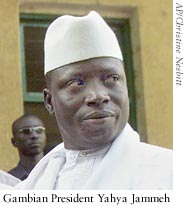
Gambian journalists, still held, say reason for detention unclear
New York, March 30, 2006—The Committee to Protect Journalists is deeply troubled by the detention since early Tuesday of two senior journalists for The Independent private newspaper, whose offices were sealed off by security forces. Police allowed Editor Musa Saidykhan and General Manager Madi Ceesay, who is also secretary-general of the Gambia Press Union, to…
Gambian security forces seal off leading newspaper, arrest staff
New York, March 28, 2006—Plainclothes Gambian security agents today sealed the offices of the twice-weekly newspaper The Independent and arrested staffers found on the premises, local journalists told the Committee to Protect Journalists. Most of the staff members were released after brief questioning, but Editor Musa Saidykhan and General Manager Madi Ceesay remained in custody…
Director of independent weekly detained
MARCH 25, 2006 Posted April 19, 2006 Aboubacar Mchangama, L’Archipel IMPRISONED, LEGAL ACTION Mchangama, director of the independent weekly L’Archipel, was detained by paramilitary police, or gendarmes, for two days in the capital, Moroni, over an article detailing discontent among army officers. He was charged with “divulging military secrets,” according to the Panapress news agency.
Court drops charges against five Voice of America journalists
New York, March 22, 2006—An Ethiopian court today granted a state prosecutor’s request to drop charges of treason against five Voice of America journalists and another radio journalist being tried in absentia. “We welcome the dropping of these ridiculous charges against VOA staff,” said Ann Cooper, Executive Director of the Committee to Protect Journalists. “But…
Sports editor assaulted
MARCH 10, 2006 Posted March 21, 2006 Peter Nimely Toby, The Analyst ATTACKED, THREATENED Armed and masked men assaulted and threatened Toby, sports editor for the independent newspaper The Analyst in the capital, Monrovia, the newspaper reported. The men jumped out of a black jeep, beat Toby with guns, and threatened him with death.
Two journalists arrested, charged for “false news”
MARCH 11, 2006 Posted March 21, 2006 Matongo Maumbi, Radio Chikuni Jyde Hamoonga, Radio Chikuni HARASSED, LEGAL ACTION Maumbi and Hamoonga, two journalists working for Radio Chikuni, a community station in the southern district of Monze, were arrested and charged with publishing “false news with intent to cause fear and alarm to the public.” The…