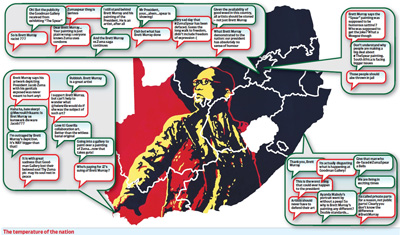
South Africans clash on Twitter over #Zumaspear
South African journalist and arts critic Charl Blignaut made what turned out to be an excellent prediction. “Of all the work on show, it’s this depiction of the president that will set the most tongues wagging and most likely generate some howls of disapproval,” he wrote on May 13 in a review of an art…
Computer crime laws belie Thai claim to modern society
At online discussion sites all over the world, comments are posted on the Web as soon as they are written. People argue, inform, express anger, and voice fears. Some say things in the heat of the moment that they might go on to regret. Others are elliptical and obscure. The enabling of such conversations is…
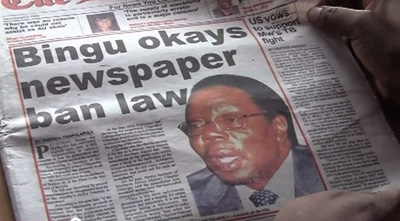
CPJ welcomes Malawi’s repeal of news censorship law
Nairobi, May 31, 2012–The Committee to Protect Journalists welcomes Wednesday’s vote in the Malawi parliament that repealed a sweeping amendment to the country’s penal code which had allowed the government to ban any news “not in the public interest.”
Free expression in Americas goes beyond left or right
On Sunday the general assembly of the Organization of American States will convene in Bolivia in the verdant, highland valley city of Cochabamba. The 35 member states (every nation in the region except Cuba) are expected to vote on a measure that, if passed, could curtail free expression and press throughout the hemisphere and put…
Ethiopian police detain VOA reporter, interpreter
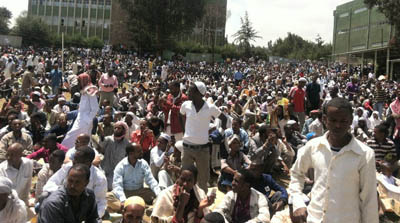
Nairobi, May 25, 2012–Police in Ethiopia today detained Peter Heinlein, a correspondent for the U.S. government-funded broadcaster Voice of America, along with Simegnish Yekoye, a freelance reporter and Heinlein’s interpreter, according to Jennifer Janin, the Africa coverage editor for VOA, and local journalists.
Liberia university suspends student journalist over article
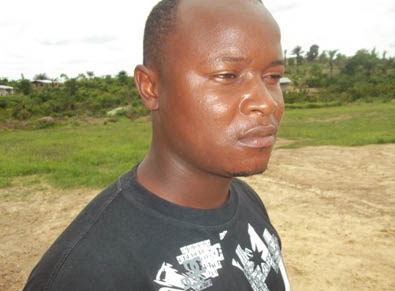
A private university in Liberia has suspended a journalist studying there for publishing a newspaper story critical of the institution’s management. On May 8, private Cuttington University in Suacoco in central Liberia suspended Selma Lomax, a reporter with independent newspaper FrontPage Africa and a third-year student in agriculture at the institution, for four months over an April 26…
Solidarity, a key to security, eludes Salvadoran press
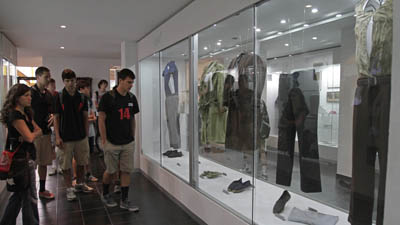
No other journalists are remembered quite like this. Visitors looking through the glass display at the Monsignor Romero Center & Martyrs Museum in San Salvador see the pajamas and other clothes that three Jesuit university priests were wearing when they were shot down by automatic rifle fire. A series of clear containers are filled with…

At CPJ Debrief, Gettleman cites Somalia danger, reward
Jeffrey Gettleman, the Pulitzer Prize-winning New York Times correspondent, says he travels with “a small militia” whenever he reports from Somalia, the East African country afflicted by armed insurgency, poverty, and hunger. As intrusive as the security detail might be, he feels far more fortunate than the local reporters who face sustained and often deadly…
In Somalia, journalist killed in Mogadishu
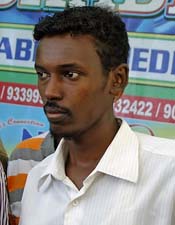
Nairobi, May 24, 2012–Assailants in Mogadishu today gunned down the host of a critical radio program, further punctuating what has already been a deadly year for the Somali press corps and for the journalist’s employer, the Shabelle Media Network. Four unidentified men fired repeatedly at Ahmed Addow Anshur at around 1:45 this afternoon while he was…