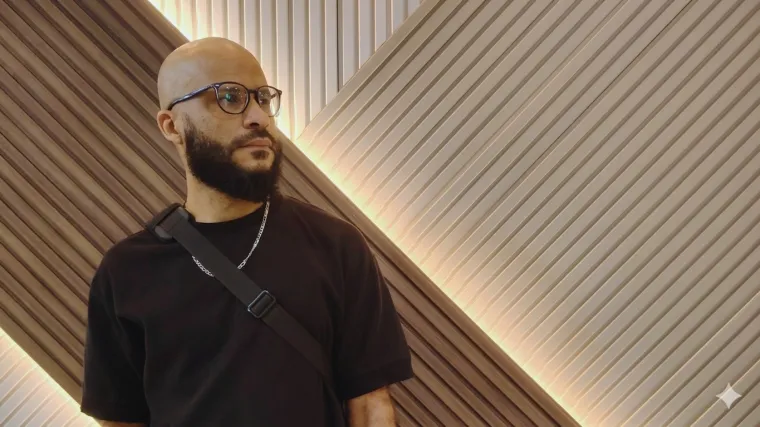
After nearly a year in prison, Venezuelan journalist Rory Branker is finally free. But he has yet to liberate himself from what legal experts and press freedom groups describe as trumped-up criminal charges that are hanging over his head.
After the U.S. military ousted Venezuelan President Nicolás Maduro in January, Branker was one of more than two dozen journalists to be released from prison after being jailed by Maduro’s repressive authoritarian regime for their critical coverage. Meanwhile, Venezuela’s new government, led by interim President Delcy Rodríguez, also approved an amnesty law, authorizing judges to erase a broad range of criminal charges filed against former political prisoners over the past 26 years.
However, Branker, the chief content officer for the independent news site La Patilla, said that when he went to court to ask for amnesty, his petition was denied. As a result, he still faces charges of terrorism, treason, conspiracy to commit crimes, and inciting hatred. If convicted he could be sent back to prison for decades.
“I think the Venezuelan government has not yet finished messing with me,” Branker, 47, told CPJ in a May 1 interview.
Yet Branker isn’t the only formerly jailed journalist to get out of prison and remain entangled in legal red tape. While most received amnesty or were tried and found not guilty, Venezuela’s National Union of Press Workers (SNTP) says eight of the 28 journalists released from prison following post-Maduro still face criminal charges.
“The amnesty law has produced concrete progress, but its application has been inconsistent,” the press workers union said in a statement last month. “The law must be fully applied in a timely manner without restrictive interpretations to guarantee that criminal cases against journalists are closed.”
Even though journalists have more space to report the news in post-Maduro Venezuela, the arbitrary application of the amnesty law is just one sign that press freedom remains under threat. Self-censorship is pervasive and many Venezuelan journalists who fled the country over the past decade remain in exile. According to the SNTP and NGO Safe and Free Connection, the websites of at least 65 media outlets are still being blocked by the government inside Venezuela.
Many pro-Maduro hardliners have remained in the new government, including Interior Minister Diosdado Cabello, who in 2015 sued La Patilla for defamation.
What’s more, the judicial branch continues to answer to the president and journalists seeking amnesty must often petition the same judges that charged them with bogus crimes in the first place. So far this year, 29 journalists have been detained by security forces, though they were quickly released, according to the Venezuela free expression group Public Space.
Branker, who has returned to work at La Patilla, recently spoke with CPJ about his convoluted legal case.
After working for La Patilla for 15 years, why were you suddenly detained and jailed last year?
La Patilla is one of the most-read news sites in Venezuela. But we were always critical of the government. We published stories about the contradictions between what the government said and what it actually did. We covered its ties to groups like Al Qaeda and Hezbollah and its links to drug cartels. Because of that, the site was blocked. Even today, you can only read La Patilla in Venezuela if you have a VPN (virtual private network) because the new government has refused to lift the block.
After Maduro stole the 2024 election, there was a massive government crackdown on dissent, and many journalists faced a very high risk of being arrested. I think the government targeted me to put pressure on La Patilla, intimidate our reporters and try to force its shutdown. Thank God, that didn’t happen. I was kidnapped on February 20, 2025, and held incognito for seven months. I was the only journalist who was forcibly disappeared for such a long period of time.
How were you treated in prison?
At first, I was put in isolation cells and tortured. The guards put a hood over my head to suffocate me and try to get information about my colleagues. But I didn’t tell them anything and they had no evidence, so they didn’t know what to do with me. I was transferred to five different prisons. At one point they told me that if I ever was freed, I would have to leave the country.
Do you know why you were released after Maduro was captured?
I was released because Trump did what he did and Maduro is no longer running the country. Trump also spoke about the problem of political prisoners. The Rodríguez government is releasing prisoners and promoting amnesty against its will. They are not happy that they now have to behave like human beings because of the U.S. pressure. I was the last imprisoned journalist to be released, which happened on February 4, 2026. But remember, there are still about 500 political prisoners behind bars.
What happened when you applied for amnesty?
Venezuela now has special terrorism courts because under Maduro they enacted many new laws on corruption, terrorism and organized crime. At a preliminary hearing while I was in prison, the judge in my case decided that I would have to stand trial for terrorism, treason, conspiracy and inciting hatred. Once I was released and requested amnesty, a different judge, citing the ruling of the previous judge, decided that my case should go to trial and rejected my petition for amnesty. My lawyer says there is no legal basis for this decision under the terms of the amnesty law, so we are appealing. Meanwhile, I can’t leave the country and have to report to judicial authorities every week.
Why do you think other journalists received amnesty, but you did not?
The decision in my case was personal. I think the government is trying to punish me, [La Patilla cofounder and editor-in-chief] Alberto Ravell, and La Patilla. It may be coming from Interior Minister Diosdado Cabello who sued La Patilla for defamation. They are still not satisfied with all they have done to me. But I am not worried. I have been to hell and back and have survived much worse things. Despite these problems, I am living a normal life in Caracas and have gone back to work for La Patilla.