Tunisia
2010
Protecting yourself from denial-of-service attacks
It’s my second link to a report by Hal Roberts (and others at the Berkman Center) in as many days, but I worry that this this detailed document on denial-of-service (DOS) and hacking attacks on independent media and human rights groups might get missed in the holiday season. The news headlines in the last few…
Analysing Tunisia’s Net censorship
Obviously all of these assumptions are mere speculations. This is an effort on our part to try to better understand one of the most secretive system of repression in Tunisia and to help demystify its processes. And obviously, we invite anyone with further information to make them public, and a fortiori, it may be that…
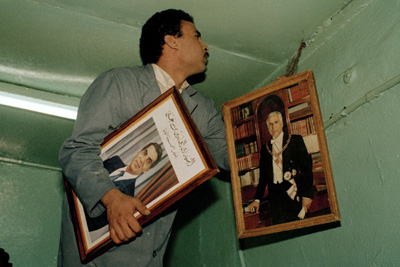

Boukadous’ wife describes bribe attempt before arrest
Tunisian police arrested Fahem Boukadous, a widely respected critical journalist, on July 15. Before his arrest, Boukadous wrote an open letter from the hospital, where he was being treated for acute asthma. On the evening he was taken to Gafsa prison, his wife, Afaf Bennacer, wrote an article about what happened that has been circulated on multiple…
An appeal from ailing Tunisian journalist Boukadous
You are all no doubt aware of what I went through this past week. Indeed, though I suffered an acute asthmatic attack that necessitated sending me to the Farhat Hached Teaching Hospital in Sousse from July 3, the Gafsa Court of Appeals insisted on sentencing me to a four-year prison term. It took no notice…
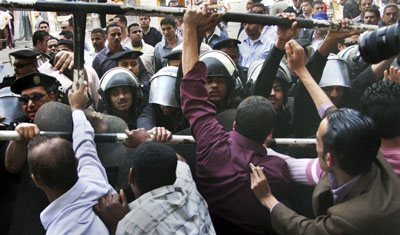
In Egypt, a deplorable press freedom climate
Judging by what’s transpired in recent weeks, press freedom in Egypt is in a deplorable state. To hear that Egyptian police abused and illegally detained peaceful protestors who took to the streets on April 6 is par for the course. To read that police and plainclothes thugs also beat and detained journalists, confiscating and destroying…
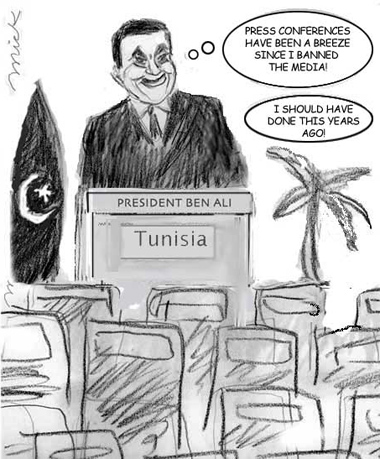
A perfect press conference in Tunisia
The government of President Zine El Abidine Ben Ali has made it clear there is little room for a critical press in Tunisia. Taking a cue from the government’s recent anti-press actions, CPJ cartoonist Mick Stern imagines the president’s “ideal” press conference. See more Mick Stern cartoons.
Tunisian airport officials confiscate CPJ publications
On Saturday, Tunis airport customs officials confiscated two copies of CPJ’s annual report, Attacks on the Press, as well as five copies of the Arabic-language translation of the Middle East and North Africa section of the book from Tunisian rights lawyer Mohamed Abbou and journalist Lotfi Hidouri on their return from Morocco, the two men told CPJ.
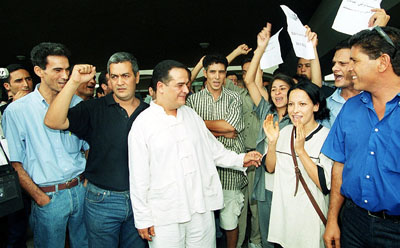
Ben Brik, still jailed in Tunisia: ‘Chains will certainly break!’
“When people want to live, destiny must surely respond. Darknesss will disappear, chains will certainly break!”Journalist Taoufik Ben Brik, 49, spurred admiration among his relatives and lawyers at a Tunis appeals court on Saturday when he chanted these two verses by Abou El Kacem Chebbi, Tunisia’s most well-known poet. This unexpected recitation of Chebbi’s verses,…