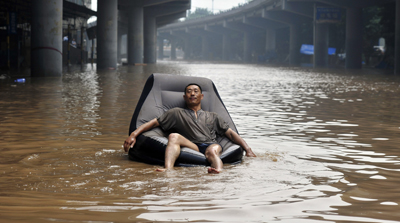
Propaganda officials miss the boat on ‘China’s Katrina’
Chinese journalists are questioning government propaganda due to conflicting reports of the death toll following Saturday’s devastating flooding in Beijing. Like the Wenzhou train crash and the Sichuan earthquake, the tragedy has galvanized mainstream and online journalists–and the official narrative is crumbling under their scrutiny.

Where is Meles Zenawi? Ethiopians don’t know.
If you search for the name of Ethiopia’s prime minister, Meles Zenawi, on Twitter these days, you’ll see a flurry of incongruent postings: Meles is hospitalized in critical condition; he’s fine and returning to work; he died two weeks ago; he’s on holiday. Journalists for international news outlets have tried to sort out fact from…
Defense tools for Sri Lanka’s online onslaught
Sanjana Hattotuwa, the founder of the citizen journalism website Groundviews, sent us the links to a new series of posters and videos focused on digital communications security. The material, which is aimed at a Sri Lankan audience, is available in English, Sinhala, and Tamil, but is relevant to anyone who uses the Internet or a…
News site blocked after covering Tajik official’s murder
New York, July 24, 2012–Authorities in Tajikistan blocked domestic access to the independent regional news website Asia-Plus on Monday after the outlet reported on the murder of a high-ranking security official and its aftermath, according to news reports. The Committee to Protect Journalists calls on the government to immediately restore access to the site.
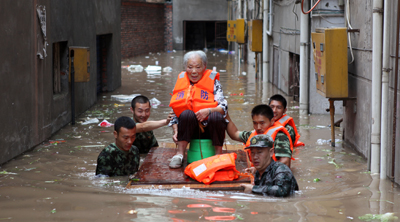
A year after Wenzhou, China still censoring disaster stories
New York, July 24, 2012–A year after drawing public ire for censoring coverage of a high-speed train crash, Chinese authorities should allow journalists to freely cover the aftermath of Saturday’s deadly flooding in and around the capital, the Committee to Protect Journalists said today. International news accounts said 37 people died in Beijing and up…

Ecuador must allow closed stations to resume broadcasts
Dear Mr. Jaramillo: The Committee to Protect Journalists is deeply concerned by the closure of at least 11 Ecuadoran broadcasters since May. Our review of the closures, detailed in an attached list, found that in some instances government regulators did not follow the due process guarantees specified by law. CPJ’s review also found that more than half of the stations that were closed had been critical of the government. While the government has the right to regulate the airwaves, it also has an obligation to do so in a transparent and unbiased manner.