Attacks on the Press 2001: Indonesia
Another year of political turmoil saw the Indonesian press clinging to its hard-won freedoms. But President Megawati Sukarnoputri, who took over from the quixotic Abdurrahman Wahid in July, is showing worrying signs of being less friendly toward the press than her predecessor. One of Megawati’s first acts in office was to appoint a state minister…
Attacks on the Press 2001: Mali
Although Mali’s press laws include punitive presumption-of-guilt standards, the media environment is reasonably liberal compared with many other African countries. Mali also has a strikingly diverse press corps, with about 40 private newspapers, some in French and others in vernacular languages, and about 100 radio stations, one fifth of them unlicensed.
Attacks on the Press 2001: Pakistan
Working as a journalist in Pakistan has long been a tricky business, and the threats only intensified after September 11, when the military government repudiated the Taliban regime in Afghanistan and then Islamist militant groups at home in order to align itself with the United States in a global “war on terror.”
Attacks on the Press 2001: Russia
A decade after the demise of the Soviet Union, Russia still struggled to define the limits of free expression. Nowhere was the struggle more intense than in the media. President Vladimir Putin’s administration was either directly involved in or held responsible for a broad range of abuses, including the selective use of tax audits, prosecutions,…
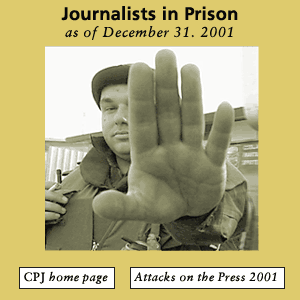
Attacks on the Press 2001: Journalists in Prison
There were 118 journalists in prison around the world at the end of 2001 who were jailed for practicing their profession. The number is up significantly from the previous year, when 81 journalists were in jail, and represents a return to the level of 1998, when 118 were also imprisoned.
CPJ urges kidnappers to release Daniel Pearl
New York, January 28, 2002—CPJ is deeply concerned about Wall Street Journal reporter Daniel Pearl, who has been missing in Pakistan since January 23. A previously unknown group stated in an e-mail to news organizations that they had abducted Pearl and accused him of working for the U.S. Central Intelligence Agency. “Daniel Pearl is a…

ONE YEAR LATER, NO PROGRESS ON MISSING CAMERAMAN INVESTIGATION IN BELARUS
New York, July 6, 2001 On the one-year anniversary of cameraman Dmitry Zavadsky’s disappearance in Minsk, CPJ deplores the fact that Belarusian authorities have made little or no progress investigating the case, despite credible leads that have emerged over the past year. “The absence of concrete progress leads us to suspect that Belarusian authorities…
Authorities brutalize provincial reporter who exposed prosecutorial misconduct
Your Excellency: The Committee to Protect Journalists (CPJ), an independent organization dedicated to the defense of press freedom around the world, protests the violent persecution of provincial journalist Olga Kitova by officials in the southern city of Belgorod.
2000 prison census: 81 journalists jailed
EIGHTY-ONE JOURNALISTS WERE IN PRISON AROUND THE WORLD at the end of 2000, jailed for practicing their profession. The number is down slightly from the previous year, when 87 were in jail, and represents a significant decline from 1998, when 118 journalists were imprisoned. While jailing journalists can be an effective means of stifling bad…