Attacks on the Press 2001: Tunisia
Throughout his 15 years in power, President Zine al-Abidine Ben Ali has sought to stifle all dissent while portraying Tunisia as a progressive and democratic nation. Sadly, he has had considerable success. Members of the U.S. Congress, for example, continued to heap praise on Ben Ali while ignoring his dismal human rights and press freedom…
Attacks on the Press 2001: Turkey
In an effort to improve its chances to join the European Union, the Turkish Parliament in October approved more than 30 amendments to the country’s restrictive constitution, which was passed in 1982 after a military coup two years before. Lawmakers are currently considering a proposal that would bring some of the nation’s repressive laws used…
Attacks on the Press 2001: United Arab Emirates
The United Arab Emirates, in particular the emirate of Dubai, has transformed itself into a center for media and new information technology. In 2001, the emirate launched Dubai Media City to serve as a regional news hub for international media organizations, along with a separate Internet City. Dubai also began providing government services online. Citizens…
Attacks on the Press 2001: United States
Since its founding in 1981, CPJ has, as a matter of strategy and policy, concentrated on press freedom violations and attacks against journalists outside the United States. Within the country, a vital press freedom community marshals its resources and expertise to defend journalists’ rights. CPJ aims to focus its efforts on those nations where journalists…
Attacks on the Press 2001: Yemen
While Yemen is known for its vocal independent and opposition press, the practice of journalism carries considerable risk. In 2001, the government continued to use criminal prosecutions, censorship, arrests, and intimidation against the press. For years, officials have prosecuted journalists under Yemen’s vaguely worded Press and Publications Law and Penal Code, which prohibits criticizing the…
Two journalists receive six-month prison sentences
New York, March 26, 2002—The Committee to Protect Journalists (CPJ) condemns the prison sentences imposed last week on two journalists from the weekly independent newspaper Sawt Al-Umma. On March 21, the Abdeen Misdemeanor Court convicted Adel Hammouda, editor, and Essam Fahmy, head of the paper’s board of directors, of defaming prominent Egyptian businessman Naguib Sawiris…
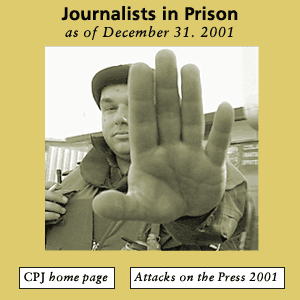
Attacks on the Press 2001: Journalists in Prison
There were 118 journalists in prison around the world at the end of 2001 who were jailed for practicing their profession. The number is up significantly from the previous year, when 81 journalists were in jail, and represents a return to the level of 1998, when 118 were also imprisoned.
PRESS CRACKDOWN CONTINUES
New York, March 20, 2002—The Committee to Protect Journalists (CPJ) is alarmed by increasing state restrictions on the press in Jordan, including the detention of some journalists and the harassment of others by security agents. On March 17, a State Security Court prosecutor imposed a 15-day detention on Hashem Khalidi, editor of the weekly newspaper…
CPJ Urges Israel to Investigate Shooting Death of Journalist, Other Attacks
New York, March 18, 2002—The Committee to Protect Journalists (CPJ) today called on Israel to provide a full accounting of a series of incidents in which a journalist was killed and several others were shot at during the Israel Defense Forces’ (IDF) large-scale military operation in the West Bank and Gaza Strip last week. “The…
Government tries to censor TV coverage of pro-Palestinian protests
Your Majesty: The Committee to Protect Journalists (CPJ) is deeply concerned about several recent government attempts to stifle television news coverage of pro-Palestinian rallies in Jordan. On March 5, the state-run Jordan TV (JTV) barred Reuters TV, Associated Press Television News (APTN), and Al-Jazeera from using its facilities to relay footage of pro-Palestinian students demonstrating at Jordan University.