In Azerbaijan, reporter for opposition paper is abducted, beaten
New York, March 7, 2006–Three unidentified men abducted a reporter for the Azerbaijani opposition newspaper Azadlyg on Sunday night, beating him, breaking some of his fingers, and slashing him, according to local and international press reports. The attack on Fikret Huseynli (Huseinli) was likely related to his work, Azadlyg Editor-in-Chief Ganimat Zahidov told reporters at…
Filmmakers held in separatist region of Abkhazia
New York, March 7, 2006—Authorities in the breakaway Georgian region of Abkhazia today charged three journalists with entering the self-declared republic illegally to shoot a documentary film, local and international media reported. Journalists Tea Sharia, Georgii Sokhadze and Teimuraza Eliava were arrested March 1 in Abkhazia, a region along the Black Sea in the northwest…
Belarusian police seize paper’s election edition
New York, March 6, 2006—The Committee to Protect Journalists today condemned escalating media repression in Belarus ahead of March 19 presidential elections. Iosef Serdiyevich, editor-in-chief of the opposition newspaper Narodnaya Volya, announced at a press conference today that police officers had confiscated 250,000 copies of a special election edition of the newspaper, according to local…
Editor imprisoned for criminal libel, insult
New York, March 2, 2006—A judge in the Azerbaijani capital, Baku, has convicted Boyuk Millat Editor-in-Chief Samir Adygozalov of criminal libel and insult and sentenced him to one year in prison, according to local press reports. Adygozalov was immediately taken into custody after the verdict was read in Nizami District Court on February 23. The…
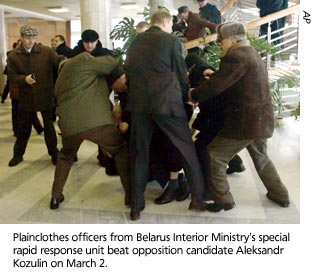
Police beat journalists covering police assault of opposition candidate
New York, March 2, 2006—Police today turned on journalists in Belarus trying to cover an attack by plainclothes police officers on an opposition candidate in March 19 presidential elections. The Committee to Protect Journalists condemned the assault. Aleksandr Kozulin, one of three candidates challenging president Aleksandr Lukashenko, was beaten and detained by police in the…
A year after editor’s murder in Baku, case appears to grow cold
New York, March 1, 2006—One year after the founder and editor of the opposition weekly Monitor was slain in the entrance of his apartment building in Baku, Azerbaijan, no suspects are in custody and many colleagues and relatives believe the government’s investigation is on the wrong track. The Committee to Protect Journalists called today for…

Computer, phone taken, bloody print left in Moscow slaying
New York, February 28, 2006—A laptop computer and cell phone were stolen from the Moscow apartment of slain NTV correspondent Ilya Zimin, and a bloody fingerprint belonging to someone other than the victim was found on a light switch, local news outlets reported today. Authorities continued to say that the weekend killing was probably not…
Uzbek reporter freed after serving term for ‘insulting’ officer
New York, February 28, 2006—Nosir Zokirov, a correspondent for the Uzbek service of the U.S. government-funded Radio Free Europe/Radio Liberty (RFE/RL), was released from prison on Sunday after serving a six-month sentence for insulting a security officer, the broadcaster reported. Zokirov, 55, a veteran RFE/RL correspondent in the eastern city of Namangan, was detained, tried…
NTV reporter found murdered in Moscow apartment
New York, February 27, 2006—The Committee to Protect Journalists today called for a thorough investigation into the killing of Ilya Zimin, a 33-year-old correspondent for the national television station NTV, who was found murdered in his Moscow apartment. Several of Zimin’s colleagues from NTV—which is owned by the state oil giant Gazprom—went to his apartment…
Investigative reporter assaulted
FEBRUARY 23, 2006 Posted: June 16, 2006 Vladimir Voronov, Novoye Vremya ATTACKED Voronov, an investigative reporter for the Moscow weeklies Novoye Vremya and Ezhenedelny Zhurnal, was attacked near his Moscow home in the early hours by two unidentified assailants who escaped, according Russian press reports.