Border guards deny Romanian journalists entry to Moldova
New York, April 8, 2009–The Committee to Protect Journalists called on Moldovan authorities today to allow Romanian journalists to enter Moldova and report on anti-communist rallies that have swept Moldova’s capital, Chisinau, since Monday. Approximately 10,000 protesters took to the streets on Tuesday to protest Sunday’s parliamentary election, which was won by President Vladimir Voronin’s…
Azerbaijani court orders editor jailed on defamation charge
New York, April 8, 2009–A district court in Baku has sentenced Asif Marzili, editor-in-chief of the independent weekly Tezadlar, to one year in prison on charges of defaming managers and professors of Azerbaijan International University, the Azeri Press Agency reported. Ruling on Tuesday, the court also handed down a six-month suspended corrective labor sentence to…
Corrupt Russian police are a ‘dark force’ against press
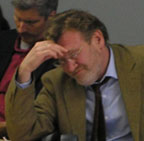
Leonid Nikitinsky has a dry sense of humor. “Unless you are killed in a very interesting way, don’t come and see me,” he told an audience at CPJ’s offices on Thursday. There are, after all, too many murders for him to cover, said Nikitinsky, right, a court reporter for Russia’s Novaya Gazeta.
Russia must investigate intimidation
We issued the following statement after press reports that the independent newspaper Novaya Gazeta received a package containing severed donkey ears at its Moscow offices on Tuesday. The package came with a sign “from the administration of the president of the Russian Federation,” the business daily Kommersant reported…
Russian newspaper founder arrested, criminally charged
New York, April 1, 2009–Police in the western city of Kaliningrad should drop trumped-up bribery charges against Arseny Makhlov, the founder of the independent weekly Dvornik, and allow him to work without fear of harassment, the Committee to Protect Journalists said today.
As newspaper designer dies, conflicting accounts emerge
New York, April 1, 2009–Police in the Moscow suburb of Khimki must conduct a thorough investigation into the sudden death of newspaper designer Sergei Protazanov, the circumstances of which are in dispute, the Committee to Protect Journalists said today.
Nazarbayev urged to curb politically motivated lawsuits
Dear President Nazarbayev: CPJ would like to draw your attention to your government’s selective and politically motivated use of civil libel lawsuits against critical journalists and their publications. In a trend that fosters self-censorship, intolerant public officials target critical news outlets with defamation lawsuits that result in crippling damages.
In Russia, criminal ties to government fuel impunity
In Russia, even official statistics present a depressing picture: Contract-style murders of journalists, more often than not, remain unsolved. Even the rare investigations that result in trials do not answer the main question: Who ordered the killing?
Getting Away With Murder 2009
CPJ’s Impunity Index spotlights countrieswhere journalists are slain and killers go free New York, March 23, 2009 — The already murderous conditions for the press in Sri Lanka and Pakistan deteriorated further in the past year, the Committee to Protect Journalists has found in its newly updated Impunity Index, a list of countries where journalists…
Another Russian journalist beaten in Moscow Region
New York, March 20, 2009–Russian authorities should thoroughly investigate the March 12 beating of Maksim Zolotarev, an editor at the independent newspaper Molva Yuzhnoye Podmoskovye in the town of Serpukhov, Moscow Region, the Committee to Protect Journalists said today.