Attacks on the Press 2003: Thailand
For the last two years, Thailand’s powerful and freewheeling media have been reeling from the effects of a popular and savvy prime minister who seems intent on using his absolute majority in Parliament to control the press. The process has been as subtle as it has been painful, with journalists saying that most pressure is…
Attacks on the Press 2003: Tonga
Tonga’s small media sector suffered a major assault in 2003 from the monarchy of King Taufa’ahau Tupou IV. One of the country’s few independent news outlets, Taimi ‘o Tonga (Times of Tonga), was banned for much of the year, and in October the government passed an amendment that weakens constitutional guarantees of free speech.
Attacks on the Press 2003: United States
The U.S. media went to war in 2003, with both embedded and independent reporters pouring into Iraq to cover the U.S.-led invasion and its aftermath. U.S. officials called the invasion the best-covered conflict in history, but it was also one of the most deadly for journalists. All told, 19 reporters died while working in Iraq,…
Attacks on the Press 2003: Vietnam
The already dire situation for Vietnamese journalists deteriorated in 2003, with attacks increasing against reporters covering crime and corruption. Those who used the Internet to distribute independent news and opinion faced harsh prison sentences and increasing surveillance. The traditional media remained under the tight regulation of government censors.
Attacks on the Press in 2003: Journalists in Prison
There were 138 journalists in prison around the world at the end of 2003 who were jailed for practicing their profession. The number is the same as last year. An analysis of the reasons behind this is contained in the introduction on page 10. At the beginning of 2004, CPJ sent letters of inquiry to…
HONG KONG JOURNALISTS QUESTIONED AND EXPELLED
New York, March 10, 2004—Authorities in Beijing interrogated three reporters from the Hong Kong-based Apple Daily newspaper yesterday and then deported them to Hong Kong, according to a spokesman for the paper. Apple Daily is the second-largest Chinese-language newspaper in Hong Kong. Early on the morning of March 9, security officials arrived at the journalists’…
CPJ URGES GOVERNMENT TO END CYCLE OF VIOLENCE AGAINST JOURNALISTS
Dhaka, March 5, 2004—The Committee to Protect Journalists (CPJ) today called upon the government of Bangladesh to vigorously investigate and prosecute all those who murder, assault, or threaten the country’s journalists, in order to end a long cycle of violence against the media and enable journalists to do their jobs safely. During a press conference…
JOURNALISTS ATTACKED
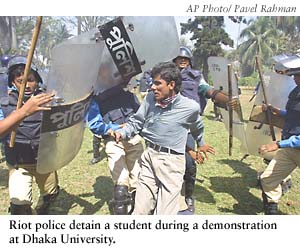
Dhaka, March 3, 2004—The Committee to Protect Journalists (CPJ) condemns yesterday’s violent attacks on at least two journalists covering a student demonstration at Dhaka University. The March 2 demonstration turned violent after police broke up a group of students, who had gathered to protest the February 27 knife attack on Dhaka University professor and writer…
TELEVISION STATION OFFICES ATTACKED
New York, March 3, 2004—The Committee to Protect Journalists (CPJ) condemns yesterday’s attack on the offices of Geo television in Quetta, the capital of southwestern Pakistan’s Balochistan Province. On March 2, about 20 rioters broke into the offices of the private Geo television station and set fire to administrative records, newspapers, and other materials, according…