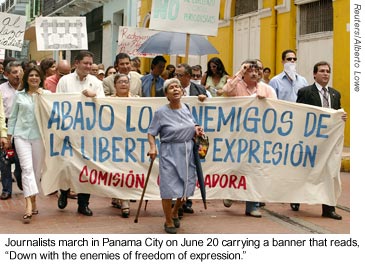
CPJ alarmed by plan to double jail time for defamation
New York, June 23, 2006—The Committee to Protect Journalists is alarmed by a proposal sent to Panama’s President Martín Torrijos to stiffen penalties for defamation, including a doubling of prison terms. A commission of lawyers and academics, which was set up by Torrijos to examine penal code reform, made the proposals in a draft bill…
Attacks on the Press 2005: Panama
PANAMA Panama took steps to improve press freedom, lifting broad deterrents against criticism of public officials and repealing laws that gave authorities vast censorship powers. The National Assembly approved a bill with wide-ranging reforms in May, and it was signed by President Martín Torrijos two months later. Panamanian journalists said the changes were encouraging given…
Attacks on the Press 2004: Panama
Panama Despite legislative steps toward repealing desacato (disrespect) laws in 2004, Panama’s press is among the most legally constricted in Latin America. The country’s “gag laws,” which include a range of statutes criminalizing criticism of public officials, were enacted under military rule in the 1960s. Some of these laws have been repealed, but Panamanian authorities…
CPJ urges repeal of desacato laws, welcomes initial step
Dear Mr. Salas: The Committee to Protect Journalists (CPJ), a New York-based nonprofit organization that works to safeguard press freedom worldwide, welcomes the Legislative Assembly’s initial approval of constitutional reforms that repeal the constitutional basis for desacato (disrespect) laws. We urge Panamanian legislators to ratify these reforms.
Journalist forced to submit to questioning in criminal defamation case
New York, March 24, 2004—Roberto Eisenmann Jr., founder of the Panama City-based daily La Prensa, was forced today to submit to questioning about a criminal defamation suit filed against him in January. This morning, at around 10:30 a.m., officers from the Technical Judicial Police came to Eisenmann’s offices in Panama’s capital, Panama City, and took…
Journalist forced to submit to questioning in criminal defamation case
New York, March 24, 2003—Roberto Eisenmann Jr., founder of the Panama Citybased daily La Prensa, was forced today to submit to questioning about a criminal defamation suit filed against him in January. This morning, at around 10:30 a.m., officers from the Technical Judicial Police came to Eisenmann’s offices in Panama’s capital, Panama City, and took…
Attacks on the Press 2003: Americas Analysis
While violence and repression against the press continued unabated and even increased in some countries, public trust in journalists and the press suffered in much of the Americas, jeopardizing support for reforms of archaic press laws and opening the door for governments to take a more confrontational approach with the media.
Attacks on the Press 2003: Panama
Panama is known for its institutionalized system of legal harassment against the press. Journalists there confront antiquated media laws that impose prison terms for defamation, criminalize criticism of public officials, and permit prior censorship. In July, Eduardo Bertoni, the Inter-American Commission on Human Rights’ special rapporteur for freedom of expression, visited Panama and recommended that…