
As US-Cuba relations thaw, what’s next for the island’s independent press?
“Our hope is that President Obama will meet journalists working for the alternative media, not just to cover his visit, but to start a dialogue,” said Elaine Díaz Rodríguez, director of Periodismo de Barrio (Neighborhood Journalism) a website focusing on climate change and the impact of natural disasters on local communities. Díaz, who last year…
CPJ Newsletter: A year in review
Over the past year, CPJ has documented anti-press violations all over the world, cases of journalists killed, imprisoned, abducted, or threatened in relation to their work. You can see all of our coverage at our website, www.cpj.org. But here at CPJ Impact we also highlight those times when CPJ has stepped in and advocated for…
Inter-American Human Rights System, campaigns against defamation laws keep journalists from jail in Americas
When a prison guard told Ángel Santiesteban Prats that he would be released from jail on a scorching summer day in July, the Cuban independent writer and blogger decided to ignore him, brushing off the news as a cruel joke. By then, Santiesteban had already spent two years and five months in prison, half of…
News from the Committee to Protect Journalists, April 2015
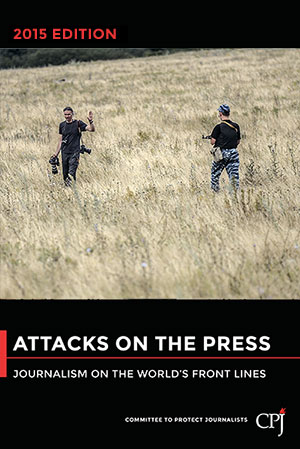
CPJ launches annual publication Attacks on the Press At a U.N. press conference on April 27 to launch CPJ’s annual publication Attacks on the Press, CPJ Executive Director Joel Simon called on the U.N. Security Council to include in its May 27 debate on Journalist Safety a warning to states that they should not use…
Journalists overcome obstacles through crowdfunding and determination
During South Africa’s Boer War, at the turn of the 20th century, a determined news organization relocated reporters, copy editors, and printing presses to the front line to ensure accurate reporting. In the Warsaw Ghetto, during World War II, a literal underground press, established to counter Nazi propaganda, required the nightly movement of cumbersome printing…
10 Most Censored Countries
10 Most Censored Countries 1. Eritrea 2. North Korea 3. Saudi Arabia 4. Ethiopia 5. Azerbaijan 6. Vietnam 7. Iran 8. China 9. Myanmar 10. Cuba Methodology » See updated list of 10 Most Censored Countries at https://cpj.org/reports/2019/09/10-most-censored-eritrea-north-korea-turkmenistan-journalist.php. The 2015 list of 10 Most Censored Countries is part of CPJ’s annual publication, Attacks on the…

In Cuba, case for harassing press has collapsed
Throughout the years, the Cuban government has justified the imprisonment of independent journalists on charges that they were acting against the State’s sovereignty at the behest of the United States. During the so-called Black Spring in March 2003, when the government then led by President Fidel Castro launched a massive crackdown against dissidents while the…
China is world’s worst jailer of the press; global tally second worst on record
More than 200 journalists are imprisoned for their work for the third consecutive year, reflecting a global surge in authoritarianism. China is the world’s worst jailer of journalists in 2014. A CPJ special report by Shazdeh Omari

Cuban blogger Yoani Sánchez launches independent news site
Late last October, as I accompanied Cuban blogger Yoani Sánchez in a cab ride from LaGuardia Airport to her hotel in Manhattan, we talked nonstop about what had changed in Cuba during 2013 and about her plans for 2014. Two things she told me then were particularly striking.