Zimbabwe: Government grows more hostile to independent press as election nears
Your Excellency: A delegation from the Committee to Protect Journalists (CPJ) visited Harare from July 11 to 14 to assess press freedom conditions in Zimbabwe during the run-up to the general elections, scheduled for next spring. The delegation, which consisted of board member Clarence Page, deputy director Joel Simon, and Africa program coordinator Yves Sorokobi, met with journalists from the independent press and held informal discussions with members of the state media. They also spoke at length with Zimbabwean human rights activists and foreign correspondents based in the country.

ZIMBABWEAN GOVERNMENT GROWS MORE HOSTILE TO INDEPENDENT PRESS AS ELECTION NEARS
New York, August 16, 2001—The Committee to Protect Journalists today sent a letter to Zimbabwean president Robert Mugabe chronicling a host of press freedom violations. The letter called on Mugabe to take specific steps to “eliminate all obstacles inhibiting the work of the press so that [upcoming] elections can take place in an environment in…
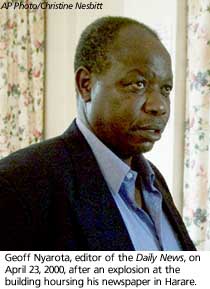
POPULAR EDITOR AND THREE COLLEAGUES ARRESTED
New York, August 15, 2001—Police arrested Daily News editor Geoff Nyarota at 12:15 a.m. this morning at his home in Harare, according to international news reports confirmed by CPJ sources in Zimbabwe. Police later detained Daily News reporter Sam Munyavi, editor John Gambanga, and Gambanga’s assistant, Bill Saidi. All four journalists remain in police custody…
Taylor government takes control of all national broadcasting
Your Excellency: The Committee to Protect Journalists is gravely concerned about your government’s refusal to lift the ban on nationwide shortwave broadcasts by Radio Veritas. On July 2, Minister of Post and Telecommunications Emma Wuor informed Radio Veritas that it was no longer allowed to broadcast on shortwave radio, leaving KISS FM and Radio Liberia International–both of which you own as part of your Liberia Communications Network–as the only stations that can air political news countrywide. Currently, Radio Veritas broadcasts on an FM frequency that only covers the capital, Monrovia.
Chiluba government cracks down on press as elections near
Your Excellency: The Committee to Protect Journalists (CPJ) is deeply disturbed by a recent string of press freedom abuses in Zambia, and by your government’s increased monitoring of state-funded media. Given the hostile climate that local journalists now face, we have little confidence that they will be able to work effectively during the run-up to general elections scheduled for later this year.
Journalist abducted by security forces, many others still missing
The fate of a dozen journalists remains unclear. New York, August 6—The Committee to Protect Journalists is gravely concerned about the safety of Mattewos Habteab, editor-in-chief of the private Tigrigna-language MeQaleh newspaper, who sources believe is being forced to perform military work in retaliation for his critical journalism.
South Africa considering invasive interception and monitoring bill
New York, August 3—The Committee to Protect Journalists (CPJ) is deeply troubled by South Africa’s proposed Interception and Monitoring Bill, which empowers the police, the National Defense Force, the Intelligence Agency, and the Secret Service to “establish, equip, operate and maintain monitoring centers.” If adopted, the legislation would allow the government to monitor electronic and…
CPJ delegation visits Harare to support local press
Harare, July 26, 2001–For more than two years, since the January 1999 arrest and torture of two journalists from the Harare weekly The Standard, the press in Zimbabwe has operated under a virtual state of siege. In April 2000, the offices of the Daily News were bombed. In January 2001, a commando team blew up…
Joseph Lelyveld: Awardee 2001
Burton Benjamin Memorial Award During nearly four decades at The New York Times, JOSEPH LELYVELDhelped define the highest principles of American journalism. Lelyveld began at The Times as a copy boy in 1962. His distinguished reporting included years as a foreign correspondent in London, New Delhi, Hong Kong, and Johannesburg. His 1985 book, Move Your…