Hungary’s new government has taken promising first steps to restore press freedom after years of state capture under former prime minister Viktor Orbán, but authorities must now move beyond quick fixes to deliver transparent, durable reforms that ensure the media is protected from any and all political interference.
After his Tisza party won a landslide victory in April elections, Péter Magyar’s government pledged to restore democratic norms, the rule of law, and media freedom following Orbán’s creation of one of the most sophisticated systems of media capture ever seen in the European Union.
“Hungary has a historic opportunity not only to repair the damage of the past 16 years, but to build a pluralistic media system that serves the public and cannot be politically captured again. If Péter Magyar’s government succeeds, it could make Hungary a role model for other countries in Europe and beyond seeking to restore freedom of the press. But if the reforms do not go deep enough, or one party’s control is simply replaced by another’s, the opportunity will be squandered,” said Attila Mong, CPJ’s Europe representative.
Magyar’s team have already taken steps to dismantle some of the Orbán-era measures that targeted journalists and placed public service media under political control, addressing several of CPJ’s pre-election recommendations.
The new government must now move beyond symbolic steps and institutional quick fixes to deliver durable reforms that align with European Union standards to permanently protect media from all political interference. This process must be transparent and inclusive, with participation from journalists, professional organizations, and civil society.
“Hungary is moving in the right direction but it is too early to declare victory. The government must deliver reforms that are effective, comprehensive and legally sound to create rules and institutions strong enough to protect the press from any and every future government,” said Mong.
What has changed so far
Since winning the April vote and taking office on May 12, Magyar’s government has begun to address some of the 10 recommendations CPJ set out before the election:
- April – May: Opening the press environment.
At his first international press conference on April 13, Magyar allowed an independent Hungarian journalist to ask the first question. After he was sworn in on May 9, the prime minister apologized to journalists and others targeted under Orbán and later that month parliament eased restrictions on journalists’ access to the parliament building. Under the Orbán government, independent journalists were selectively denied accreditation, restricted from reporting in parliament and other public institutions, and in some cases were removed by police or officials when they tried to question politicians at public events. This new openness must now be embedded in law so that it becomes consistent across institutions and not left to political discretion.
- June: Public media and regulatory overhaul.
On June 23, parliament adopted a media law that ended the mandates of the previous state media and regulatory leadership. This dissolved the centralized former structure of state media, which served as the Orbán government’s propaganda machine, smearing opposition and civil society activists. The law was enacted quickly, but without meaningful prior public consultation. The government has since launched a consultation with journalists and press freedom groups, and this should shape the next stage of a more comprehensive media reform package and appointments planned for later this year.
- June 30 – Sovereignty Protection Office (SPO) abolished.
The abolition of the SPO, which had been used to harass and delegitimize independent media by labeling them threats to national sovereignty, directly addresses a central CPJ recommendation. A Russia-style “foreign agent” bill – which would have expanded the SPO’s powers – was shelved by the Orbán government in June 2025 amid domestic and international pressure and automatically lapsed when the new parliament took office. It should be permanently abandoned, with the government rejecting any similar proposal in the future.
- July 1 – Media regulator leadership changed.
The government removed András Koltay as president of the National Media and Infocommunications Authority and the Media Council after Magyar accused him of helping sustain the previous government’s propaganda system. Removing one powerful Orbán-era appointee is significant but a personnel change alone does not create an independent regulator: the new appointment process and institutional safeguards will be the real test of long-term change.
- July 7 onward – Transition of public service news.
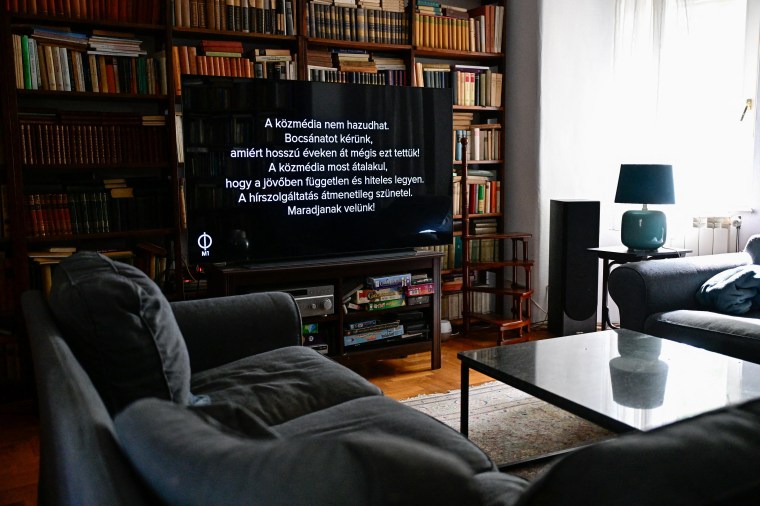
Public service media, which had operated as a mouthpiece for Orbán’s government, suspended news broadcasts in July and apologized to audiences, with some channels displaying the following message: “Public media should not lie. We are sorry for doing it for so long.” News services are being gradually restored under transitional leadership and with new editorial staff. This represents an important break with the past but during the transition, Magyar’s government must guarantee the continuity of news services, and genuine editorial independence for the temporary leadership.
Taken together, these changes show the breadth and speed of the new government’s intervention. Speed can be necessary when institutions have been deeply politicized, but it also creates risks: replacing leaders, suspending broadcasts, and rewriting governance rules do not by themselves guarantee independence. Further reforms will be needed to create a public service media that can function fairly even when those in power dislike the journalism produced.
What must come next
The new government should now publish a clear timetable for future reforms and establish a formal, transparent consultation process involving journalists, professional organizations, independent experts, and civil society at every stage. Appointments to public service media and regulatory bodies should be open, merit-based, and protected from government or party influence, with clear safeguards against interference.
Following the election, CPJ said Hungary’s reforms should fully align with European law and recommendations and it urged EU member states to support this process.
CPJ had previously identified 10 priority issues for the government with regards to press freedom. While there has been progress as described above, a number of issues still need concrete action:
- Authorities should transparently investigate the use of Pegasus spyware against journalists, introduce independent judicial oversight of national security surveillance, and provide redress to those unlawfully targeted.
- They should restore timely and meaningful access to public information, enforce court orders requiring disclosure, and introduce early-dismissal safeguards against abusive lawsuits together with an explicit journalistic exemption under the EU’s General Data Protection Regulation.
- The government should establish transparent and equitable rules for state advertising and media funding. A broader review of media legislation should address ownership transparency and market concentration, and implement the European Media Freedom Act, the Audiovisual Media Services Directive, relevant European Court of Human Rights judgments, and EU whistleblower protections.
- The public media transition must remain lawful and transparent, with news services restored under editorially independent leadership and the new Press Fund, aimed at supporting community and minority media, insulated from political favoritism.
- The government should ensure that reforms to public service media and state advertising strengthen, rather than undermine, independent newsrooms that exposed corruption, held power to account, and sustained public-interest journalism under Orbán. The rebuilt public broadcaster and public-interest news funding system should complement, not distort or displace, Hungary’s pluralistic media market.
Hungary’s new government has acted swiftly and the steps taken so far are welcome but the job is not yet done. Independent journalists must be able to operate freely in Hungary, secure in the knowledge that the system is robust enough to prevent any future government from seizing control of the media to undermine democracy.
Watch our video: CPJ spoke to three Hungarian journalists about their hopes for the future.