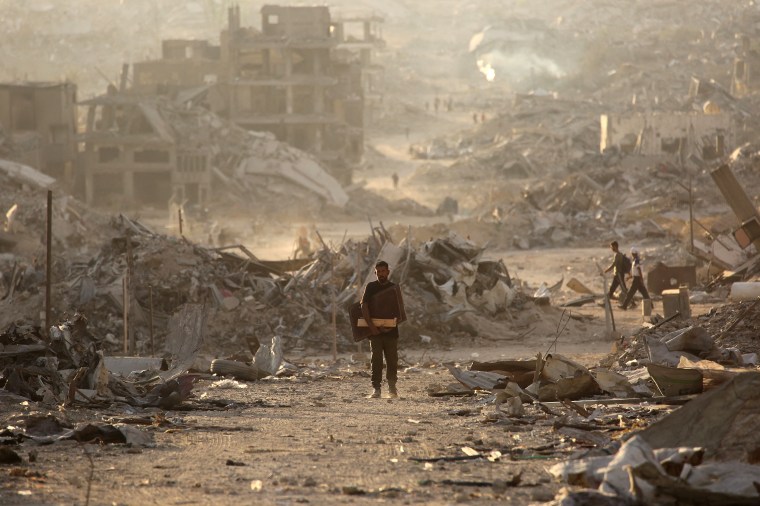
As a fragile ceasefire pushes through a second week, Palestinian journalists in the West Bank and Gaza still face immense risks. Despite a pause in large-scale fighting, attacks, detention and threats to press freedom persist.
While seven journalists were released as part of the ceasefire that began on October 10, the Committee to Protect Journalists has documented the killing of a journalist and a media worker, as well as the injury of another in Gaza. In the West Bank, five journalists were attacked, one arrested, and several harassed. Fourteen foreign journalists and others who had been detained while sailing aboard an aid convoy to Gaza, most of them for four days — were deported in the first days of the ceasefire.
Israel’s ongoing media ban remains in place, barring international reporters from entering Gaza, leaving exhausted local journalists as the only witnesses to report on critical developments — a situation that has raised concerns about transparency and significantly hindered the international community’s ability to independently assess the situation on the ground.
Gaza: 2 killed, 1 injured
- On October 12, journalist Saleh Aljafarawi was killed while covering clashes between Hamas security forces and armed factions in Gaza City’s Al-Sabra neighborhood — the first journalist to die since the October 10 ceasefire.
Authorities said the fighting involved the Doghmush clan and the Al-Shabab militia, which Israel has said it is backing to weaken Hamas’ control. Israel’s withdrawal from parts of Gaza, without the deployment of a stabilization force, has created a power vacuum. Ismail Al-Thawabta, director of Gaza’s Government Media Office, told CPJ that Aljafarawi was “killed by gunfire from one of these gangs.”
Following his death, Israeli media outlets labelled Aljafarawi a “Gazan internet star affiliated with Hamas” a “terrorist,” and “one of the most recognized activists in Hamas propaganda” during the war, without providing evidence. Israeli media have repeatedly made unsubstantiated claims that many journalists deliberately killed in Gaza were militants.
- On October 19, Israel accused Hamas of violating the ceasefire after an anti-tank missile in Rafah killed two soldiers, prompting airstrikes across Gaza that it said targeted “dozens of Hamas sites.” One struck the central Gaza headquarters of Palestine Media Production (PMP), a media production company based in Gaza that provides services to both local and international clients, killing broadcast engineer Ahmed Abu Mutair and injuring PMP camera operator Ismail Jabr.
Shortly after, the IDF provided CPJ with files asserting that Abu Mutair was a member of Hamas’s military wing, the Qassam Brigades, claims CPJ could not independently verify.
The documents list Abu Mutair’s date of birth as March 19, 1991, though several outlets, including ZDF, reported that he was 37. His brother, Dr. Mahmoud Abu Mutair, an international law specialist, told CPJ that Ahmad did not belong to any political or security organization.
After reviewing the document shared by CPJ, he said that while some data appeared accurate—since Palestinian civil registry information is accessible to Israel and online—he believed the document itself was fabricated. He insisted the signature was not Ahmad’s, and noted his blood type was A+ (not O+), and in 2021 the media worker had two children, not the number stated. Footage available online from Ahmed’s funeral shows him covered with his press vest.
However, Al-Hadath TV correspondent Osama Al-Kahlout said conditions in Gaza had improved.
“There is no intimidation, and the security situation now is much better,” he said, noting that most clashes occurred near border areas as security forces pursued groups accused of cooperating with Israel. He added that journalists remained fearful as “there are still attacks targeting civilians in parts of Khan Younis and Gaza City” by Israel.
Wasaf Fares, a correspondent for Lebanon’s Al-Akhbar and Al-Manar TV, said reporters were careful when covering sensitive topics, especially alleged collaboration with Israel, and self-censored to stay safe.
“We avoid personal conflicts and speak in general terms because we can be easily targeted or kidnapped,” he said.
On October 13, seven journalists — Alaa Sarraj, Nidal Elian, Imad Ifranji, Ahmed Abdel Aal, Shadi Abu Sido, Osama Dabour, and Khalil Odeh — were released by Israel as part of the ceasefire deal.
West Bank: 5 attacked, 1 arrested
On October 10, Israeli settlers attacked farmers during the olive harvest in Beita, Nablus governorate, setting vehicles on fire, including that of Agence France-Presse photographer Jaafar Ashtiyeh, who was beaten and hospitalized. Wahaj Bani Mufleh of Quds News Network and Saja Al-Alami of Al-Ghad TV suffered gas inhalation and injuries from stun grenades, and Yazan Hamayel of Al-Fajr TV was beaten.
On October 10, during a media tour organized by the Hurriya (Freedom) Initiative, in the northern village of Al-Mughayyir, an Israeli soldier told the group to leave and made discriminatory comments.
In a video, Israeli activist Doron Meinert, who was leading the tour, explains the group includes Arab journalists from local and international media, but the soldier insists they must leave, saying, “All Arabs here are enemies.” When a journalist asks if he considers all Arabs enemies, the soldier replies, “Yes. After the events of October 7, I saw things that made me reach this position.” Journalist Samir Abdel Hadi confirmed the account to CPJ.
The Israeli army spokesperson told CPJ via messaging app, “The soldier’s statements do not reflect the values of the Israeli army. We are working to verify the soldier’s identity.”
On October 11, 2025, Israeli authorities extended the closure of Qatari-based broadcaster Al Jazeera’s Ramallah office for 60 days, citing “incitement and aiding terrorism,” the seventh time since September 2024.
On October 12, Israel issued or renewed administrative detention orders for 60 Palestinians, including West Bank journalists Mohammed Anwar Muna and Samer Khuwaira, the Commission of Detainees and Ex-Detainees Affairs and the Palestinian Prisoners’ Club said, adding that such detentions under “secret files” had sharply increased since the war began.
On October 13, the Palestinian Authority’s security forces detained freelance journalist Sami al-Sa’i in the West Bank city of Tulkarem for allegedly sharing a post critical of the Authority in a private WhatsApp news group. Al-Sa’i told CPJ the post was shared by mistake and contained accusations against the Authority “without intent.” He was released on bail on October 16.
On October 19, independent US journalist Jasper Nathaniel was chased by Israeli settlers during an attack on a group of Palestinians harvesting olives in Turmus Ayya, a town in the West Bank’s Ramallah and al-Bireh Governorate. Nathaniel told CPJ that he repeatedly shouted, “Press, American, press, American,” while fleeing from the attackers as they chased them, but his calls were ignored. He said the car he was in was hit with rocks, and his rear view mirror smashed in with a club.
Editor’s note: This article has been updated in the seventh paragraph to include information on allegations by the IDF that Ahmed Abu Mutair was a member of Hamas’s military brigade, which CPJ could not independently verify. It has updated the second and seventh paragraphs to reflect that he was a media worker.