Go »
  Go »

Saudi Arabia

2012


Worldwide tally reaches highest point since CPJ began surveys in 1990. Governments use charges of terrorism, other anti-state offenses to silence critical voices. Turkey is the world’s worst jailer. A CPJ special report

At least 49 journalists remain jailed in Turkey. (AFP)

Most censored nations each distort the Net in own way

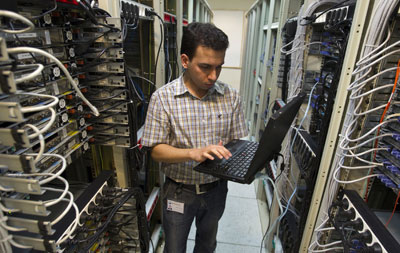
Iran has invested in technology with the explicit intent of restricting
Internet access. (Reuters/Caren Firouz)

One big reason for the Internet's success is its role as a universal standard, interoperable across the world. The data packets that leave your computer in Botswana are the same as those which arrive in Barbados. The same is increasingly true of modern mobile networks. Standards are converging: You can use your phone, access an app, or send a text, wherever you are.

CPJ's new analysis identifies Eritrea, North Korea, Syria, Iran as worst

CPJ Deputy Director Robert Mahoney counts down the 10 countries where the press is most tightly restricted. How do leaders in these nations silence the media? And which country is the worst of all? (4:03)

Read CPJ's report on the 10 Most Censored countries for more detail on how censorship works, and which countries were the runners-up.

New York, March 16, 2012--Three Saudi Web managers whose sites cover political unrest in the country's highly restricted Eastern Province should be released from detention immediately, the Committee to Protect Journalists said today. 

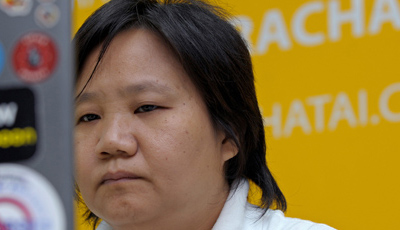
Thai website editor Chiranuch Premchaiporn faces criminal charges. (AFP/Pornchai Kittiwongsakul)

Legislation for Internet security can quickly turn into a weapon against the free press. Cybercrime laws are intended to extend existing penal codes to the online world, but they can easily be broadened to criminalize standard journalistic practices. By Danny O'Brien

Saudi authorities maintained a suffocating atmosphere of censorship as they further tightened the country's highly restrictive media law. In May, a royal decree amended five articles of the law, barring the publication of any material that contravened Sharia law, impinged on state interests, promoted foreign interests, harmed public order or national security, or enabled criminal activity. In January, the Kingdom issued new regulations for online media that included several restrictive and vaguely worded provisions that grant the Ministry of Culture and Information sweeping powers to censor news outlets and sanction journalists. The government withdrew the accreditation of Riyadh-based Reuters correspondent Ulf Laessing in March, apparently angered by his coverage of a pro-reform protest. Reuters stood by the reporting. The same month, amid popular uprisings across the region, authorities banned three critical columnists working for the government-controlled daily Al-Watan. Authorities did not cite a reason, but all three had written about the region's political unrest. In late year, as demonstrations broke out in the kingdom's eastern province, authorities blocked local and international journalists from gaining access to the region. With a few exceptions, the demonstrations went uncovered.

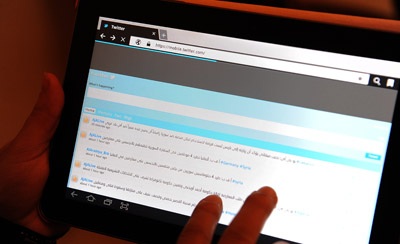
An Internet user checks a Twitter account in Saudi Arabia, where a journalist faces legal action after writing about the Prophet Mohammed on Twitter. (AFP/Fayed Nureldine)

New York, February 13, 2012--Saudi columnist Hamza Kashgari, whose Twitter postings about the Prophet Mohammed have drawn death threats and government reprisals, was deported from Malaysia back to his home country on Sunday, according to news reports

New York, February 9, 2012--The Committee to Protect Journalists condemns death threats and a publishing ban against columnist Hamza Kashgari for comments he posted on Twitter addressing the prophet Mohammed.

« Previous Year: 2011 | Next Year: 2013 »

  Go »
Text Size
A   A   A
Killed in Saudi Arabia

1 journalist killed since 1992

1 journalist murdered

1 murdered with impunity

Attacks on the Press 2012

8th Most censored nation. Coverage of unrest in Eastern Province is blocked.

Country data, analysis »

Contact

Middle East
and North Africa

Program Coordinator:
Sherif Mansour

Research Associate:
Jason Stern

smansour@cpj.org
jstern@cpj.org

Tel: +1 (212) 300-9018,
+1 (212) 300-9017
Fax: 212-465-9568

330 7th Avenue, 11th Floor
New York, NY, 10001 USA

Twitter: @CPJMena

فيسبوك : لجنة حماية الصحفيين بالعربية

Blog: Sherif Mansour
Blog: Jason Stern