Iran
2010
Internet Blotter
Venezuela prepares law to regulate media, including the Internet. Iranian blogger Hossein Derakhshan briefly released from jail on $1.5 million bail… …but fellow Iranian-Canadian anti-censorship software designer Saeed Malekpour still faces death penalty. Syrian telecom minister says awareness of the dangers, not censorship of the Internet is the solution.

With 145 journalists behind bars, what’s in a number?
Today we released our annual census of imprisoned journalists around the world, citing 145 reporters, editors, and photojournalists behind bars on December 1, an increase of nine from 2009 figures. The tally begs the question, What’s in a number?
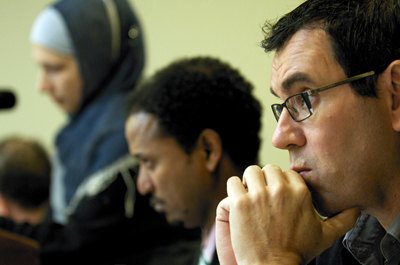
CPJ Press Freedom Awardee: ‘I always wanted answers’
The last few weeks have been extremely busy for everyone at CPJ as we’ve been preparing for the 2010 International Press Freedom Awards. Today’s press conference in Washington will be followed by a series of events culminating in our awards ceremony Tuesday in New York. As always, the awardees make it special.
Internet Blotter
Egyptian blogger Karim Amer is finally free after four years in prison. Iran launches yet another police force to deal with the Internet, headquartered with the Revolutionary Guard. Its commander says the state plans to quadruple its Internet control budget. Google lobbies U.S. policymakers to consider online censorship a free trade issue. Is breaking into…

Press Club honors jailed Iranian Kouhyar Goudarzi
The National Press Club next week will honor an Iranian journalist who is languishing in prison. Kouhyar Goudarzi, an online reporter and human rights activist, was pursuing an aerospace degree at Sharif Industrial University when security agents put him behind bars, according to the International Campaign for Human Rights in Iran. Goudarzi, left, was an…
Internet blotter
CPJ protested the arrest of Bahrain blogger Ali Abdel Imam back in September — The Wall Street Journal has a story on his continuing detainment. Activism around the imprisonment of Canadian-Iranian blogger Hossein Derakhshan continues: PEN Canada is focusing on his case and Canada and France’s foreign ministers have urged his release. Local Thai ISPs are…
Internet Blotter
Omid Memarian gives insight into the Iranian hardliner in-fighting that led to “blogfather” Hossein Derakhshan’s arrest and sentencing.Pakistan blocks Facebook, but doesn’t block militant jihadi sites.What happened when the authorities shut down the Internet in China’s Xinjiang province.”Deleted” Facebook photos can stay available for years (from the excellent Ars Technica, now banned in Iran).Quote of…
Petition highlights Nokia sales to Iran
Access, a global Internet freedom advocacy group, has launched a “No To Nokia” petition as part of a campaign supporting Iranian journalist Issa Saharkiz’s lawsuit against Nokia Siemens. The Saharkiz lawsuit claims that Nokia Siemen’s sales of mobile tracking technology to Iran was instrumental in allowing the Iranian government to locate the journalist when he…
A Golden Pen for Iran’s Zaid-Abadi
The World Association of Newspapers on Wednesday honored the jailed Iranian journalist, Ahmad Zaid-Abadi with its Golden Pen of Freedom Award in the German city of Hamburg. Zaid-Abadi, right, was sentenced in 2009 to six years in prison, five years of internal exile, and a lifetime ban on working as a journalist. He is behind…

Derakhshan case: When keeping quiet does not work
The severity of the nearly 20-year jail sentence handed down to veteran Iranian blogger Hossein Derakhshan, left, has shocked many exiled Iranian journalists and bloggers with whom I’ve spoken. It’s also reinforced their belief that the best way to help jailed colleagues is not through quiet diplomacy but by making a lot of noise.