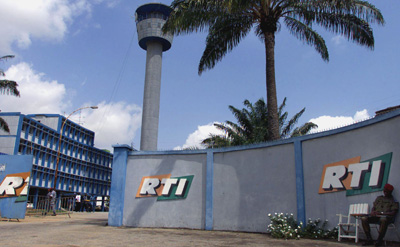
In Ivory Coast, the tense post-election dispute between incumbent President Laurent Gbagbo and rival and self-proclaimed president-elect Alassane Ouattara is a power struggle for control of national institutions–including the sole state media outlet, Radiodiffusion Télévision Ivoirienne (RTI).
Two parallel governments now claim power in Ivory Coast since the disputed results of the November 28 runoff between Ouattara, who proclaimed himself president after the Independent Electoral Commission and international institutions named him the winner, and Gbagbo, who was declared the victor by the Constitutional Council–the supreme Ivorian electoral body. Ivorian security forces, which have remained loyal to Gbagbo, have surrounded Ouattara’s headquarters at the Golf Hotel in Abidjan, the economic capital
In this tense standoff, both sides are vying for control of RTI. From the besieged hotel, Ouattara
In a December 15 press conference, Gbagbo
Cut off from the state media, Ouattara’s self-proclaimed government uses the international media and an improvised radio station to make itself heard. The station, called Radio Côte d’Ivoire, la Voix du Rassemblement, broadcasts political statements, music, and call-in programs 24 hours a day from the Golf Hotel and is also on the Internet at ADOsolutions.ci, Lancine Koné, a reporter with the station, told CPJ. On December 13, RTI broadcast a statement from the National Broadcasting Council–which is loyal to Gbagbo
The United Nations, which recognizes Outtara as president, has also incurred the wrath of Gbagbo
In an interview with CPJ, UNOCI spokesman Hamadoun Touré denied the minister’s accusations. “We give voice to both Gbagbo’s and Ouattara’s sides. Radio ONUCI FM is in journalism and not propaganda,” he said. “It is RTI which is making propaganda that incites to hatred.”
On the other side, Gnonzié denied accusations that RTI was inciting hatred. RTI is a state media outlet that “covered all views and respected the institutions of the republic and the Ivorian constitution,” he said. “If the Constitutional Council recognizes Gbagbo as the elected president of Ivory Coast, it is normal for RTI to support him,” he told CPJ. “If Mr. Allassane Ouattara wishes to speak as an opponent, we could give him voice, but not as president, because the Ivorian institutions recognize only Mr. Gbagbo as president.”
Since Ivory Coast’s independence in 1960, RTI has always been under the control of the ruling power. In January 2010, hundreds of opposition supporters organized a peaceful march to RTI headquarters to denounce what they said was subjugation of the national broadcaster by Gbagbo’s supporters. Following the November 28 elections, RTI repeatedly broadcast footage of alleged victims of purported violence in the northern part of the country (Ouattara hails from an ethnic group living in the north of the country which is considered his stronghold), according to CPJ research. RTI exclusively aired views supporting such allegations and backing the premise that the ballots in the north should be thrown out on account of the alleged violence. When Gbagbo’s government imposed a ban on French news channels for broadcasting live the announcement of election results by the Electoral Commission that declared Ouattara the winner, RTI aired news and debates lambasting the French media and accusing them of interference.
Yet RTI is under its own sort of attack. According to Gnonzié, the station’s broadcasts were scrambled on December 21 by “unidentified persons.” Viewers in the countryside hardly receive RTI broadcasts anymore and the station has experienced disturbances on its satellite transmissions, according to local reports. Meanwhile, Ivoirians are turning to the variety of politicized newspapers that continue reporting on the situation, the Internet–where they can listen to the suspended French news channels–and news websites like Abidjan.net, according to CPJ research. They are also interacting with their compatriots in the diaspora through social media sites like Facebook and Twitter where the #civ2010 (for “Côte d’Ivoire 2010“) hashtag has become popular.
Nassirou Diallo is an intern in CPJ’s Africa Program.