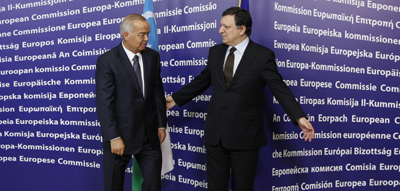
Unless European Union officials mean to expose the inconsistency of their own policymaking, they should stand firm by their declared commitment to defend press freedom and human rights in the former Soviet countries. For now, their drastically different approaches to authoritarian leaders in Belarus and Uzbekistan leave one questioning the EU’s strategy.
Belarusian authorities’ ongoing crackdown against independent media and opposition activists prompted the European Parliament last week to condemn the abuses and call for targeted sanctions against President Aleksandr Lukashenko and his government. In a sound response to the crisis, European MPs demanded the immediate release of all imprisoned journalists and opposition candidates and urged European institutions and officials to reconsider EU policy towards Belarus. In particular, they called for a freeze on economic and financial aid to Belarus, and the imposition of a visa ban against Lukashenko and his government’s officials. The MPs also urged the EU to support Belarusian civil society activists and independent media “with all financial and political means.”
News of the timely measures against Lukashenko have been welcomed in Belarus and internationally, including by U.S. government officials. But the EU’s decision to welcome the repressive Uzbekistan president, Islam Karimov, to Brussels today has left many people stunned and outraged.
Karimov’s regime is known for its decade-long crackdown against government critics and political dissent. Unlike in Belarus where independent media continue to report, independent press and opposition activists have been brought to the brink of extinction in Uzbekistan. The nadir of Karimov’s oppressive record came during the 2005 Andijan massacre–a brutal dispersal by government troops of civil protesters in the eastern city of Andijan. Hundreds were killed when Uzbek troops opened fire on the protesters. (In comparison, Belarusian police used clubs against the protesters and journalists.)
To ensure word of their brutality does not spread beyond the borders, Uzbek authorities booted all foreign broadcasters from the country, blocked critical news websites, and barred local reporters from contributing to foreign outlets. Nothing has changed since then. Rather, Uzbek authorities extended their crackdown by intimidating, prosecuting, and imprisoning critical journalists, including the president’s own nephew, Dzhamshid Karimov. For the third year, Uzbekistan continues to hold the leading position of the most persistent jailer of journalists in Europe and Central Asia.
Although the EU imposed economic and political sanctions, including the visa ban, against Karimov’s regime, as of 2009 these mechanisms have been lifted. The Council of Europe cited improved human rights in the country, a misleading characterization given the regime’s success in wiping out dissenting views and critical news coverage.
So today, the Uzbek leader was greeted by the same EU that once pledged to defend human rights in Uzbekistan. Jose Manuel Barroso, president of the European Commission, said in a statement today that he raised key concerns with Karimov regarding human rights and fundamental freedoms, and called for the release of all political prisoners.
But what happens in Brussels too often stays in Brussels. Karimov ignored the EU’s demands for years; now that the EU has relented on its sanctions and handed Karimov the positive publicity from a visit to Brussels, why is the regime going to be motivated to undertake human rights and press freedom reforms? As evidence of the EU’s ineffective tack, Uzbek state media has ignored Barroso’s statements on human rights so far.
Without directly addressing Uzbekistan’s appalling press freedom record and demanding unconditional improvements, the EU will show Lukashenko that he, too, can get away with his brutal repression. If so, expect to see Lukashenko in Brussels and European capitals soon.