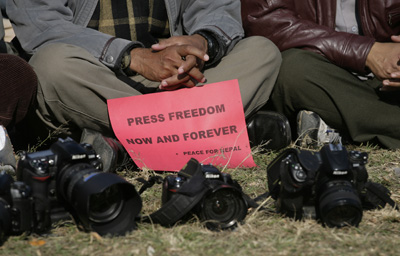
The times, they’re getting a bit too interesting in Nepal. Journalists who are supposed to cover the news are becoming the news themselves.
The latest threats have been directed at Nepal’s largest media company, the Kantipur group, for reporting on police investigations into the murder of media tycoon Jamim Shah on February 8. Shah was gunned down in broad daylight in a heavily guarded part of Kathmandu by assassins on motorcycles who blocked his SUV and fired on him in the front passenger seat.
Shah, a Nepali Muslim, had been accused in the past by the Indian authorities of being involved with underworld figures like Dawood Ibrahim, whom they have linked to Pakistani intelligence. Shah always denied these allegations but in 2004, his Space Time network was vandalized in riots and he closed down his newspapers.
Nepal’s largest circulation newspaper, Kantipur, and its English sister publication, The Kathmandu Post, had been drawing parallels between the Shah’s murder and one that took place 11 years ago. An Indian gangster who fell out with Ibrahim, Chhota Rajan, said he had killed a member of parliament because of his “anti-Indian” activities.
Sudheer Sharma, Kantipur’s editor, and Akhilesh Sharma of The Kathmandu Post received threats by phone last week to stop pursuing the story. The publisher of the two papers, Kailash Sirohiya was also reportedly threatened by e-mail.
The Nepali media has been citing suspicious murders in recent weeks of people suspected of using Nepal’s open border with India to smuggle in fake Indian currency. The son of an assembly member was caught and jailed last month. Also last month, Nepalese Home Minister Bhim Rawal returned from India without signing an extradition treaty that would have required Nepal to hand over to New Delhi various people the Indians think are a threat to their national interest.
For the past three years, Nepal has been making a shaky transition from war to peace, from authoritarianism to democracy, from monarchy to republic.
The ensuing political instability and lawlessness has criminalized politics and politicized crime. Local journalists are often caught in the crossfire. There have been four brutal murders or disappearances of journalists in the past three years, according to CPJ research, mostly along the country’s southern plains, and, in most cases, former Maoist rebels are suspected of being involved. Four people have been arrested in the murder of radio journalist Uma Singh in January 2009, but they are thought to be small fry. In none of the other cases has anyone been tried or brought to justice.
Nepal’s impunity has led to journalists regularly being threatened or attacked, radio stations vandalized, delivery vans torched. After the attack on Uma Singh, many women journalists left the profession. Reporters are now threatened for not broadcasting press releases, not attending press conferences, reporting on corruption in contracts, naming those involved in crime, and even for not giving enough prominence to rallies.
All this has resulted in rampant self-censorship: Reporters readily admit that they just don’t report on certain subjects anymore, and this includes the local correspondents of national TV, radio or newspapers.
Reporters who used to wear their press IDs around their necks, or photographers who wore green vests, have stopped doing so. But despite this, journalists in the districts still play a mediatory role in local disputes, in humanitarian interventions, and even in negotiating with criminals during kidnappings. Local journalists feel there is a lot more to the profession than just reporting, and they take their role as members of civil society seriously. One editor in eastern Nepal told me recently that he saw press freedom as not being just for journalists but for the public at large. It is the citizen’s freedom of information that journalists are guarding.
Despite constraints, there are many courageous reporters, editors, and broadcasters in the districts who regularly cover wrongdoing and expose corruption. At great personal risk, Nepali journalists have been fulfilling the public service role and respecting the public’s right to know. The kind of threats in Kathmandu to the editors of national dailies is nothing new. In the hinterland, journalists have been living through it for years now.
The free press in Nepal has been attacked by both the extreme left and extreme right. The king sent his army into newsrooms to directly censor content in 2005. But that was civilized compared to the Maoists who sent goons to beat up journalists after they were elected to power in 2008. The big difference is that the king was in charge during the post-coup dictatorship, so there was no pretense about anyone trying to be friendly about press freedom. Now, we have a ruling party that was elected to government, a party that used democracy and the free press to come to power is attacking the very institutions that propelled them into government. This is much more insidious: It means we have to be more careful about democratically elected totalitarians than the hereditary dictators of the past.
Kunda Dixit is the publisher of the English-language Nepali Times weekly newspaper in Kathmandu.