A year ago last week in Senegal, two reporters covering a soccer match were assaulted with tasers, handcuffed, and abused by police officers after the reporters refused to halt a post-game interview at Léopold Sédar Senghor Stadium in the capital, Dakar. A year on, Senegalese law enforcement has fallen short in bringing to account those responsible for this and other abuses against the media.
Le Quotidien
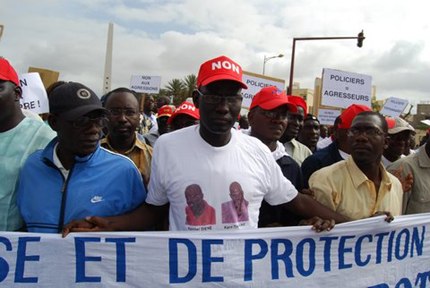
The beating of sports editor Babacar Kambel Dieng of Radio Futurs Médias and reporter Kara Thioune of bilingual station West Africa Democracy Radio triggered public outcry in both Senegal and Chicago, particularly after an audio recording of the beating was aired in the media. In Chicago, protesters greeted President Abdoulaye Wade as he arrived for the annual convention of the U.S.-based National Association of Black Journalists. In Senegal, a national debate on the state of press freedom erupted. Press leaders formed a Committee for the Protection and Defense of Journalists (CPDJ), which organized major street protests (above) and news blackout to press the government for justice. Authorities eventually appointed a senior judge to lead an investigation. Then-Interior Minister Cheikh Tidiane Sy announced the transfer of the officers involved–while, in the same breath, accusing the journalists of provoking the officers.
A year on, neither Dieng nor Thioune have been given an opportunity to confront or identify their attackers. Thioune told me he was questioned twice, once by the investigating magistrate and once by the police. Dieng, who was hospitalized for 21 days, was questioned on three occasions, one of which included a re-enactement of the incident, he told me.
The senior magistrate overseeing the case, Mahawa Sémou Diouf, said in an interviewon Monday that he had renewed investigations by placing them under the authority of the paramilitary police, or gendarmes, according to private daily LeQuotidien.
But El Hadji Diouf, one of several lawyers defending the two journalists, told me the case has not moved forward in months. Prior to involving paramilitary police, the magistrate had tasked the police’s Criminal Investigations Department (notorious for detaining journalists and raiding newsrooms) to carry out investigations, but the agency did not produce any results, the lawyer said.
“The government is delaying the process,” Diouf said, adding that authorities have information about which officers were on duty the day of the assault, June 21, 2008.
Diouf, who doubles as a member of Senegal’s National Assembly, is also representing the daily L’As, one of two critical newspapers whose offices were ransacked last year by assailants with links to former Air Transport Minister Farba Senghor. Senghor, who reacted to the attacks by declaring, “When one saws the wind, one should expect to reap the whirlwind,” was under investigation after his driver and two bodyguards were convicted in the attacks.
But Wade ordered the case brought before a special parliamentary court, the High Court of Justice. The four lawmakers selected in January to sit on the court and try Senghor, propaganda chief of the ruling Senegalese Democratic Party, are fellow party members.
The Assembly has yet to vote on formally charging Senghor, according to Diouf. Meanwhile, Wade pardoned those convicted in the raids and set them free in April this year.
“These shelved, unresolved cases create a climate of impunity and insecurity, and the public is the victim of this injustice, which spares no one,” said Ibrahima Khaliloullah Ndiaye, a journalist with the state-run national daily Le Soleil. Ndiaye, who is also the spokesman of the CPDJ, said the committee organized a panel with various human rights organizations to mark the one-year anniversary of the stadium incident. Discussions centered on devising strategic partnerships in defense of human rights in Senegal, he said.
A year ago, in a letter to President Wade, CPJ expressed concern that thorough, transparent investigations into abuses against the media have seldom taken place in his country. The events of the past year, sadly, have shown a continuation of those practices.