New York, December 21, 2009—Mortar shells destroyed the Radio Voice of Democracy building this morning in the Somali capital,
Mohamed Olad Hassan, at left, a reporter for the BBC and The Associated
Press, and chairman of the Somali Foreign Correspondents Association, recounts
his experience covering a deadly ceremony in

New York, December 15, 2009—The managing editor of a private newspaper in 
New York, December 3, 2009—Three journalists were among the victims of a suicide bombing at a Benadir University graduation ceremony in Mogadishu today. At least 22 people were killed at Hotel Shamo, including three government ministers, by suspected Islamic insurgents, according to The Associated Press.
Hassan Zubeyr, a cameraman for the Saudi-owned Al-Arabiya television network and Radio Shabelle reporter Mohamed Amin were killed instantly in the explosion, local journalists told CPJ. Abdulkhafar Abdulkadir, who recently took up freelance photography part-time, died of injuries in the hospital, according to local journalists. CPJ was unable to determine immediately if Abdulkadir was on assignment for a specific outlet.

I shall
never forgive myself for having initiated and encouraged my younger brother, Didace Namujimbo, to
take up journalism. Working for 21 years in Bukavu,
a city nestled on the picturesque shores of Lake Kivu, led me to cover every
aspect of the brutal conflict and humanitarian catastrophe in this part of
eastern Democratic Republic of Congo, but a year ago nothing prepared me to
deal with the news that my brother had been killed.
Washington, November 19, 2009—Naziha Réjiba,
editor of the Tunisian online news journal Kalima,
said she knows what to expect when she returns home—surveillance, harassment,
and threats conducted by one the world’s most repressive governments.News from the Committee to Protect Journalists

As the news editor of Zambia’s largest circulation newspaper and a mother to two young children,

After The Boy
Who Harnessed the Wind, the autobiography of ingenious
22-year-old William Kamkwamba’s homemade electric
windmill in Malawi, comes “the boy who harnessed the airwaves” by building a radio station
with rudimentary materials. The tale of 21-year-old Malawian Gabriel
Kondesi also showcases the inventiveness spawned by life in this impoverished, landlocked
nation in southeastern
A basement in the
gray, Gothic heart of the

Senegalese President Abdoulaye Wade has written a response to a recent CPJ protest letter. While we welcome his attention to the issues we raised about press freedom last month, we note with great concern the president’s comments about the ongoing criminal case of two journalists assaulted by police in 2008.
Twenty-three years
ago, on October 19, 1986, the sun quite suddenly set at noon. In the brutal
darkness, we lost Dele Giwa, just two short years after he and I, along with two
other professional journalists, launched
We've launched a new section of our Web site, and we hope you
take a few minutes to read some of its pages. There is one, for example, on Russian reporter Natalya Estemirova, who dared to examine human rights crimes in New York, October 15, 2009—The editor-in-chief of
Reporter Jolly Kamuntu is more than eight months pregnant,
but she joined hundreds of Congolese journalists today in nationwide protest marches
against insecurity and threats. Kamuntu, who is based in Bukavu, where three
reporters have been murdered since 2007, was cited recently in an anonymous
text message threatening
to kill her and two other local journalists,
More than two weeks have passed since the cold-blooded killing of Bayo Ohu, assistant news editor and political reporter for the Lagos, Nigeria-based The Guardian. The 45-year-old, soft-spoken workaholic opened the door to his home early on Sunday, September 20, as he prepared for church. According to eyewitnesses and local reports, five gunmen and one female ringleader shot Ohu repeatedly in his doorway while his children hid inside. One of his children told The Guardian that from her hiding place she heard one of the men shouting in Yoruba, “Olori Buruki e ti ku”—“The fool is dead.” Curiously, the killers took only Ohu’s laptop and cell phones.
It’s been a couple of weeks since I left

Shadows of emerging skyscrapers in a
neighborhood in Nairobi
come alive as the sun glides down the western horizon. I am walking down one of
the deserted streets in the city’s Eastleigh
shantytown. Lately, New York, September 24, 2009—A newspaper editor in police custody
in Niger since Sunday was charged with criminal libel on Wednesday in
connection with a story accusing a top official of involvement in a corruption
scandal, according to local journalists and news reports.
September 23, 2009
His Excellency Abdoulaye Wade
President of the Republic of Senegal
c/o Permanent Mission of Senegal to the United Nations
238 E. 68th St.
New York, NY 10021
Via facsimile: (212) 517-3032
Dear Mr. President,
The Committee to Protect
Journalists is heartened by your recent directive to the prime minister to renew
consultations with the press on the decriminalization
of press offenses in
According to an official
statement reported by the state-run Senegalese
Press Agency, you asked the prime minister on Friday to start talks with
the press. Also on Friday, Judge Mamadou Kane of the regional tribunal of
Kaolack jailed reporters Papa Samba Sène of private
daily L’As and Abdou Dia of Radio Futurs Médias, according to local
news reports. Kane charged the journalists with defamation, publishing false
news, and criminal conspiracy under
We urge you now not only to decriminalize press offenses, but also to address a culture of impunity for those who attack journalists and to review the police’s practice of interrogating journalists who criticize your administration.
In prepared remarks
to your delegation in
Mr. President, we also ask you to review long-standing censorship and intimidation practices, such as interrogating journalists and blocking the distribution of information or views critical of your administration. This year for instance, a judge blocked the distribution of the June edition of the monthly newsmagazine L’Essentiel, ruling that its headlines, which criticized your government’s performance, risked “gravely disturbing public order,” according to news reports. On August 28, the Criminal Investigation Division of the Senegalese police interrogated three journalists of daily Le Quotidien for several hours, pressing them to reveal sources and retract stories critical of the administration, according to the same sources.
Finally, we urge you to use your influence to address a pattern of impunity for those involved in harassing and attacking journalists for their coverage. For example, none of the policemen involved in the June 2008 beating of sports journalists Babacar Kambel Dieng and reporter Kara Thioune have been charged, according to local journalists. In fact, CPJ investigations found that members of your administration, supporters of your party, security forces, and followers of the politically influential Mourides Muslim brotherhood involved in incidents of physical and verbal abuse of journalists have seldom been publicly brought to account or prosecuted to the full extent of the law.
We would like to encourage you to continue to take positive steps toward restoring your country's reputation as a haven of press freedom. Thank you for your attention to this matter.
Sincerely,
Executive Director
Last week in New York, September 11, 2009--The government-run
Uganda Broadcasting Council effectively shut down four radio stations today and
Thursday, and ordered all radio stations to halt political debate programming in
the wake of violent clashes in the capital, Kampala.
New York, September 11, 2009—Authorities in the Democratic Republic of Congo
must aggressively investigate threats made against three radio reporters
in the eastern city of Bukavu in the Democratic Republic of Congo, the
Committee to Protect Journalists said today.
CPJ sat down recently with the Rwandan minister of information, Louise Mushikiwabo, who spoke of several media developments, including a new press law. “I am convinced the new legislation will help professionalize our media—there were many holes in the former law,” she told CPJ. Some, however, do not share her enthusiasm.
On an ordinary Friday, Sarata Jabbi-Dibba, a
reporter in the West African nation of 
New York, September 3, 2009--Five journalists and a TV station covering
Official results announced today declared Ali Ben Bongo--son of Omar Bongo, the late 41-year ruler of the oil-rich, equatorial nation--the winner of Sunday's vote between 18 candidates, but challenges to the results turned to violent unrest. Journalists and media outlets with perceived partisanship to Bongo or his rivals have come under attack.
New York, September 2, 2009--The Committee to Protect Journalists is concerned about the health of imprisoned editor Abdoulaye
Tiémogo after his transfer from
a hospital in

New York, August 31, 2009--A magistrate in Zambia issued a summons today for the entire
editorial staff of the southern African country's largest independent newspaper
to appear in court on Wednesday on contempt charges, according to local
journalists and news
reports. The ruling was prompted by an op-ed commenting on the prosecution
of the paper's news editor.
New York, August 28, 2009--A Ugandan newspaper's critical caricature of President Yoweri Museveni led police to interrogate three journalists today on allegations of sedition, according to a defense attorney and local journalists.
New York, August 26, 2009--Two Ethiopian journalists were thrown in prison on Monday after a judge
convicted them under an obsolete press law in connection with coverage
of sensitive topics dating back several years, according to local journalists and news reports.
New York, August 25, 2009--Four journalists from
New York, August 24, 2009--The Committee to Protect Journalists called today for an end to an
ongoing government crackdown on independent journalists in
New York, August 19, 2009--The Committee to Protect Journalists CPJ calls on Cameroonian authorities to reopen a private
radio station shut down on Monday over a popular talk show.About 20 paramilitary police summarily sealed the studios of Sky One Radio, based in the capital, Yaoundé, the station's president, Joseph Angoula Angoula, told CPJ. The station was accused of "recurring violations of legal and administrative regulations" of media laws, according to a statement on the Web site of

President Yoweri Museveni of
New York, August 18, 2009--The Committee to Protect Journalist is concerned Kenyan police are
attempting to intimidate journalists at the private daily, The Star, to reveal their sources for a June 20 article that said
the Kenyan Anti-Terrorism Police Unit had lost crucial files about an accused al-Qaeda
member.
In 
Last week, the Ethiopian government tried to force private
Kenyan broadcaster Nation Television (NTV) to drop a four-part
exclusive report on separatist rebels in southern
Some Zimbabwean journalists say 2003 was the most repressive year for independent journalists. Others claim it was 2008. But no one is yet claiming it was 2009 after a recent series of positive developments for the country's media.

In
Like many radio listeners in

On July 22, Gambian President Yahya Jammeh once again went after journalists in an interview on the country's only state-run television station. The president made a thinly veiled threat toward six independent journalists currently facing "seditious publication" and "criminal defamation" charges in the country: "So they think they can hide behind so-called press freedom and violate the law and get away with it. They got it wrong this time. We are going to prosecute them to the letter," Jammeh said.
New York, July 30, 2009--The
Committee to Protect Journalists called on authorities today in the Democratic Republic of Congo to
lift a ban on the FM broadcasts of Radio France
Internationale (RFI) across the Central African country. The government silenced the station in response to
its coverage of the ongoing conflict in the east, RFI said.
"Are you sure about coming back here now?" My cousin in Walter Cronkite had such a profound impact in so many ways that one might overlook an important part of his legacy--his long efforts on behalf of international press freedom and his advocacy on behalf of local journalists around the world. Cronkite was a vital participant in the launch of the Committee to Protect Journalists 28 years ago and, though his title here may have been honorary co-chairman, he was an active force throughout the years.
July marks the start
of seal hunting season in
New York, July 17, 2009--The Committee to Protect Journalists is alarmed by the harassment of international journalists covering this week's disputed presidential elections in Republic of Congo.New York, July 15, 2009--The Committee to Protect Journalists is alarmed by the arrest of Zambian
journalist Chansa Kabwela on bogus charges of circulating obscene materials.
New York, July 6, 2009--The Committee to Protect journalists is saddened by the death of Radio
IQK journalist Mohamud Mohamed Yusuf who was shot twice in the stomach on
Saturday in the capital, Mogadishu. Yusuf, commonly known as "Ninile," was hit
by stray bullets after leaving the station in Afarta Jardin, northern
Articles published
in New York, June 29, 2009--The Committee to Protect Journalists calls on national police Inspector
General Mike Okiro to investigate reports that Delta state police harassed six
journalists and attacked at least three of them last week. The Nigerian Union
of Journalists Delta State Chapter said police attached to the state Ministry
of Land prevented the journalists from reporting on the June 23 demolition of several
buildings on government land.

This week, in an exclusive interview with the Financial Times, Ethiopian Prime Minister Meles Zenawi suggested that the press in his country freely expresses dissent. In fact, that is hardly the case. The Horn of Africa nation remains one of the world's worst backsliders of press freedom.
New York, June 22, 2009--Seven Gambian journalists charged with sedition last week for criticizing
the president have been freed on bail, while two other detainees were released
without charge, local journalists and the press union told CPJ today.
My intention to remain in my home country, to use my pen to correct injustice, and to champion press freedom was aborted by security threats that forced me and my family into exile. I left behind my beloved country and editorial desk in the hands of perpetrators.
The unlawful detention
of seven Gambian journalists since last Monday is serious cause for
concern. These respected journalists were detained at the National Intelligence
Agency headquarters in
New York, June 18, 2009--A journalist in
Sri
Lankan journalists flee under severe pressure in the past year.

New York, June 16, 2009--The Committee to Protect Journalists called today for Gambia's national security agency to release seven journalists it arrested on Monday. The detainees include leaders of the country's press union and editors of newspapers that published a union press release criticizing President Yahya Jammeh's recent comments about the unsolved 2004 murder of editor Deyda Hydara.

New York, June 12, 2009--The editor of a private newspaper in the
New York, June 11, 2009--The Committee to Protect Journalists urges the Canadian and Australian governments
to work for the immediate release of two freelance journalists who have been
held captive in the Somali capital, Mogadishu, since August.

Last week, President Yahya Jammeh, at left, discussed the unsolved 2004 murder case of editor Deyda Hydara in an interview on "One on One," a weekly program on The Gambia Radio and Television Service. The government "has for long been accused by the international community and so-called human rights organisations for the murder of Deyda Hydara, but we have no stake in this issue," media reports quoted Jammeh as saying. "And up to now one of these stupid Web sites carries 'Who Killed Deyda Hydara'? Let them go and ask Deyda Hydara who killed him," The Point newspaper quoted him as saying.
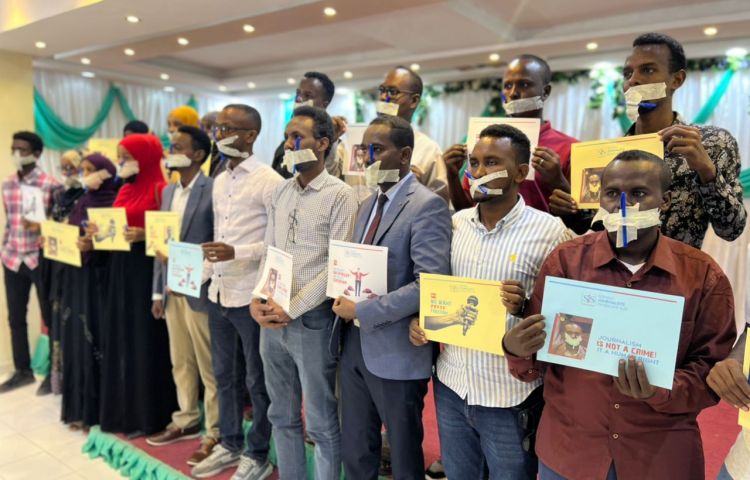
Somali journalists held an emotional press
conference in Journalism conferences discussing global trends often
inflate the real but intermittent risks faced by foreign correspondents from
wealthier nations who travel to and report from less stable regions of the
world. They do so at the expense of downplaying if not plain ignoring the much
greater risks faced by local journalists who live in such areas with their
families and report daily for homegrown, regional media. The Deutsche Welle
annual Global Media Forum in

New York, June 8, 2009--Following the attack by unidentified gunmen on two staff members of Radio
Shabelle on Sunday that left one dead and one injured, the Committee to Protect
Journalists called today for all sides in the ongoing conflict to allow
journalists to carry out their work without fear of retribution.
On April 16, 2009, police in Yaoundé, the capital of Cameroon, arrested James Mbouma, deputy managing editor of the weekly L'indépendant, in connection with a legal dispute over ownership of photographs he published.

Last week, President Isaias
Afeworki of
On April 24, 2009, journalist El Malick Seck, who was serving a three-year prison sentence over an editorial implicating President Abdoulaye Wade and his son in an alleged money laundering scandal, was released on presidential pardon, according to local journalists and news reports. The sentence had been upheld in February. He was first imprisoned on August 28, 2008.
New York, May 27, 2009--A magistrate in
New York, May 27, 2009--The Committee to Protect
Journalists is alarmed by the government of Gabon's crackdown on independent
media coverage of President Omar Bongo's hospitalization and potential succession
issues. Bongo,
New York, May 26, 2009--The Committee to Protect Journalists is very concerned about the well-being
of two captive journalists, a Canadian and an Australian, who
urged their respective governments to work harder for their release in a phone
call with a reporter on Sunday. Both journalists said they were sick and being
held in harsh conditions.
New York, May 26, 2009--The Committee to
Protect Journalists is deeply saddened by news that radio reporter Nur Muse
Hussein died today as a result of gunshot wounds suffered while covering
fighting in April. Hussein, left, a veteran correspondent for Radio IQK, suffered two
bullet wounds to his right leg while reporting on clashes between militia
groups in the central town of 
New York, May 22, 2009--The Committee to Protect
Journalists mourns this morning's death of radio journalist Abdirisak Mohamed Warsame, left, who was killed during renewed fighting in
On May 7, 2009, the Court of Criminal Appeal in
Franchou
Namegabe Nabintu, an award-winning journalist from the Democratic Republic of Congo, operates in one of the most dangerous regions for
journalists in New York, May 19, 2009--Authorities in Malawi should immediately release three journalists arrested today in a police raid on an opposition radio station, the Committee to Protect Journalists said. The country is holding general elections between today and Thursday.
In Madagascar
New York, May 14, 2009--Police in
A mysterious fire in
A French judge on
Tuesday authorized an
anti-corruption group to pursue a complaint that questions how the leaders of three
oil-rich, central African nations amassed their personal assets. One byline was
absent in news media coverage: Bruno Ossébi, an online Congolese columnist and one
of the few local journalists who had covered the sensitive issue. Ossébi died
in February in a mysterious fire that destroyed his home and killed three
others.
On Thursday, the U.S.-based National
Association of Black Journalists announced the winner of its 2009 Percy
Qoboza Foreign Journalists Award: Zimbabwean
journalist Anderson Shadreck Manyere. Half a world away, however,
Manyere, left, lingered in a hospital in the capital,
CPJ names the worst online oppressors. Booming online cultures in many Asian and Middle Eastern nations
have led to aggressive government repression.
Sen. Richard Durbin (D-Ill.) leads a group of six senators to call for the immediate release of the former state Daily Observer newspaper, "Chief" Ebrima Manneh today. Colleagues at the newspaper say they witnessed two plainclothes Gambian National Intelligence Agency officers whisk Manneh, right, away in July 2006. He has not been seen since despite repeated calls to the government to disclose his whereabouts.
Bruno Jacquet Ossébi, a Franco-Congolese journalist known for outspoken coverage of government corruption in the
On March 2, 2006,
Kenyan state agents conducted a commando-style midnight raid on the
Standard Group, owner of an independent daily and KTN Television in the capital,
Eyewitnesses saw him being led away. "We were in our
7, 2006, working on the next issue of the Daily Observer, when two plainclothes
officers with the Gambian National Intelligence Agency approached Chief," wrote Observer editor
and correspondent Ousman Darboe. "I knew one of the officers as a Corporal
Sey. They told Chief, a subeditor and reporter at the paper, that he was needed
at the Bakau police station for questioning. He went along voluntarily, leaving
his bag behind and saying he was confident he would be back soon."
The whereabouts of "Chief" Ebrima Manneh, right, the Gambian journalist
who has been missing since his arrest by state security agents in July 2006,
has become an urgent issue again in the country's media houses, homes, and human
rights offices. The question needs to be studied carefully, and no one should draw
quick conclusions.New York, April 14, 2009--Gambian authorities must authoritatively account for the whereabouts, health, and legal status of journalist "Chief" Ebrima Manneh, who was taken into government custody by security agents in July 2006, the Committee to Protect Journalists said today. Authorities, who have held Manneh in secret locations since the arrest, have provided conflicting and incomplete accounts this month regarding his status.
presidential elections in July.
Testifying at the
The case had all the hallmarks of a sordid thriller.
There was "a rogue politician, a journalist getting killed, a staunchly
incurious police, and the media in frenzy," veteran journalist Lansana Gberie wrote
in the New African, describing the fatal
2005 beating of editor Harry Yansaneh in
New York, March 23, 2009 -- The already murderous conditions for the press in Sri Lanka and Pakistan deteriorated further in the past year, the Committee to Protect Journalists has found in its newly updated Impunity Index, a list of countries where journalists are killed regularly and governments fail to solve the crimes. Colombia, historically one of the world’s deadliest nations for the press, improved as the rate of murders declined and prosecutors won important recent convictions.
New York, March 20, 2009--Ivorian authorities on
Thursday abruptly jailed a journalist who was scheduled to appear in court next
week on libel charges related to a column critical of the government, according
to local journalists and press reports. The imprisonment appeared to violate the 2004 Ivorian
press law, which decriminalized press offenses and banned pretrial
detention of journalists.
New York, March 18, 2009--A Burundian online journalist jailed since last September was acquitted today, according to local journalists. In a separate case on Tuesday, however, authorities detained two journalists covering the activities of a former CPJ Press Freedom Award winner, according to the same sources.
New York, March 13, 2009--The Zimbabwean
attorney general's office should halt a baseless criminal investigation into
human rights lawyer Beatrice Mtetwa, the Committee to Protect Journalists said
today.
The staff at CPJ was
relieved to hear that former CPJ Press Freedom
Award winner Alexis Sinduhije was released from prison today. The former radio
station director and veteran Burundian journalist was acquitted by a About two weeks ago, traditional authorities in the mountain kingdom of Swaziland slapped the nation's most outspoken political columnist, Mfomfo Nkambule, with a fine--to be paid in cows--for criticism of the administration of King Mswati III, Africa's last absolute ruler.
Journalists in
In a ruling issued on January 9, 2009, the state-run media
regulator, the High Communication Council, suspended from circulation the
private daily Le Citoyen for one month for allegedly
violating journalism ethics, according to news reports and local
journalists.
An appeals court in the Senegalese capital of
A week ago today, CPJ sent a letter
of concern to President Blaise
Compaoré of Burkina Faso urging his government to investigate a series
of death threats sent in the past year or so via e-mail to independent
journalists there. Using Yahoo
This week in the
We received good news this morning from
Filmmaker Robyn Kriel, 25, from Bulawayo, Zimbabwe, spoke to PBS' Wide Angle last week about the risks she took reporting from Zimbabwe in the lead-up to the country's 2008 presidential election. Last April, CPJ closely followed the case of Kriel's mother, Margaret Kriel, who was imprisoned for four days on accusations of "practicing journalism without accreditation." You can listen to the interview here.
New York, February 9, 2009--Authorities in the Indian
Ocean
New York, February 6, 2009--An online columnist known for criticizing the
government and alleging high-level corruption was buried in the Republic of
Congo today following his death in a military hospital on Monday, according to
local journalists. Bruno Ossébi, left, was badly burned in a late-night fire at his residence on January 21, although he was said
to be recovering and his death was unexpected. Authorities have not provided
any information on the cause and circumstances of the fire, which coincided
with a similar fire at the French home of an exiled political dissident.
Falastiin Iman, a former producer for the independent Somali
broadcaster HornAfrik, was talking by phone on Sunday with the station's
director, Said Tahlil, left. He was upbeat, she said, a mood that is not easy to come
by in New York, February 5, 2009--Eritrean authorities must disclose the medical condition and care being provided to jailed journalist Dawit Isaac, the Committee to Protect Journalists said today following unofficial reports saying that he was hospitalized. CPJ points out that the well-being of the long-jailed Isaac, an Eritrean with Swedish citizenship, is the responsibility of the government, which has yet to provide any information as to his whereabouts, health, or medical care.
New York, February 4, 2009--The director of HornAfrik, one of Somalia's leading radio and television stations, was killed by three masked gunmen in the Bakara Market area of Mogadishu on Tuesday afternoon, local journalists told CPJ. The assailants shot Said Tahlil repeatedly as he and six other senior journalists were walking to a meeting with members of the militant Al-Shabaab group.

Freelance journalist Frank Chikowore visited CPJ this week
after receiving the Tully Center Free Speech Award
at
We issued the following statement in response
to the killing of reporter Francis Kainda Nyaruri of the private Weekly Citizen, whose decapitated body was
found Thursday in a forest in western Kenya.
New York, January 26, 2008--Angry opposition supporters burned down two pro-government television stations in the Indian Ocean island of Madagascar today, a few hours after authorities destroyed the antenna of an opposition radio station, according to news reports and local journalists.The Hong Kong police announced on Monday they would
investigate the alleged assault on photographer Richard Jones by
On Friday, as we welcomed the
release of a journalist kidnapped in
New York, January 16, 2009--CPJ welcomes the release of a freelance Somali photojournalist and two Somali drivers on Thursday but remains deeply concerned for the fate of two foreign freelance reporters who have been held since their abduction on August 23, 2008, by unknown gunmen.
New York, January 16, 2009--The Committee to Protect Journalists is concerned about the health of a Zimbabwean photojournalist who was denied bail today despite allegations that he was tortured while in police detention in the capital Harare.
Kenyan President Mwai Kibaki says he will reconsider the
deeply flawed communications legislation that he signed into law at the
beginning of the year. Kibaki said he would direct the Information Ministry and
attorney general to consider the concerns of
New York, January 9, 2009--Zimbabwean photojournalist Anderson Shadreck Manyere, who was arrested
on December 24, was remanded in custody today by a court in Harare despite
allegations that he was tortured while in police detention, according to local
journalists. Manyere is expected to return to court on January 23.
New York, January 7, 2009--The Committee to Protect Journalists is concerned by the ongoing
police persecution of two Ugandan journalists. The police's Media Offences
Department has repeatedly interrogated the two over a story critical of the
government's handling of an international security
operation against the rebel Lord's Resistance Army last month, according to
a local lawyer and journalists.
José Cendon, freelance
ABDUCTED
Freeman, a British foreign correspondent forNew York, January 2, 2009--A government soldier killed Radio Shabelle reporter Hassan Mayow Hassan, shooting the veteran journalist twice in the head after stopping him in the Somali town of Afgoye on Thursday morning, three local journalists told the Committee to Protect Journalists today. The journalists said they had interviewed witnesses to the killing.
CPJ’s Joel Simon, Robert Mahoney, and Nina Ognianova pay tribute to journalists who died in 2008. The toll was highest in Iraq, but conflicts in South Asia and the Caucasus were deadly as well. Impunity in journalist murders in Russia, Philippines, and Mexico were top issues.