New York, February 24, 2011–The Committee to Protect Journalists remains alarmed by the Libyan government’s ongoing, threatening rhetoric against the press, as well as the continued violence against journalists–a number of whom have not been heard from since demonstrations began on February 17. In a separate development, an Iraqi journalist was killed and another reporter injured today in a suicide bombing in Anbar province, according to news reports.
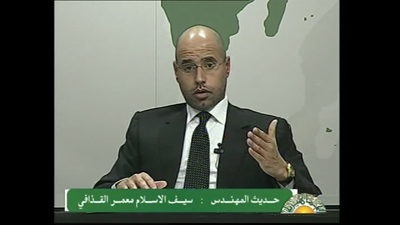
In Libya, Saif al-Islam, the son of Muammar Qaddafi, announced during an appearance on the official station, Libyan TV, that the country is accessible to the international press. “Starting today, Libya will be opened to journalists from all over the world,” he said, according to Al-Jazeera. However, in the same speech he attacked the Arab media. “The conspiracy doesn’t come from Libyans but from your Arab brothers who unleashed on you their broadcasters, poisoned words, and false rumors.” He added that “this is a media battle. They misguided the Libyans with media and false information. The information that these stations and channels are broadcasting is a lie,” he said, according to Dubai-based satellite channel Al-Arabiya.
The New York Times reported today that three Libyan bloggers tweeted that Libyana, the country’s leading cell phone provider, sent residents of Tripoli text messages that said that “a local cleric issued a fatwa against watching television channels ‘like Al Jazeera,’ that incite bloodshed.”
“We are concerned by reports that a number of Libyan journalists have not been heard from for several days,” said CPJ Deputy Director Robert Mahoney. “As the authorities in Tripoli invite media to visit the capital they must remember that the international community holds them responsible for the safety of all journalists.”
Naim Ibrahim al-Ushayba, a Libyan journalist from Benghazi and a correspondent for Libya Al-Youm news website, told CPJ that there is still no news about his colleague Atef al-Atrash, who disappeared after speaking to Al-Jazeera on the air on February 17. Al-Ushayba said the following other journalists have also been missing since the day before the demonstrations began: Mohamed al-Sahim, a blogger and political writer who published a critical article about the Libyan regime shortly before February 17; Mohamed al-Amin, a cartoonist; blogger Jalal al-Kawafi; and Idris al-Mismar, a writer and the former editor-in-chief of Arajin, a monthly culture magazine.
A government militia today briefly detained a group of nine Italian journalists invited by the Libyan government to Tripoli as they drove to the city center from the airport, Italian daily Corriere della Sera reported. Fabrizio Caccia, a correspondent for Corriere, was beaten and kicked. The journalists were released after an inspection and were able to reach their hotel in the capital, according to the paper.
In Iraq, Mohamed al-Hamdani, a correspondent for Al-Itaijah satellite TV, was killed today when a suicide attacker detonated a bomb in Ramadi, in Iraq’s Al-Anbar province during religious celebrations, news website Al-Sumaria News reported. Al-Hamdani was covering the celebrations in a cultural center in Ramadi. Two journalists for Al-Aan satellite TV station– correspondent Ahmad Abd al-Salam and radio and TV reporter Ahmad al-Hayti–were injured, according to news reports. Fourteen people were killed and 23 injured in the attack.
Meanwhile, in Syria, blogger Ahmad Hadayfa–who writes under the name Ahmad Abu al-Khair–has been released, according news reports. Hadayfa was detained on Sunday.